

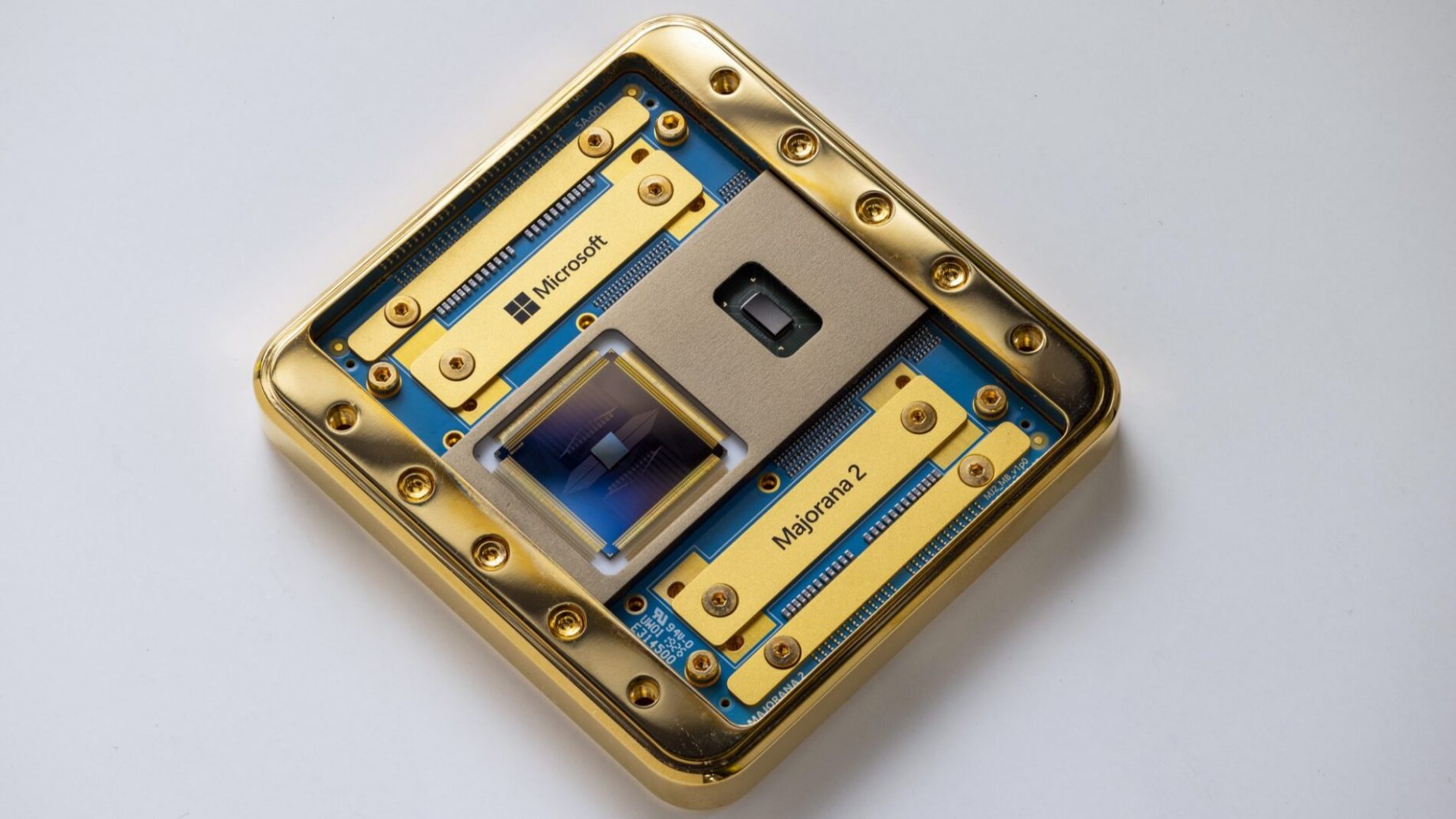
Microsoft says it has made a significant breakthrough in its effort to build a commercially useful quantum computer after developing a new chip that is far more reliable than its predecessor.
The Majorana 2 processor uses qubits that remain stable for an average of 20 seconds, compared with the milliseconds recorded by the first-generation Majorana 1 chip released in 2025. Microsoft said the improvement represents a more than 1,000-fold increase in reliability.
Qubits are the building blocks of quantum computers, which are designed to handle certain highly complex calculations beyond the practical limits of conventional machines. However, they are extremely sensitive to temperature changes, vibrations, and other environmental disturbances, making it difficult to maintain their performance for long periods.
Microsoft believes its latest progress could help bring commercially viable quantum computing closer to reality.
“We will have a quantum machine in 2029 that can solve commercially viable, reasonable problems,” said Zulfi Alam, corporate vice president of Microsoft Quantum.
The company has spent around two decades pursuing topological quantum computing, an approach based on the properties of Majorana quasi-particles. These were first proposed in the 1930s by Italian physicist Ettore Majorana.
Majorana 2 currently contains 12 qubits, although a large-scale quantum computer would require millions. Microsoft said the latest chip performs better partly because researchers replaced aluminium with lead as the superconducting material. Artificial intelligence was also used to support the research process.
The announcement is likely to face close scrutiny. Microsoft previously withdrew a paper published in Nature in 2018 after concerns were raised about its analysis. Some physicists also questioned whether the evidence released with Majorana 1 was sufficient to support the company’s claims.
Microsoft said it had shared confidential technical information with Darpa, the U.S. defence research agency, which is assessing whether the company’s quantum computing plans are viable.
If the technology can be scaled successfully, quantum computers could help researchers develop better fertilisers, reduce microplastic pollution, and find ways to break down persistent chemicals. However, scientists have yet to build a scalable quantum machine capable of solving commercially useful problems.