

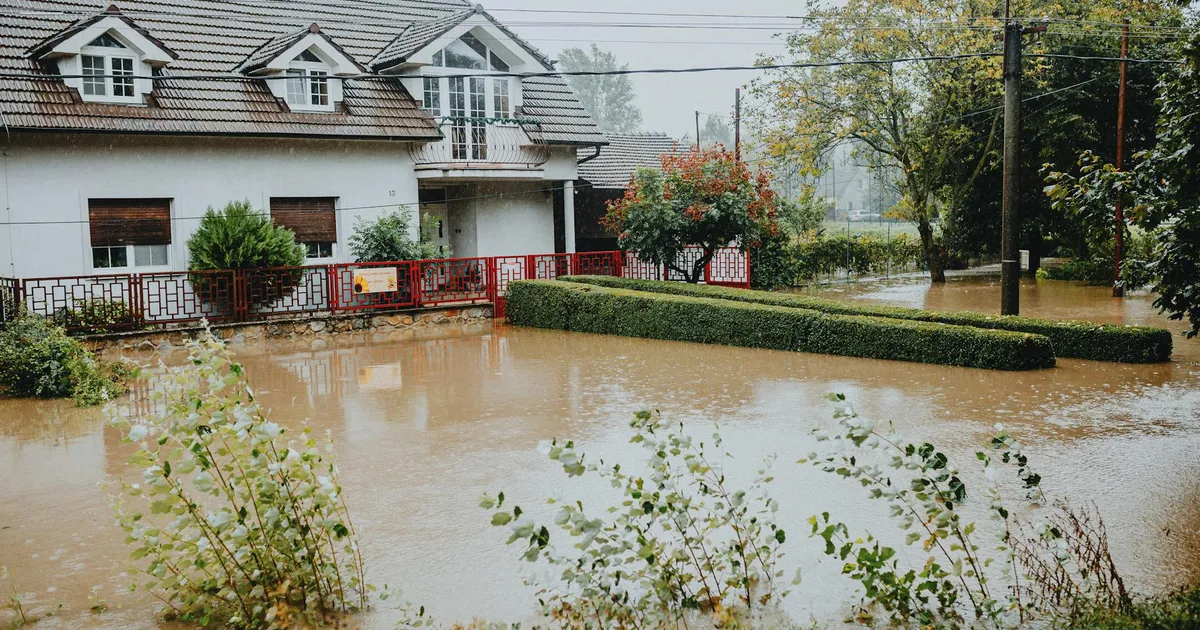
The market is already moving
IAG, the country’s largest general insurer, published data in April showing 46 storms generated 33,174 claims in the 12 months to February 2026, a 256% increase on the prior year’s 9,324. Storm frequency has doubled from the 15-year average of once every 19 days to once every eight days. IAG climate spokesperson Bryce Davies described the national response as “very ad hoc, very fragmented” with no coherent system for managing natural hazard risk.
This is not an abstract climate story. It is a pricing story. When an insurer with AMI, State and NZI on its books says the system is broken, it is telling you what your next renewal will look like.
556,000 properties, $235 billion in replacement value, no plan
The Climate Change Commission’s 2026 National Climate Change Risk Assessment identified roughly 556,000 properties in areas at risk from inland flooding with a collective replacement value of $235 billion. In 2024, the RBNZ’s Financial Stability Report found that around 6% of properties were assessed at high flood risk, with 20% of insurers’ quotes already including additional flood risk premiums averaging $250 or more annually.
A Treasury-commissioned Finity Consulting report from 2024 found nationwide average residential building insurance premiums rose $239 in a single year to January 2024, a net increase of 25.6%. That was before the latest storm surge hit the data.
Climate Change Minister Simon Watts acknowledged the problem but said there is “no change to the time-line for work on cost-sharing”, describing it as “a complex area.” Finance Minister Nicola Willis pointed to $400 million in Budget 2026 for highway resilience upgrades. Against $235 billion in identified flood-risk property and $5.5 billion in average annual natural hazard costs, that figure is rounding error.
Spending 97% on cleanup and 3% on prevention
In 2025, an IAG-commissioned Sapere Research report quantified the structural imbalance: since 2010, 97% of government natural hazard spending went to response and recovery; only 3% to risk reduction. Total natural hazard costs since 2010 exceed $64 billion, with private insurers absorbing $31 billion.
The contrast with targeted investment is damning. The Awanui Flood Protection Scheme cost $15 million and has already avoided an estimated $50 million in damage. A $4 million stop bank upgrade in Taradale protects around 10,000 properties. The return on prevention is obvious. The political appetite for it is not.
Reinsurers are watching and they do not care about election cycles
The mechanism that converts government inaction into household pain is the global reinsurance market. FMG CEO Adam Heath told an industry panel that global reinsurers are “well and truly alive to the fact that we’re getting wetter” and are looking for New Zealand to demonstrate risk mitigation. Following the 2023 events, FMG implemented its largest-ever rate increases, with cancellations rising by roughly 50%.
Insurance Council CEO Kris Faafoi has proposed scrapping the FENZ levy, which collected nearly $800 million in 2024/25, and replacing it with a Community Protection Levy directed at disaster resilience. His assessment of the current position: “We’ve done a lot of policy thinking … but no one actually wants to commit the funding.”
The legal tripwire nobody is discussing
Environmental law specialist Mike Wakefield identified a risk that most coverage has missed. He warned that requiring councils to produce adaptation plans without resolving funding “could create new risks”, and that identifying hazards without resolving them “may well feed interest from the insurers as to whether or not they should continue to provide cover” in certain parts of the country.
This is the mechanism business owners need to understand. A council-produced risk map, mandated by statute, becomes the evidence base for an insurer’s underwriting decision. Government inaction on funding does not prevent risk identification. It just ensures identification happens without resolution, handing insurers a formal basis for coverage withdrawal.
Gisborne mayor and LGNZ president Rehette Stoltz put it bluntly at the Insurance Council conference: “Councils were being asked to carry a national problem on local balance sheets and that could not carry on.”
What this means for your balance sheet
Simplicity chief economist Shamubeel Eaqub described the endpoint: without a shift, “we only have rich people who can afford insurance”. For property developers, landowners, mortgage lenders and commercial landlords, the implications are immediate. Risk-based pricing is already arriving. Banks require insurance as a condition of lending. If insurers withdraw from or heavily surcharge exposed areas, lender collateral is impaired, property values fall, and the RBNZ has a financial stability problem it has already flagged.
The government has chosen to defer the hard question of who pays for adaptation until after the next election. That is not caution. It is a decision to let the insurance market do the rationing instead. The insurance market will do it faster, less transparently, and without a single public hearing.
Sources
- RNZ: ‘A storm every eight days’ – country’s biggest insurer calls for systemic response (2026-06-09)
- RNZ: ‘Urgency’ needed over climate adaptation funding, Insurance Council says (2026-06-09)
- Insurance Business Mag: ICNZ flags coverage gaps if climate exposure goes unaddressed (2026-05-12)
- RNZ: Insurance Council wants FENZ levy scrapped and replaced with disaster resilience funding (2026-06-12)
- RNZ: Delays on climate adaptation must stop now, mayor says (2026-06-12)
- Insurance Business Mag: Inaction on insurance affordability carries a measurable cost, ICNZ panel warns (2026-06-09)
- ICNZ: Act now or pay later – Hazard resilience policies a must in the 26′ election (2026-04-06)
- Treasury/Finity Consulting: Insurance Data Collection Report May 2024 (2024-05)