

The cyclone broke things. They wrote it down and fixed it.
When Cyclone Gabrielle hit Hawke’s Bay in February 2023, the airport lost power after the Tutaekuri River breached the Rissington substation. Cellphone coverage dropped out. The operations team was running a critical transport node on whiteboards and landlines.
In March 2024, Operations Manager Deb Suisted documented the lessons publicly for the NZ Airports industry body. Her advice was blunt and practical: keep radio-telephones handy, maintain an external landline, feed your staff a hot meal because it sustains morale, and keep a checklist so the airport can run even if the operations team cannot get there. She also noted that relationships are everything, from Civil Defence to local tradies.
What happened next is the part that matters for every business owner whose supply chain depends on regional infrastructure. Instead of filing the lessons in a resilience strategy and moving on, the airport’s board funded a capital programme that directly addressed every vulnerability Gabrielle exposed.
A fire station that doesn’t need the grid
The new 550-square-metre fire station came into service around March 2026. It achieved an Importance Level 4 structural rating, the classification reserved for post-disaster response facilities. It generates its own power through solar panels. It harvests rainwater for firefighting and operational use. It is positioned at the south-east end of the runway for uninterrupted airfield access and is designed to serve the airport for 50 years.
The building itself is constructed from mass timber, with glulam columns and cross-laminated timber wall panels, using low-carbon concrete for foundations. RTA Studio designed it with what they describe as a “more-with-less philosophy,” and the timber surfaces required specific engineering work to meet fire-safety criteria for an IL4 building. This was not a simple materials substitution.
Chair Jon Nichols said in January 2025 that the station is the biggest capital project since the terminal expansion and has been designed to accommodate future growth.
The investment did not happen in isolation
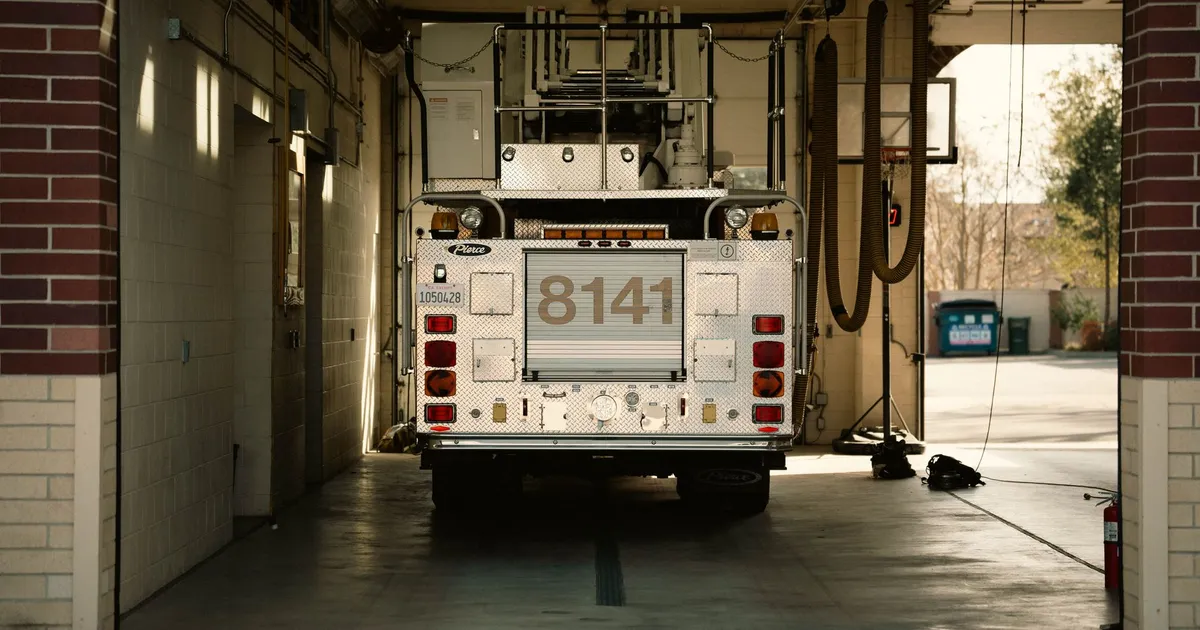
The fire station caps a broader capital sequence. In August 2024, the airport took delivery of a $1.6 million Rosenbauer Panther fire truck from Austria, a vehicle with a 700-horsepower engine carrying 7,400 litres of water and monitors that spray up to 90 metres. The airport ran the tender jointly with two other airports to maximise buying power.
Construction on the station began in January 2025, with walls and roof going up by mid-2025 using pre-fabricated CLT panels.
All of this was delivered while the airport grew. In FY2024, passenger numbers rose 2.4% to 655,000, revenue climbed 3% to $13.0 million, and the airport delivered EBITDA of $7.3 million meeting its Statement of Intent targets.
Sustainability and resilience turned out to be the same investment
Hawke’s Bay Airport is the only New Zealand airport to hold ACI Airport Carbon Accreditation Level 4+ ‘Transition’, a rating held by fewer than 45 airports worldwide out of nearly 42,000 globally when it was achieved in 2023. That same year it secured a $23 million sustainability-linked loan from ASB with interest rate reductions tied to performance targets.
The fire station extends this logic. Solar panels, rainwater harvesting, and mass timber are sustainability features, but they are also what makes the building function when the grid and mains water fail. The airport’s FY2025 Statement of Intent explicitly listed “progressive resilient infrastructure enabling growth” as a strategic priority. For once, a strategy document and the actual capital programme match.
The question business owners should be asking
The airport is owned 50% by the Crown, 26% by Napier City Council, and 24% by Hastings District Council. It is a council-controlled organisation that has delivered a complex capital project on time, within budget, and with a clear line from disaster experience to design specification. That sentence should not be remarkable, but in New Zealand local government, it is.
For business owners whose logistics, supply chains, and regional connectivity depend on airports like this one, the uncomfortable question is whether they actually know how resilient their critical infrastructure dependencies are. Hawke’s Bay Airport had its stress test forced on it by a cyclone. It responded by spending two years hardening physical assets against the next one. Most councils are still on the workshop.
Sources
- Sustainability Takes Flight – RTA Studio (2026-03-03)
- Hawke’s Bay Airport Buys New Fire Truck (2024-08)
- Sound progress in Airport’s 60th anniversary year, but economic headwinds dampen outlook (2024-09-27)
- Airport Achieves Significant Milestone On Sustainability Journey (2023-04)
- Running an airport in a crisis – NZ Airports (2024-03-10)
- Hawke’s Bay Airport releases annual Statement of Intent 24-25 (2024-06-27)
- New Firestation – Hawke’s Bay Airport (2025)