

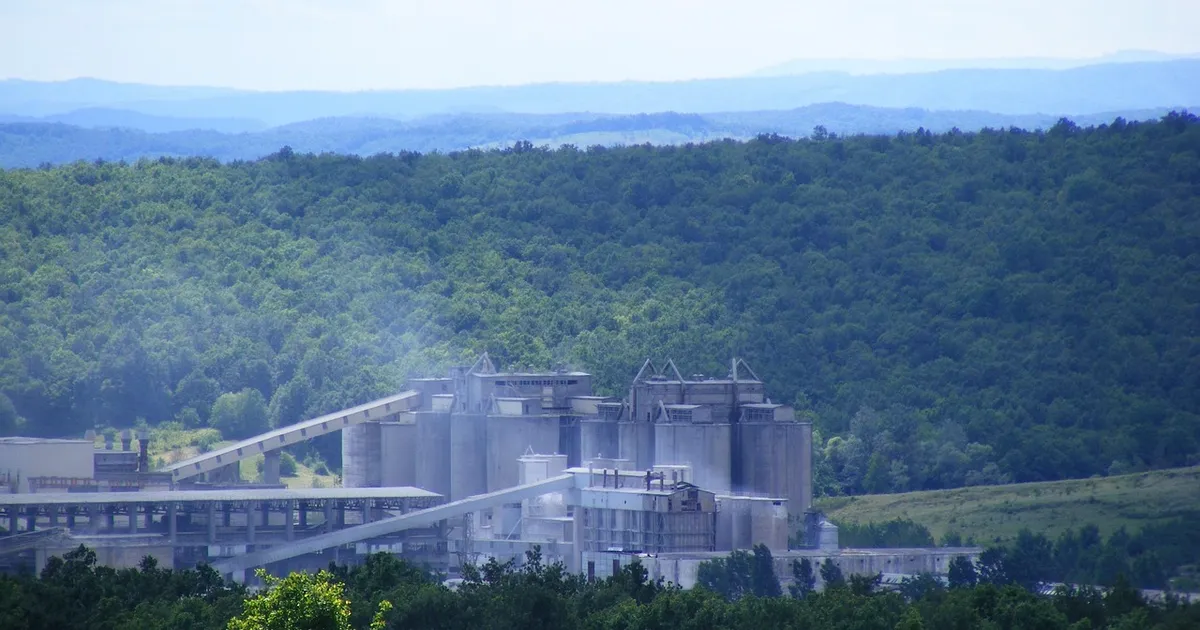
Fletcher Building has confirmed the government will give Golden Bay Cement a $60 million grant, not a loan, to keep the Portland plant near Whangarei running. On the surface it is a clean supply chain win. Look at why the plant needed rescuing and it becomes something less tidy: the state is paying to offset the competitive damage its own carbon policy inflicted on a strategic domestic manufacturer.
Why the plant was heading for the exit
Portland supplies nearly 60% of the cement used in New Zealand, with roughly 95% of its output sold domestically. An independent assessment found that without support, rising costs including carbon costs would have forced closure and a shift to an import-only model from 2030. The plant employs more than 150 people directly and supports another 450 jobs across the Whangarei district.
The deal is explicit about the trigger. It addresses “the carbon cost disadvantage that Golden Bay Cement faces relative to imported cement”. Under the Emissions Trading Scheme, a plant making cement here pays a carbon cost that an overseas producer shipping cement into New Zealand simply does not. Fletcher CEO Andrew Reding framed the case on resilience grounds, saying “domestic cement production matters for New Zealand’s resilience as much as for its economics” and that onshore supply reduces exposure to shipping disruption, supply shocks and price volatility.
A subsidy that quietly tightened into a penalty
The ETS gives free carbon credits to trade-exposed manufacturers to blunt exactly this disadvantage. But the allocative baseline for cement has been steadily tightened by the Ministry for the Environment, from 0.9615 in 2023 to 0.8300 in 2024 and 0.8273 in 2025. Each cut leaves Golden Bay carrying more net carbon cost per tonne.
In January 2026, Fletcher warned publicly that the allocation system, built on emissions intensity data from 2006, was penalising the company for actually cutting emissions and not rewarding the capital it had put into decarbonisation.
The irony is that the same scheme once did the opposite. In 2021, Newsroom reported that Fletcher’s cement operation received at least 144,000 excess credits over three years, worth over $5 million, because the government kept issuing credits on outdated baselines even as the company cut emissions. By 2024, Newsroom found major emitters were still banking excess subsidies, with Glenbrook steel topping the list. The policy swung from over-compensating industry to under-compensating it, and now the taxpayer is writing a cheque to correct the swing.
The bigger carbon bill sitting behind all this
This grant lands while the government faces a far larger carbon problem. As of June 2026, Treasury estimated a bill of up to $5 billion to buy offshore carbon credits to meet the 2030 Paris commitment, covering a shortfall of 84 million tonnes in domestic reductions. So the feedback loop is complete: carbon costs make local production uneconomic, the government pays to keep it running, and the offshore credit bill mounts anyway because the ETS is not driving enough domestic decarbonisation.
Employers have been flagging exactly this hollowing out. The EMA’s Alan McDonald said in July 2026 that the country had gone “from a country that attracted international business because of our energy supply, to having energy costs and availability routinely cited as a reason for closing domestic businesses”. He named cement explicitly as a strategic industry worth keeping onshore for when “things go wrong in the world.”
What construction gets out of it
For the construction supply chain, the short-term outcome is genuinely good. In exchange for the grant, Golden Bay has committed to run the plant to at least 2040 and to invest at least $150 million through to 2040 in operations and decarbonisation. That is supply security, a modernisation programme, and a price anchor against import volatility, all leveraged off a comparatively modest public contribution.
The plant has weathered a brutal downturn to get here. Fletcher’s Q2 FY26 report put Golden Bay cement volumes near flat, with Reding warning any meaningful recovery would not reach the business until calendar 2027.
The defensible read is that resilience is worth paying for. The uncomfortable read is that this is not industrial strategy so much as a workaround for a scheme that made a strategic input uncompetitive at home. The real question for every builder, developer and importer is whether this is a one-off, or the template for how New Zealand keeps its remaining heavy industry alive while carbon policy pulls in the other direction.
Sources
- Government gives Fletcher Building $60m for Golden Bay Cement bailout (2026-07-19)
- Carbon Catch-Up: Fletcher warns regulation hindering decarbonisation efforts (2026-01-16)
- Calls for carbon subsidy reform as polluters bank gains (2024-08-20)
- Fletcher Building gets $5m too much in carbon subsidy (2021-07-28)
- Government facing up to $5 billion bill over carbon credits, Treasury reveals (2026-06-11)
- EMA Calls For Fewer Policy Shocks, More Certainty For Business (2026-07)
- Employers want future government to step in to stop hollowing out of manufacturing (2026-07-13)
- Fletcher Building Quarterly Volume Report Q2 FY26 (2026-01-13)
- Updates to allocative baseline used for industrial allocation (2025-01-17)