

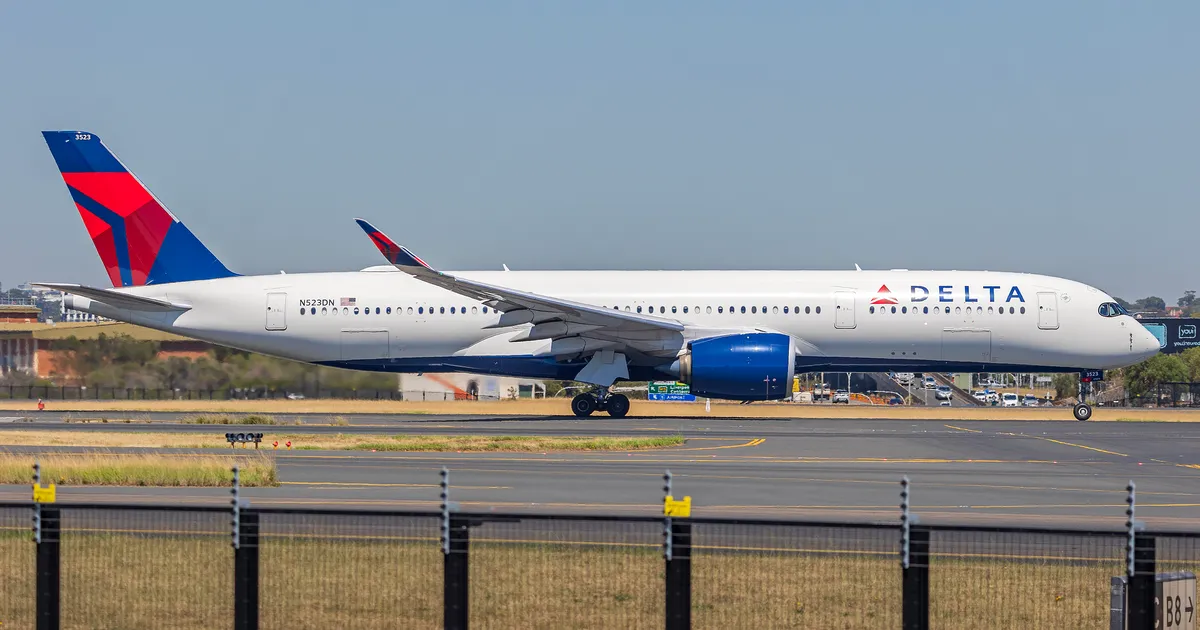
Delta Air Lines restarts its seasonal Auckland-Los Angeles service on 26 October, and its Asia-Pacific vice-president Jeff Moomaw is unusually frank about the backdrop. He concedes New Zealand’s “mediocre economy and weak dollar” make demand from Kiwis flying out less impressive. Delta is flying anyway, and the reason tells you a lot about where New Zealand’s growth is actually coming from.
The route was never built for Kiwis
Moomaw’s point is that Delta’s Auckland revenue is mostly sold in US dollars to Americans heading south. “When we started service to Auckland, we knew it was going to be very heavy US point of sale demand… Particularly in peak season, it’s a very common destination for Americans,” he told the Herald. He added that Delta’s revenue systems shift where seats are sold as currencies and demand move, so a weaker kiwi simply tilts the mix further towards American buyers.
That is not spin. A cheap dollar is a discount sticker on the whole country for US travellers. BusinessNZ’s latest planning forecast puts it plainly: “A relatively weak NZ dollar is also generally helpful for inbound tourism because it makes New Zealand cheaper for overseas visitors.” The currency that is squeezing Kiwi households is the same one filling Delta’s A350s.
The inbound numbers back him up
The data supports Delta’s confidence. International visitor spend for the year to June 2026 rose 20% to $14.3 billion, with arrivals up 9% to 3.67 million. Tourism remains the country’s second-largest export earner, behind dairy at $24.2 billion and ahead of meat at $11.8 billion.
July delivered a symbolic milestone. Overseas visitor arrivals hit a record 256,600 for the month, 100.4% of the July 2019 level and the first time since early 2022 a month has beaten its pre-Covid equivalent. US arrivals were up 1,700 on a year earlier. Two months earlier, arrivals were still sitting at 93% of pre-Covid May levels, so the recovery is accelerating, not plateauing.
Auckland is the soft spot
There is a wrinkle. Customs data shows Auckland, which handles more than 70% of passenger volume, saw average monthly arrivals 1.4% lower across April to June than a year earlier, while Queenstown grew 14.3% and Christchurch 9.2%. Middle East conflict weighed more heavily on Auckland and Wellington. Yet scheduled seat capacity for July, September and October was higher than in 2025.
In other words, airlines are scheduling ahead of confirmed demand at the main gateway. That is a bet, and Delta is one of the carriers making it. For an airline that answers to shareholders, not ministers, it is a meaningful vote of confidence in the coming summer.
Seats are market access
For business owners, the airfare story is the least of it. Delta entered the route in 2023 after American Airlines failed to bring back its summer service, leaving Air New Zealand as the sole non-stop operator, with capacity at roughly half pre-pandemic levels. A single-carrier route to the world’s largest economy is a cost and a risk for any firm with US customers, investors or staff.
Competition keeps fares honest, and wide-body jets carry more than passengers. Customs reports air cargo grew 5.36% in 2025/26, with total cargo forecast to rise 6.35% in the coming year. Belly-hold space on a Los Angeles flight is a direct line for high-value perishables and time-sensitive goods into the US market. Every extra seat is also extra freight capacity.
A long-horizon bet on the Pacific
Delta is not treating Auckland as a one-season punt. From 28 March 2027 it becomes the only US airline flying non-stop between Los Angeles and Manila, which Moomaw frames as part of a pivot away from a saturated domestic market towards international growth. It has picked Amazon’s Leo satellite network over Starlink for in-flight Wi-Fi, with coverage promised from 2028, and it is a major sponsor of the Los Angeles Olympics that year. This is an airline building Pacific infrastructure for the rest of the decade.
That aligns with the broader shift BusinessNZ identifies, that tourism is “likely to become an increasingly important source of export led growth at precisely the time domestic consumption remains relatively subdued.”
The lesson for New Zealand is straightforward. The weak dollar is hurting importers and Kiwi holidaymakers, but foreign capital is reading it as an opportunity. Delta’s planes will land in Auckland this month carrying people who think the country is a bargain. Tourism operators, exporters and firms with American links should treat the summer as exactly that, and plan to capture it before the currency turns.
Sources
- NZ Herald: Delta resumes Auckland-Los Angeles flights as it backs summer demand, overhauls dining, goes with Amazon over Elon Musk (2026-10-14)
- NZ Herald: Why Delta Air Lines pressed go on the Auckland-Los Angeles route (2023-01-29)
- BusinessNZ: NZ economy – Spring is here! (2026-09-06)
- MBIE/TEIC: IVS Release – Key Highlights (Year ending June 2026) (2026-09-01)
- Stats NZ: International travel July 2026 (2026-09-14)
- Stats NZ: International travel May 2026 (2026-07-14)
- NZ Customs: Update of forecast scenarios for passengers and cargo August 2026 (2026-08)
Join the discussion
Add useful context, ask a good question, or challenge an idea — keep it specific and respectful.