

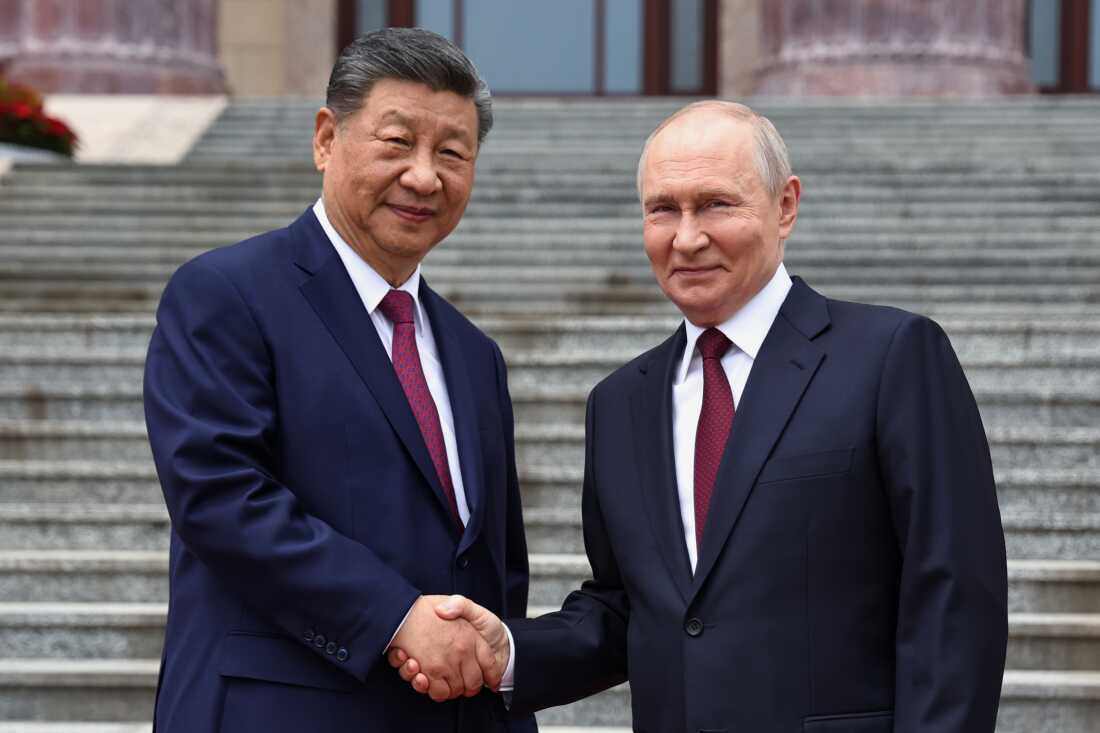
Beijing staged a carefully choreographed welcome for Russian President Vladimir Putin on Wednesday, using the visit to underline China’s deepening partnership with Moscow only days after President Xi Jinping hosted U.S. President Donald Trump.
Putin was received at the Great Hall of the People with the full ceremony of a state visit, including an honour guard, military music, a gun salute, and children waving flags and flowers. The reception closely followed the formal welcome given to Trump the previous week, but the tone of Putin’s visit appeared warmer and more politically aligned.
During talks, Xi presented China and Russia as steady partners in a world facing growing instability. His comments also appeared to carry a pointed message for Washington, reflecting Beijing’s long-standing criticism of U.S. influence in global affairs.
“The international situation is marked by intertwined turbulence and transformation, while unilateral hegemonic currents are running rampant,” Xi said.
Chinese state media said Xi called for stronger “comprehensive strategic coordination” between the two countries, whose ties have expanded across trade, security, diplomacy, energy, and technology in recent years.
Putin praised the relationship, saying China-Russia ties had reached an “unprecedentedly high level” and were among the “main stabilizing factors on the international stage.” He also highlighted his personal rapport with Xi, using a Chinese idiom that translates to “One day apart feels like three autumns,” a phrase expressing longing after separation.
The two leaders signed a joint statement reaffirming their support for a “multipolar world,” language often used by Beijing and Moscow to challenge the U.S.-led international order. The statement also criticised Washington’s proposed Golden Dome missile defence system.
“The parties believe that the U.S. ‘Golden Dome’ project poses a clear threat to strategic stability. These plans completely negate the key principle of maintaining strategic stability, which requires the inseparable interconnection of strategic offensive and strategic defensive weapons,” the statement said, according to the Kremlin.
Xi also warned that the conflict involving the U.S., Israel, and Iran risked disrupting energy supplies, trade, and global supply chains.
“A comprehensive cessation of war brooks no delay, restarting hostilities is even less desirable, and persisting with negotiations is particularly important,” Xi said.
China and Russia signed about 20 cooperation agreements covering trade, nuclear energy, artificial intelligence, transport, and visa-free travel. However, there was no announced breakthrough on the long-discussed Power of Siberia II gas pipeline, a project Moscow has sought as it tries to offset lost energy sales to Europe.
For Xi, the back-to-back visits from Trump and Putin reinforced China’s bid to present itself as a central diplomatic power. For Putin, the Beijing welcome offered a public show of support from a crucial partner as Russia remains under pressure from the war in Ukraine, sanctions, and growing economic reliance on China.