

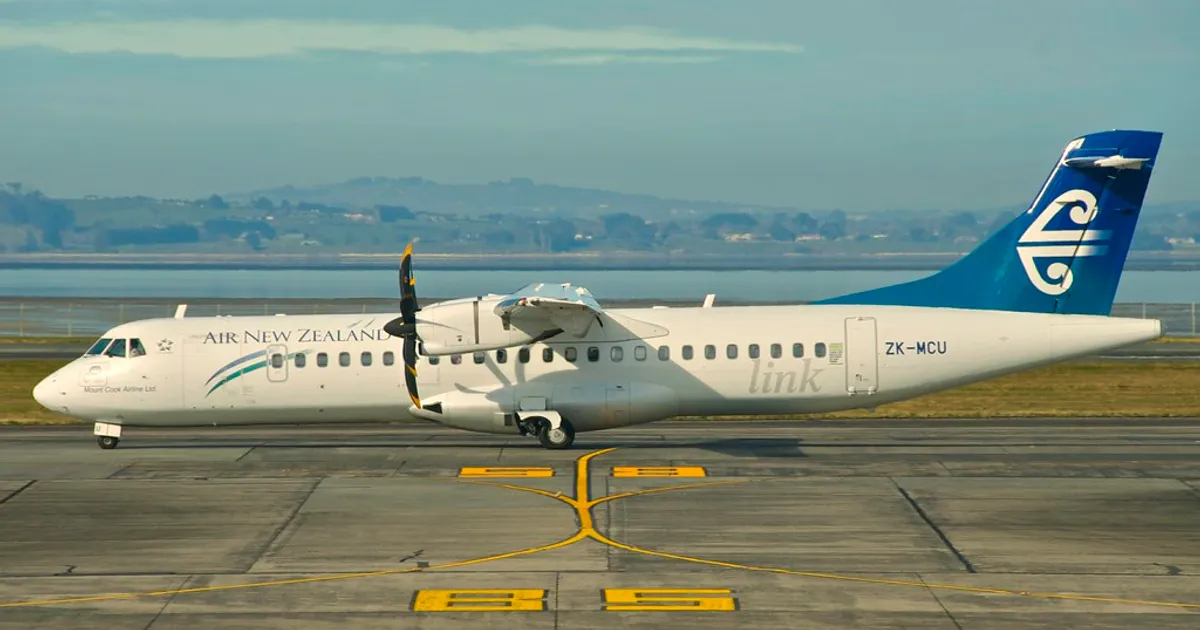
The engine that caught fire on an Air New Zealand ATR72 approaching Wellington on 1 September 2024 had been overhauled by its manufacturer, Pratt & Whitney Canada, less than four flying hours earlier. The fatigue crack that failed a turbine blade slipped through the manufacturer’s quality checks. Air NZ did not cause the fault, but it carried the consequences.
That is the uncomfortable lesson in the Transport Accident Investigation Commission’s final report. It is also a lesson for any business that outsources work it cannot afford to get wrong.
A fresh overhaul that was already failing
The Christchurch to Wellington flight carried 70 passengers and four crew. A low-pressure turbine blade failed through fatigue cracking, and oil leaked into the engine. The resulting smoke and flames triggered the fire warning shortly before landing.
The aircraft landed safely. The fire warnings stayed on after suppressant was discharged, so the captain ordered an evacuation. A second blade from the same engine also showed signs of fatigue.
TAIC chief investigator of accidents Louise Cook called it a “rare but serious technical failure”. She said it showed why maintenance assurance must be strong enough to detect fatigue before components return to service. TAIC has recommended Pratt & Whitney Canada strengthen its overhaul quality assurance procedures.
Air NZ chief safety and risk officer Nathan McGraw pointed out that the report “found no evidence of Air NZ maintenance or operation contributing” to the blade failure. That is true, and it is also the problem. The airline’s safety record depended on an inspection it neither ran nor could see.
Ninety seconds became nearly three minutes
The second failure happened in the cabin. Evacuating the aircraft took 2 minutes 51 seconds, roughly double the 90-second certification benchmark. Cook warned that beyond 90 seconds, “the risk to life increases exponentially”.
Passengers kept stopping for their bags:
- At the forward-right exit, 10 of 12 passengers took baggage.
- At the forward-left exit, 8 of 15 did the same, and those passengers walked close to the engine that had been on fire.
- At the rear-left exit, an estimated 17 of 42 took bags.
The forward passengers did this despite the safety briefing and crew instructions to leave bags behind.
TAIC identified several causes. Some passengers did not recall the briefing or did not hear the crew. Some copied others who grabbed bags, and some felt less urgency because they could see no flames. A few simply ignored instructions.
The flight crew also never made an evacuation radio call. That left airport fire crews to switch from firefighting to managing passengers without being told.
Fixing what the airline controls
Air NZ has accepted the findings. It plans to develop a cabin emergency evacuation trainer and strengthen training on the ATR’s rear service door. It will also update passenger briefing material and align crew commands across the fleet to tell passengers explicitly to leave their bags. These are sensible, practical fixes. The harder problem sits upstream.
The same pattern, with someone else’s name on it
This is at least the third serious Air NZ engine event TAIC has investigated in under a decade.
- December 2024: An A320neo flying from Wellington to Sydney suffered an uncommanded engine shutdown at 36,000 feet with 142 passengers aboard. The crew declared a mayday and diverted to Auckland. TAIC’s 2025 interim report traced it to a defective fire switch and recommended the regulator work with European authorities to replace faulty switches.
- 2017: A Rolls-Royce Trent 1000 engine failed on an Air NZ 787-9 near Auckland. TAIC’s 2020 report found the manufacturer’s fatigue prediction model could not reliably forecast blade failure. Affected blades were eventually replaced across 99% of the global fleet.
The three events involved different aircraft, different engine makers and different years. Each time, the root cause sat with the manufacturer’s processes, while Air NZ absorbed the risk.
The bill lands in Auckland
The ATR blade failure is a separate engine family from the problems hitting Air NZ’s widebody and A320neo fleets. The financial theme is the same, though, and it is now unmistakable.
Air NZ reported an FY2026 net loss after tax of $242 million on revenue of $7.0 billion. Rolls-Royce Trent 1000 and Pratt & Whitney PW1100 engine availability problems cost an estimated $190 million. That cost came through lost capacity, extra lease and engine costs, and lower fleet utilisation. Maintenance costs rose $139 million, and no final dividend was declared.
What boards should take from this
Outsourcing a task does not outsource the risk. A supplier’s quality failure becomes your operational incident, your reputational hit and your line item. Businesses that rely on contracted maintenance, manufacturing or IT should look at their contracts and their assurance audits. The real question is whether they can independently verify the work, or whether they are simply trusting the paperwork.
The evacuation carries its own lesson for anyone running workplace emergency drills. Procedures that look fine on paper can fall apart when people improvise under pressure.
The next test is whether Pratt & Whitney Canada acts on TAIC’s recommendation, and whether Air NZ can push manufacturers to share more of a cost they keep creating. Until then, the national carrier will keep paying for mistakes made in other companies’ workshops.
Sources
- 1News: Missed cracks sparked Air NZ engine fire, evacuation took too long (2026-09-24)
- NZ Herald: Air NZ flight fire, passengers took carry-on bags during evacuation, engine blade crack likely missed in overhaul (2026-09-24)
- RNZ: Inquiry finds evacuation took too long after engine fire on Air NZ flight (2026-09-25)
- TAIC: Passenger aircraft engine fire and evacuation, 1 September 2024 (2026-09-25)
- TAIC: Aircraft fire inquiry highlights evacuation safety lessons (2026-09-25)
- TAIC: AO-2024-007 interim report, Airbus A320neo ZK-NHA uncommanded engine shutdown (2025-11-01)
- TAIC: Boeing 787-9 ZK-NZE Trent 1000-J2 engine failure near Auckland (2020-11-12)
- Air New Zealand: 2026 annual results market release (2026-08-28)
- NZX: Air New Zealand announces 2026 annual results (2026-08-28)
Join the discussion
Add useful context, ask a good question, or challenge an idea — keep it specific and respectful.