

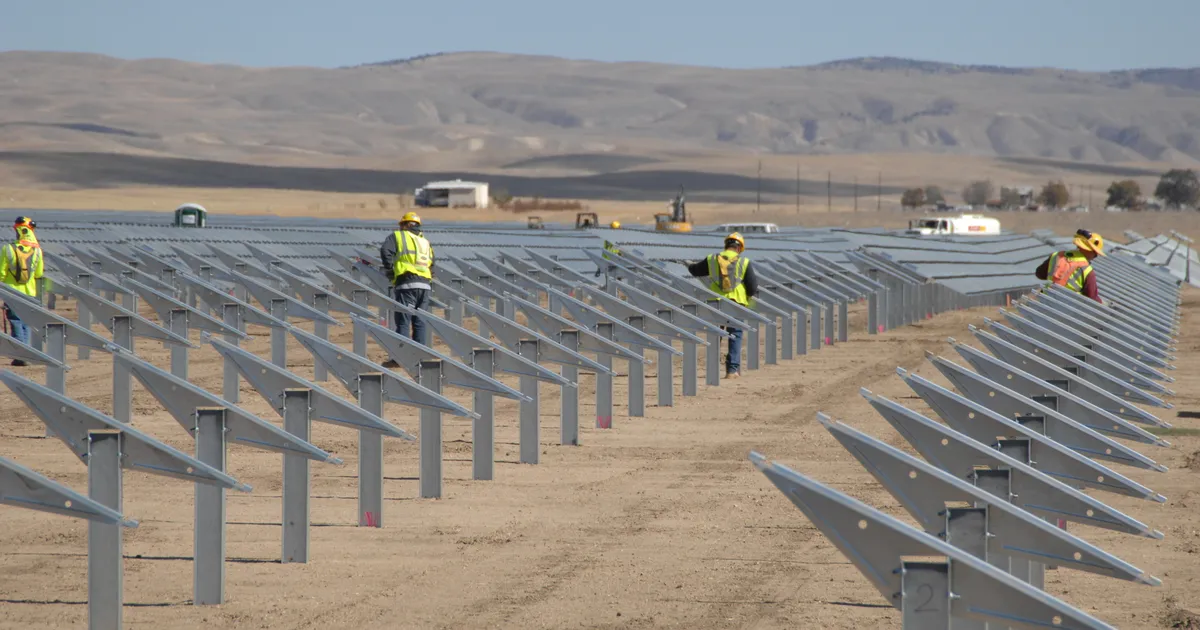
New Zealand has produced no shortage of energy reviews, taskforces and strategy papers in the past two years. What it has been short of is new generation. Kōwhai Park, which officially opened at Christchurch Airport today, is the useful kind of energy announcement: steel, glass and megawatts.
The farm covers 230 hectares with around 300,000 panels, producing 150MW AC and roughly 275GWh a year, enough for about 36,000 homes. The $273 million project is a 50/50 joint venture between Contact Energy and Lightsource bp, and it is the South Island’s biggest solar farm. It switched on in August and was producing 90MW under cloud cover at today’s ceremony, where Prime Minister Christopher Luxon called it “pretty phenomenal” and Energy Minister Simeon Brown used the stage to pitch consent-free plug-in solar for households.
The politics are predictable. The more interesting story is how the project got built.
Green-lit in the middle of a crunch
Contact made its final investment decision in August 2024, when the market was in genuine trouble. With hydro storage at less than half its usual level, Brown said at the time that “we do not have enough natural gas to meet demand” and that manufacturers and exporters were cutting output. That same month, critics including Haast Energy Trading’s Phill Anderson accused the big four gentailers of running an oligopoly “happy to keep electricity supply tight and prices high”.
Kōwhai Park was, in part, Contact’s answer. Lightsource bp locked in a NZ$267 million financing package from Westpac, Mizuho, China Construction Bank and Intesa Sanpaolo, with project finance making up about 77% of the capital structure. In 2024, Contact chief executive Mike Fuge framed it as proof the company would “contribute more renewable generation as New Zealand decarbonises”.
It also needed foreign capital to clear the Overseas Investment Act. The January 2024 consent showed a project then costed at $270.16 million, with beneficial ownership spread across the UK, US, Australia and New Zealand, on land previously used for grazing. Anyone who still thinks offshore money in energy is a threat should note what it actually bought here.
Two years from decision to electrons
Construction ran from late 2024 to mid-2026. By New Zealand infrastructure standards, that is quick. The build employed 235 people at peak and drew on 66 Canterbury businesses, a meaningful regional injection during a soft construction market.
Speed matters because the gap between a price spike and new supply is where industrial users get hurt. Solar’s advantage is precisely that it can go from investment decision to output inside a single electoral cycle, something new hydro or geothermal rarely manages.
The buyers who didn’t wait
The sharpest business lesson sits in the offtake contracts. Contact buys 80% of output under a 15-year PPA with escalation clauses. Christchurch Airport and Synlait have both signed long-term agreements too, with Synlait taking 25% of production to run its Dunsandel and Dairyworks sites.
That is how a dairy processor stops being a passenger in the wholesale market. Rather than lobby for intervention or wait for the next review, Synlait put its balance sheet behind a contract that underwrote new capacity.
EY made the structural case for this in 2024, warning that New Zealand’s model had become “come and we will build” rather than build ahead of demand. Its bleakest line was that if the price needed to trigger new generation is the same price that shuts down industrial users, the country is “caught in a downwards spiral where nobody wins”. Long-term PPAs were among its recommended fixes. Kōwhai Park is a working example, delivered without an Australian-style capacity scheme or a UK-style subsidy.
One farm is not a market
None of this means power prices are fixed. 275GWh a year helps, but it is a fraction of national demand, solar output dips in winter when Canterbury needs it most, and firming still depends on hydro, gas and batteries. One project cannot discipline prices on its own. A steady pipeline of them can.
That is the test for the next two years. The government’s job is to keep consenting and overseas investment rules from slowing the next five Kōwhai Parks. The gentailers’ job is to prove the 2024 oligopoly charge wrong with more final investment decisions, not more press releases. And for large energy users still sitting on the spot market, the message from Synlait is blunt: the businesses with the most secure power in 2028 will be the ones signing contracts in 2026.
Sources
- The Press: South Island’s biggest solar farm opens at Christchurch Airport (2026-10-15)
- ODT: $273m Christchurch solar farm gives NZ ‘an incredible renewable energy advantage’ (2026-10-15)
- Christchurch Airport: Kōwhai Park opens at Christchurch International Airport (2026-10-15)
- The Press: Landscape-altering Christchurch solar farm weeks away from starting operations (2026-09-17)
- Newsroom: Gas and solar to help answer ‘power profiteering’ claims (2024-08-14)
- Lightsource bp: Lightsource bp secures NZ$267m financing package for Kōwhai Park solar farm (2024-08-16)
- Contact Energy: Contact invests in Kōwhai Park Solar Farm (PDF) (2024-08-16)
- NZX: Contact invests in Kōwhai Park Solar Farm (2024-08-16)
- EY: New Zealand’s Renewable Energy Market – Addressing Supply-Demand Challenges (2024-10-28)
Join the discussion
Add useful context, ask a good question, or challenge an idea — keep it specific and respectful.