

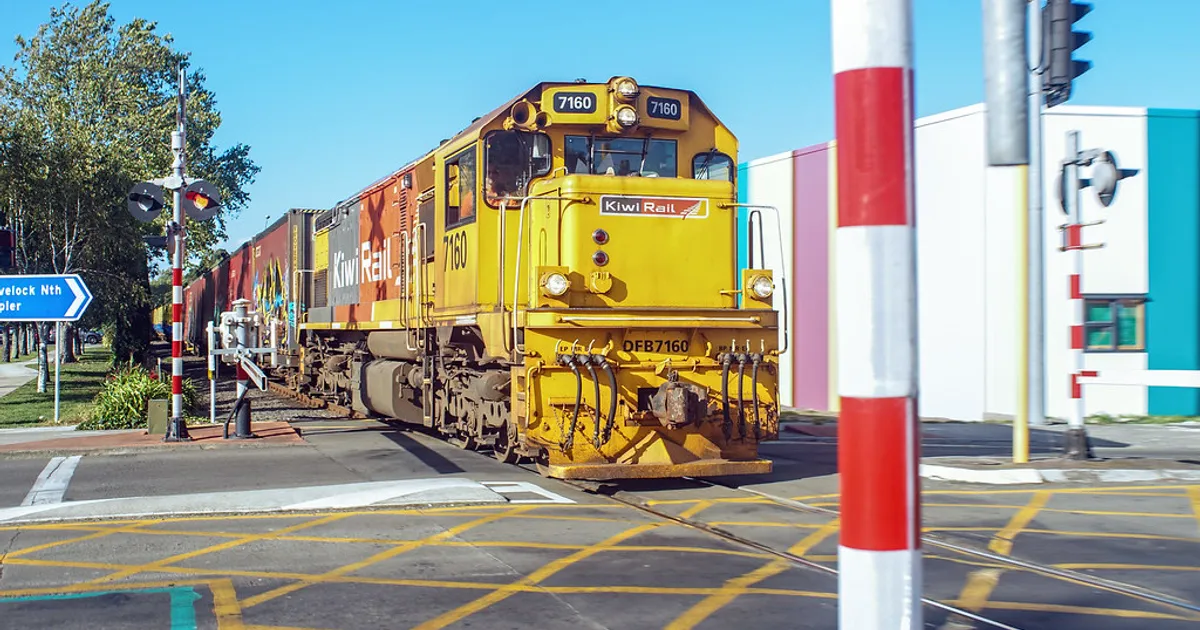
KiwiRail had its best operating year in recent memory and it barely matters. The state-owned operator reported a $1.4 billion net loss for the year to 30 June 2026, with almost $1.2 billion of that coming from writing down City Rail Link assets transferred onto its books, and a further $556 million from its annual revaluation of rail, ferry and related assets.
Both are non-cash. Neither reflects how well the trains ran. But together they show exactly where the real money in New Zealand rail goes, and who decided to spend it.
The operating story is genuinely good
Strip out the writedowns and KiwiRail’s operating surplus climbed to $162 million, up roughly 45% on FY25’s $111.2 million. Freight revenue rose 11% and volumes grew.
That clears the $160 million target, which in 2025 Treasury described as “a step up” after surpluses had run between $100 million and $135 million over the previous three years. The half-year signalled it was coming. In February 2026 KiwiRail reported a first-half surplus of $73.4 million, nearly triple the prior period, and chief executive Peter Reidy said at the time that spending on engines, rolling stock and the network was “paying off”.
This matters because it breaks a trend. In FY25 freight revenue actually fell 4% to $456.1 million even as tonnage rose. Winning volume and price in the same year is progress, and management deserves credit for it.
Then the tunnel arrived on the balance sheet
Reidy is candid about why the CRL writedown happened. “It comes on to our books now, which means there’s no commercial value to the CRL but it delivers significant value for Auckland,” he says.
That is an accountant’s way of saying the asset will never earn back what it cost. The CRL’s price rose from an original $3.4 billion to $5.5 billion, and Treasury and the Ministry of Transport flagged the economic case as “weak” as far back as 2015. Former CRL chief executive Sean Sweeney has acknowledged the project was over-engineered and could have been built for about half the cost with a leaner design, pointing out the nine-car station capacity decision predated his tenure. Taxpayers’ Union economist Jim Rose, in a 2026 report, called it “a white elephant, a monument to future generations of the sunken cost fallacy.”
There is a real counter-argument. Supporters say the CRL will double the number of people who can reach central Auckland by public transport and free up capacity for freight across the wider network. Those benefits are plausible. But they do not change the fact that the gold-plating is now permanently baked into the accounts of a company that also has to run a freight business.
This is a pattern, not an accident
FY26 is not a one-off. In FY25 KiwiRail recorded impairments of $946.8 million, turning a modest operating surplus into a $422.2 million deficit. Every year, the operating line improves and the bottom line drowns.
And the operating gains themselves rest on heavy public capital. In FY25 KiwiRail received $596.1 million in capital grants, mostly from the National Land Transport Fund. More than $9 billion has been committed under the Government’s multi-year rail programme. A $162 million surplus is welcome, but it is being generated on assets taxpayers keep buying.
Freight customers still want more
The bigger commercial question is whether rail is actually winning freight. Nationally, it is not. NZTA data shows rail’s share of the combined road and rail task slid from 13.85% in 2017/18 to 12.21% in 2024/25, while road freight kept growing.
Customers have noticed. In April, Mainfreight chief executive Don Braid said KiwiRail was “missing in action” during the fuel price squeeze, failing to offer extra capacity when shifting freight from trucks made obvious sense. Reidy replied that KiwiRail had made hundreds of containers available. Both can be true, and that is the point. Capacity remains tight even as the numbers improve.
What happens next
For exporters and logistics operators, the operating result is the number to watch, and it is heading the right way. For taxpayers, the $1.4 billion loss is the one that counts. It is the bill for decisions made years before this management team arrived, and it will keep landing as more of the CRL’s cost flows through.
The lesson for whoever builds the next big project is blunt. Running an asset well cannot rescue an asset that was specified badly. KiwiRail has shown it can lift its operating game. Future governments need to show they can stop handing it tunnels with no commercial value attached.
Sources
- NZ Herald: CRL $1.4b hole masks KiwiRail turnaround (2026-09-29)
- Stuff: KiwiRail tracks $162m surplus as freight revenues jump 11% (2026-09-29)
- KiwiRail: Integrated Report 2025 (2025-09-30)
- KiwiRail: KiwiRail achieves in year of significant challenges (2025-09-30)
- KiwiRail: Half-Year Report 2026 (2026)
- Treasury: KiwiRail and Ferry Holdings Performance Report for the six months to 30 June 2025 (2025-12-09)
- Scoop: Performance lift in first half in line with FY26 $160m full year target (2026-02-27)
- Ngā Motu News: KiwiRail profit triples as Aotearoa’s rail renaissance gathers pace (2026-02-28)
- Public Policy Club: Explainer, The Auckland City Rail Link, effective, efficient and economical? (2026-09-24)
- NZTA: Road and rail freight statistics from 2017-18 to 2024-25 financial years (2025-12-12)
- RNZ: Mainfreight CEO frustrated with KiwiRail, AT for not offering additional services (2026-04-17)
Join the discussion
Add useful context, ask a good question, or challenge an idea — keep it specific and respectful.