

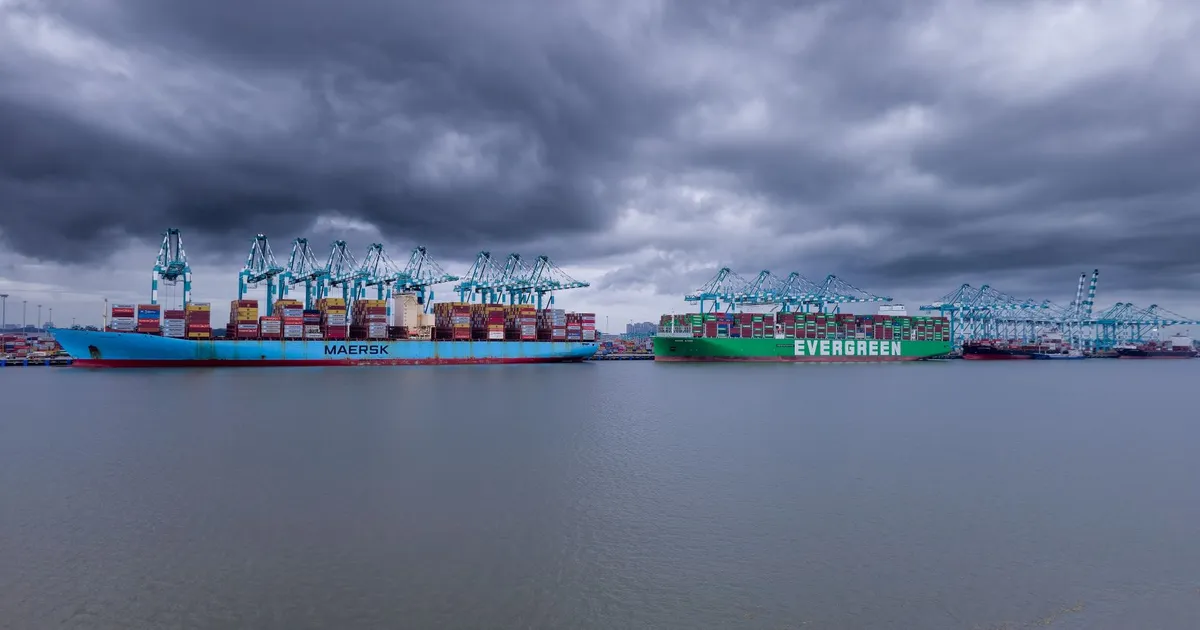
A storm that freezes the world’s factory floor
Typhoon Noul is bearing down on Guangdong with maximum sustained winds of 145km/h near its centre, and by Saturday afternoon more than 340,000 people had been evacuated across the province. China’s National Meteorological Centre issued its highest-tier red typhoon alert, and Hong Kong hoisted storm signal No. 8, its third-highest level.
Landfall is forecast for Sunday morning around Huizhou and Shanwei on the Guangdong coast. More than 150 flights were cancelled at Hong Kong International Airport, Cathay Pacific grounded all flights in and out of Hong Kong for most of Sunday, and train services across Guangdong were cancelled for the day. Bloomberg had flagged the incoming deluge days earlier.
The geography is the point. Guangdong is home to Shenzhen and Guangzhou, two of the planet’s biggest export hubs, and sits alongside Hong Kong, the region’s transhipment gateway. Electronics, components, consumer goods, textiles and machinery parts all flow through this corridor to New Zealand shelves and factory floors.
Not a one-off, a pattern
Here is the detail that should make importers sit up. Noul is the third significant storm to hit southern China in under a month. Typhoon Maysak made landfall on 3 July, and Typhoon Bavi followed on 11 July, forcing more than two million evacuations. July and August are peak typhoon season in the South China Sea, so more disruption before the season ends is a live probability, not a tail risk.
A single typhoon is a temporary shock. Production slows, inventories are drawn down, shipments reroute, and things normalise within weeks. Three storms in 25 days is something else. It is a structural feature of the production zone New Zealand relies on, and every fresh storm is one more reason for firms to question single-country dependence.
How dependent NZ actually is
The scale of exposure is easy to underestimate. In the year ending June 2022, China was New Zealand’s largest import source at NZ$17.6 billion, part of a two-way goods and services relationship MFAT then valued at NZ$38.5 billion. Those figures are nearly four years old now, but the structural dependency they describe has not gone away. China remains New Zealand’s largest trading partner, and a meaningful chunk of that import flow originates in or transits through the southern coast now under a red alert.
Supply chain disruption is not an abstract macro problem either. Treasury analysis has documented how global supply chain shocks feed through to prices and availability. The cost lands hardest on firms with thin margins, and it reaches consumers through higher prices later in the year.
What to do before your next order ships
The practical response splits across three horizons.
In the immediate days, ports at Yantian, Shekou, Guangzhou Nansha and Hong Kong will slow or suspend around landfall. Container movements freeze. If you have goods in transit or waiting to load, your freight forwarder should be your first call, and force majeure clauses are about to get a workout.
Over the following weeks, the post-storm congestion is usually worse than the storm. Vessels that waited at anchor or diverted create a backlog, and delays of one to three weeks on affected shipments are a reasonable planning assumption, with knock-on effects rippling through global vessel schedules.
Structurally, the ordering calendar matters. Q3 and Q4 is when New Zealand retailers place Christmas stock and manufacturers place year-end component orders. If your supplier is in Shenzhen and you need November delivery, you are ordering straight into typhoon season, which runs through October. Build in the contingency now.
The diversification case just got another data point
The uncomfortable maths for small and medium importers increasingly favours buffer stock. The cost of holding a few extra weeks of inventory now looks modest against a three-week disruption that empties your shelves in peak trading season. Businesses running a single Guangdong supplier have no fallback at all, and the argument for keeping critical components in at least two geographies, whether Vietnam, India or a domestic alternative, is no longer just a geopolitical hedge. It is commercial common sense.
Cheap supply chains carry an interruption cost that rarely shows up until the weather does the sums for you. Noul will pass. The season will not. Firms that treat this cluster of storms as a prompt to check their freight insurance, recalculate lead times and audit supplier concentration will be the ones still shipping when the next red alert goes up.