

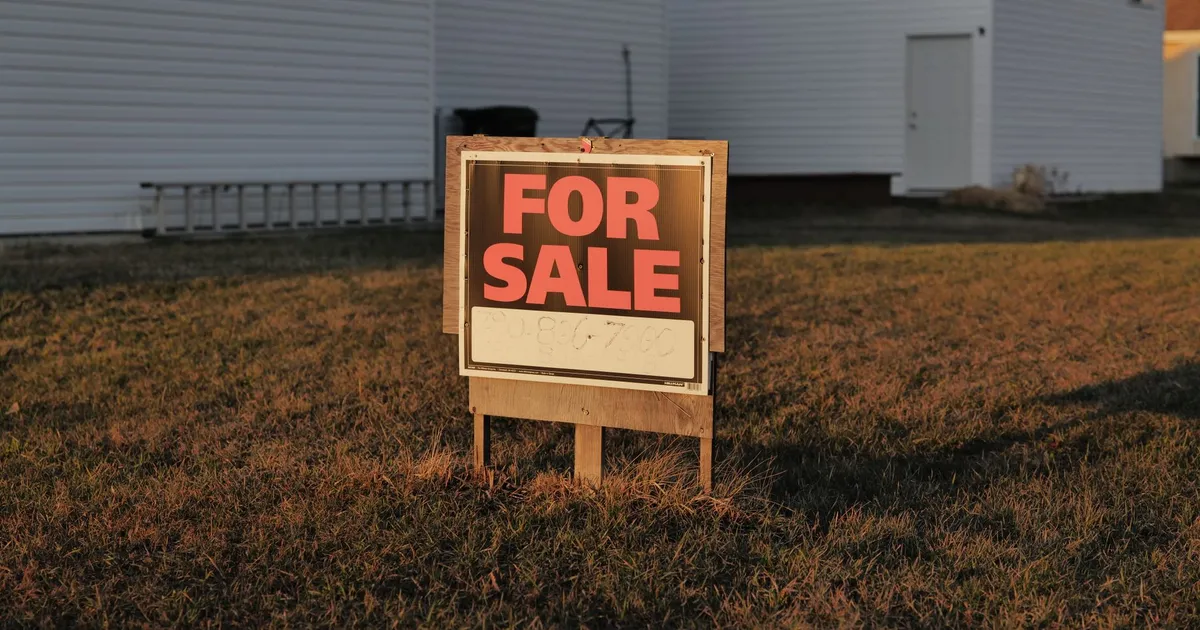
The standoff nobody wins
New Zealand’s housing market has recorded four consecutive monthly falls in sales volume, with roughly 1,500 fewer homes sold so far in 2026 compared to the same period last year. April saw national sales fall 7.9% year-on-year to 6,262 transactions, ranking it 18th out of 35 Aprils in data going back to 1992. Experts who began 2026 forecasting 8-10% growth in sales volumes have quietly abandoned that view.
This is no longer a pause between cycles. It is a structural freeze, and the economic damage extends well beyond the property sector.
Prices look flat until you adjust for inflation
The average home value sits at $808,187, down just 0.6% over the past year in nominal terms. That number is misleading. Adjusted for inflation, house prices have fallen approximately 31% from the 2022 peak, effectively returning to mid-2016 real values. Auckland and Wellington have fared worst, down 37% and 39% respectively in real terms.
The national median sales price eased 0.6% year-on-year to $775,000 in April, with the REINZ House Price Index down 0.9% nationally and 2.8% in Auckland. Cotality chief economist Kelvin Davidson described the data as continuing “a sluggish start to 2026, with interest rates already lifted and likely to rise further as the Iran conflict continues.”
Owners are responding rationally but unhelpfully. Cotality’s Pain and Gain report shows profit-making resales now carry a median hold period of 10 years, the longest on record. Vendors are not panic-selling. They are simply not selling at all. That restraint prevents a price crash but freezes the transaction volume that powers downstream activity.
Buyers have vanished and agents know it
Independent economist Tony Alexander’s survey of real estate agents paints a blunt picture. In May 2026, only 8% of agents reported buyers displaying FOMO, down from 26% in early December 2025. Alexander’s verdict: “For the third time since the middle of 2023, an upturn in the residential real estate market has been snuffed out and gone into reverse.”
From a survey of 231 licensed agents nationwide, a net 37% reported prices falling in their area. The dominant concern is interest rates, with 52% of agents naming rate anxiety as the single biggest buyer issue, up from just 2% in October 2025. Fear of overpaying has surged too: 45% of agents flagged buyer concern about prices falling after purchase, compared with 21% before the Iran conflict began.
Investors are largely absent, with net 35% of agents reporting reduced investor buying interest. First-home buyers remain the most active cohort at 28% of the market, but they cannot carry volumes alone.
A repricing wave will tighten the vice
The forward risk makes this more than a real estate story. Around 58% of existing mortgages by value are fixed but due to reprice within 12 months, with 33% repricing within six months. Many were locked in when rates were lower. They will now roll onto current rates: the two-year fixed rate was 5.69% in May and the floating rate 6.15%.
Borrowers are hedging by locking in longer, with more than 50% of new lending now fixed for more than 12 months, up from around 20% at the end of 2025. That behaviour alone signals how dramatically the rate outlook has shifted. The housing market no longer has the tailwind of falling rate expectations, and most major bank economists now consider an OCR hike this year probable.
Two countries, one housing market
The national data conceals a sharp regional split. The HUD March 2026 quarterly update shows South Island markets recording positive price growth: Canterbury up 3.7%, Otago up 3.6%, Southland up 7.9% over the year to March. North Island centres declined: Auckland down 1.2%, Wellington down 1.8%.
Wellington’s underperformance is structural. Davidson cited “the underlying weakness of areas’ economies, particularly Wellington facing public sector cuts” as creating scope for further falls. The REINZ April data showed the largest softening in regions with higher vehicle dependency and lower median household incomes, including Hawke’s Bay, Manawatu-Whanganui, and Marlborough.
Apartments are under severe pressure everywhere. In Q1 2026, 41.1% of apartment resales were at a loss versus 11.3% for standalone houses, with median apartment losses around $70,000.
The businesses that feel it first
Every residential transaction that does not occur is a lawyer not engaged, a conveyancer not paid, a removalist not booked, a renovation not commissioned, and a furniture purchase deferred. With active listings nationally at 37,500 in March, supply is not the constraint. The constraint is a standoff between vendors anchored to old expectations and buyers unwilling to commit in a rising-rate environment.
Rents for new tenancies fell 0.4% year-on-year to March, removing the traditional signal that would push investors back into the market. Election-year dynamics compound the freeze, with REINZ noting that election years typically bring slower vendor decision-making rather than sharp price movements.
The housing market does not need a crash to cause economic damage. It just needs to stay exactly where it is.
Sources
- RNZ: Warnings property market softness likely to continue (2026-06-14)
- NZ Herald: Cotality data shows Kiwis holding onto homes for longer amid prolonged housing downturn (2026-06-14)
- 1News: Why house prices are actually down about 30% (2026-06-04)
- Scoop: Cost-Of-Living Pressure Bites Housing Market (2026-05-14)
- OneRoof/Tony Alexander: Agents tell it straight – the housing market is grinding to a halt (2026-05)
- MPA Mag: Buyers call the shots – and they know it, agents warn (2026-05)
- HUD: Housing Market Update March Quarter 2026 (2026-03)