

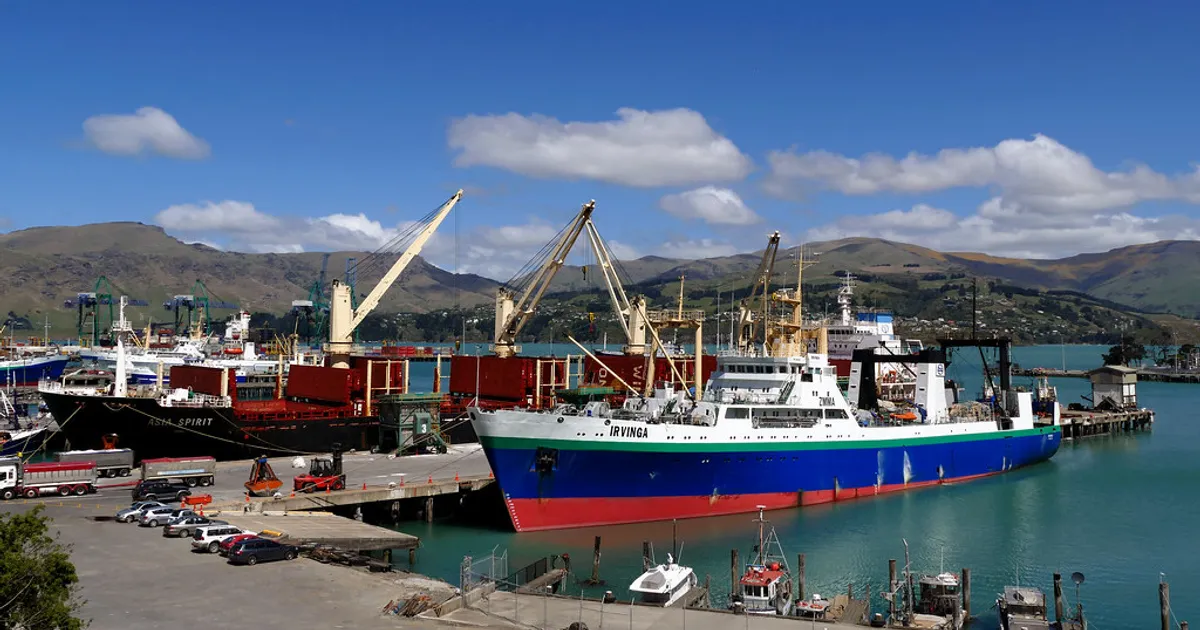
Half a year’s sediment in three days
Lyttelton Port Company began an emergency dredging campaign in late April after a subtropical low-pressure system on 27 March dumped more than 430,000 cubic metres of sediment into its main shipping channel. That is more than half a typical year’s infill from a single weather event.
Since scheduled maintenance dredging was completed in November 2025, nearly one million cubic metres of material have accumulated in the channel, well above the normal annual range of 600,000 to 800,000 cubic metres. Prolonged large sea states from January through April accelerated the problem. In some areas, the loss of depth is now imposing tidal constraints on vessel movements, meaning ships can only enter or exit during certain windows.
Simon Munt, LPC’s chief customer and supply chain officer, was unusually direct: “The scale and speed of the infill we have seen over the past few months is well outside what we would normally expect. Extreme weather events are clearly having a much greater impact on the harbour.”
Dutch Dredging’s trailing suction hopper dredger TSHD Elbe is now on site. The campaign is expected to take three to four weeks.
The surcharge precedent is already set
Business owners who ship through Lyttelton know exactly how port disruption translates into cost. In November 2025, following a separate labour-related congestion crisis, Maersk imposed a USD $200 per container congestion surcharge at the port. On a shipment of 100 containers, that is $20,000. On a regular weekly service, it compounds fast.
The current tidal restrictions create a structurally identical risk. When berth windows tighten, shipping lines face the same calculation: absorb the inefficiency or pass it through. They passed it through last time.
LPC already has a dredging surcharge in place for 2025, meaning customers are paying a levy intended to cover scheduled maintenance. The emergency campaign sits on top of that. Someone is absorbing this cost, and it will not be the shipping lines.
Every port in the network is exposed
Lyttelton is the most quantified example, but it is not isolated. In April 2026, harbourmasters simultaneously closed Northport, Marsden Point, Port of Auckland and Port of Tauranga as a cyclone hit the upper North Island. Two oil tankers were turned away from Whangarei Harbour and forced to shelter nearly 200 nautical miles northwest of Cape Reinga. Port of Auckland paused all operations.
In March 2026, Port Marlborough’s earnings trajectory was hit by a windstorm. New Zealand’s port system has no redundancy for severe weather. When ports close or restrict, goods stop moving.
The insurance industry is done pretending this is exceptional
The Insurance Council of New Zealand weighed in ahead of the 2026 election. Chief executive Kris Faafoi stated that New Zealand has averaged over two months each year under some form of declared emergency over the past five years, with at least 100 days of local states of emergency in just the first three months of 2026.
Faafoi cited the Awanui Flood Protection Scheme, which cost $15 million and has already avoided an estimated $50 million in damage. The economics of prevention versus cleanup are not subtle.
What this means for exporters and importers
Lyttelton is the South Island’s primary freight gateway. In its FY2025 Annual Report, published in September 2025, LPC showed ship turnaround times had dropped from 52.7 hours to 34.8 hours, a 33.6% improvement. The port had climbed from 385th to 273rd in the World Bank Container Port Performance Index. Those gains are now at risk of being erased by sediment.
For Canterbury’s dairy, meat and horticultural exporters, the maths is straightforward. Emergency dredging costs money. Tidal constraints delay vessels. Delayed vessels attract surcharges. Surcharges land on the exporter’s invoice. None of this is theoretical. Maersk proved the mechanism five months ago.
New Zealand’s infrastructure planning has historically treated extreme weather as exceptional, budgeted for in contingency rather than operations. A storm that deposits half a year’s sediment in three days, in a pattern the port’s own officers and the insurance industry describe as the new normal, makes that framing untenable. The question for businesses shipping through Lyttelton is no longer whether climate disruption will affect logistics costs. It is how often, and how much.
Sources
- EXCLUSIVE: TSHD Elbe kicks off Lyttelton dredging campaign (2026-05-01)
- Emergency dredging underway at Lyttelton Port after extreme weather (2026-05-01)
- NZ-bound oil tankers turned away from port, pounded by 4m storm waves at sea (2026-04-10)
- Act now or pay later: Hazard resilience policies a must in the 26′ election (2026-04-06)
- Port Marlborough earnings trajectory hit by windstorm (2026-03-03)
- Lyttelton Port Operational Challenges – Maersk (2025-12-02)
- Lyttelton Port Company releases 2025 Annual Report (2025-09-26)
- Pricing and Conditions – Lyttelton Port Company (2025-04-01)