

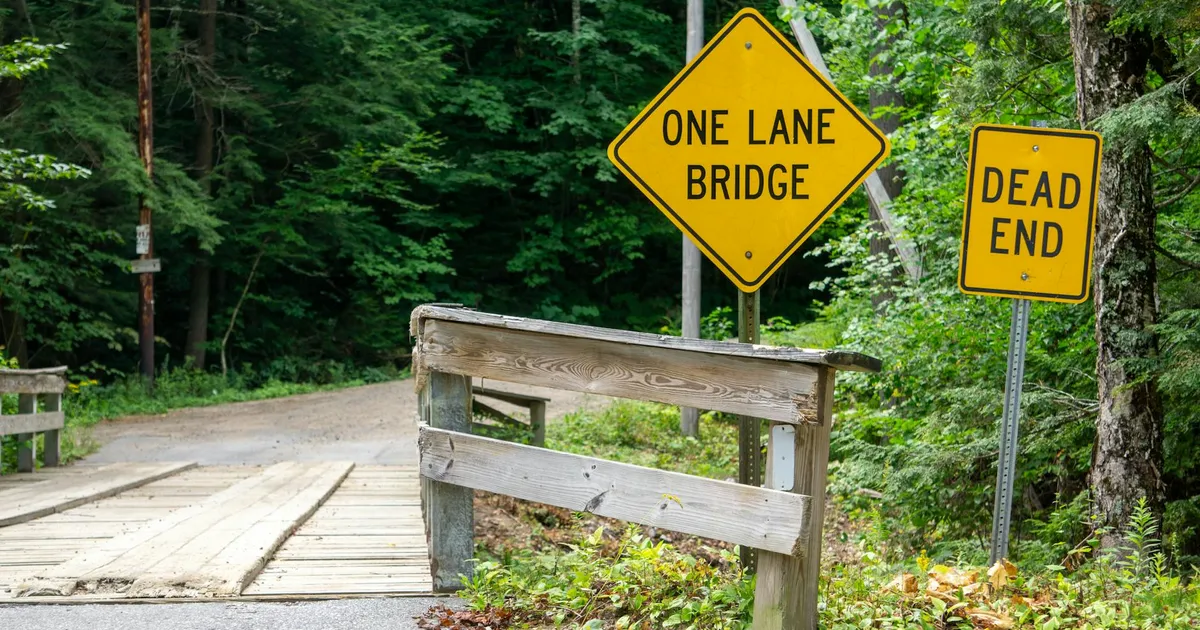
A bridge built with second-hand timber finally gave out
Whanganui’s Wakefield Street Bridge carried 1,800 vehicles a day until January 2025, when a safety inspection found significant decay in its timber beams. The bridge was built in 1954 using second-hand timber for its major structural components. Vehicles regularly exceeded its posted 4,500kg gross weight limit. It is now closed to all traffic.
The replacement is budgeted at approximately $2.7 million, with NZTA potentially covering 62%. But as of March 2026, the funding still had not been confirmed. Whanganui Mayor Andrew Tripe publicly apologised for telling residents it was on its way.
“That was based on what I thought was very good advice that I’d been given, that we were to receive the funding with just a little bit of paperwork required,” Tripe said. “As it turned out, that was not the case.”
A motion to loan-fund the replacement without NZTA, which would have cost ratepayers an average of $14.20 each per year, failed to gain a seconder at the March 19 strategy meeting. A $2.7 million bridge sits unfunded because no councillor would second a $14 motion.
Whanganui’s second bridge is held together with fortnightly inspections
The Wakefield closure is not even Whanganui’s only bridge crisis. The Aramoho pedestrian bridge, which had 126,600 users per year as of 2023, was considered for closure in April 2025 before a new engineering report allowed it to remain open under intensified monitoring.
Roading manager Mark Allingham described the approach with uncomfortable honesty: “Basically, we are putting Band-Aids on Band-Aids, patching bits and pieces and keeping it going.”
The replacement cost has already blown out from $3 million to $4.5 million before being stripped back. If NZTA’s 2027-2030 funding round does not pick it up, Allingham warned that “tough decisions” would follow.
Councillor Ross Fallen put the pipeline on the record: “We have so many bridges with weight restrictions. Don’t worry about just Wakefield, there is a series of bridges coming up that makes me want to disappear very quickly.”
The East Coast’s freight lifeline is getting plank repairs
The pattern repeats on state highways. NZTA’s own OIA data from November 2024 showed 173 single-lane bridges remain on New Zealand state highways. The Pekatahi Bridge on SH2 carries approximately 2,100 vehicles daily, including around 450 trucks. NZTA spent $4.9 million maintaining it over the decade to 2024, including a $3.66 million repair in 2018. The reward for that investment? Another $70,000 for plank repairs and $80,000 for professional services in the current NLTP. Not replacement.
In 2025, truckers compared its condition to developing-world infrastructure. The bridge’s narrow-spaced steel beams make widening physically impossible.
Over-design kills projects before they start
When councils do attempt replacements, cost inflation frequently stops them. ACT infrastructure spokesperson Simon Court, a former civil engineer, highlighted the Burnside Bridge in Central Hawke’s Bay in April 2026 as a case study. A practical replacement would cost around $2.75 million. The council scoped a two-lane design pushing costs toward $16 million, with $560,000 allocated just for demolition.
“No one gets in trouble for over-designing, but taking a practical approach carries risk,” Court said. “So costs keep rising until the project falls over.”
The funding model is the disease, not the symptom
Infrastructure New Zealand CEO Nick Leggett identified the structural problem in a March 2026 report: “Current funding settings are criticised for favouring new capital expenditure over maintenance, increasing long-term costs and reducing resilience.”
The accumulated cost of that bias is staggering. A June 2025 report from the Helen Clark Foundation and WSP estimated New Zealand’s infrastructure deficit exceeds $100 billion and could double by 2030. The boom-bust cycle has been bipartisan: eight major road projects cancelled under Labour were reinstated by National at higher costs, and the iReX ferry was scrapped after $424 million had been spent. A 30-year national infrastructure plan, the report argued, could save between 13% and 26.5% on project costs.
For freight operators, the costs are immediate. Closed or weight-restricted bridges force longer routes, higher fuel bills, and slower delivery times. When a January 2025 slip closed Russell Road in Whangārei, it cut off approximately 800 homes and multiple businesses, with the detour stretching to 2.5 hours. The clean-up budget hit $16 million for a single storm event.
Every council in the country knows what deferred maintenance looks like. The question is whether any funding model will change before the next bridge closes.
Sources
- Whanganui’s Wakefield Street Bridge no longer safe for any vehicles, says safety review (2025-01)
- Whanganui mayor apologises for premature bridge funding announcement as wait continues (2026-03-30)
- Whanganui’s Aramoho pedestrian bridge avoids closure as funding sought for replacement (2025-04)
- East Coast’s Pekatahi Bridge worse than Third World – truckers (2025-06)
- Information regarding Pekatahi Bridge on SH2 – Official Information Act Response (2024-11-11)
- Looking After What We Have, Better – Media Statement, Infrastructure New Zealand (2026-03-26)
- How to end the wasteful boom-bust cycle driving NZ’s infrastructure gap: new report (2025-06-26)
- $16m Bridge That Doesn’t Exist When $2.75m Would Do (2026-04-26)
- Weather-hit Whangārei road remains closed, with slip only 35% cleared (2025-04)