

The numbers that should end the argument
Cruise tourism is not a marginal contributor to Dunedin’s economy. It is one of the few sectors that reliably delivers external dollars into a city with a limited economic base.
An independent valuation compiled for Port Otago put the sector’s contribution at $187 million for the Otago region in 2023-24, supporting about 1,400 jobs. A separate MBIE-commissioned study estimated $156 million for Otago in the same period, making it the second-highest beneficiary nationally after Auckland’s $604.7 million. Nationally, cruise tourism injected $1.37 billion into the New Zealand economy that year, supporting close to 10,000 jobs and $425.9 million in wages.
The government’s own research agency ran the full cost-benefit, including emissions priced at the Shadow Price of Carbon, and found a net annual benefit of $90 million to $185 million. Under a medium-growth scenario, the 30-year GDP contribution was estimated at $15.2 billion. This is not a close call.
Ships are leaving and the reasons are self-inflicted
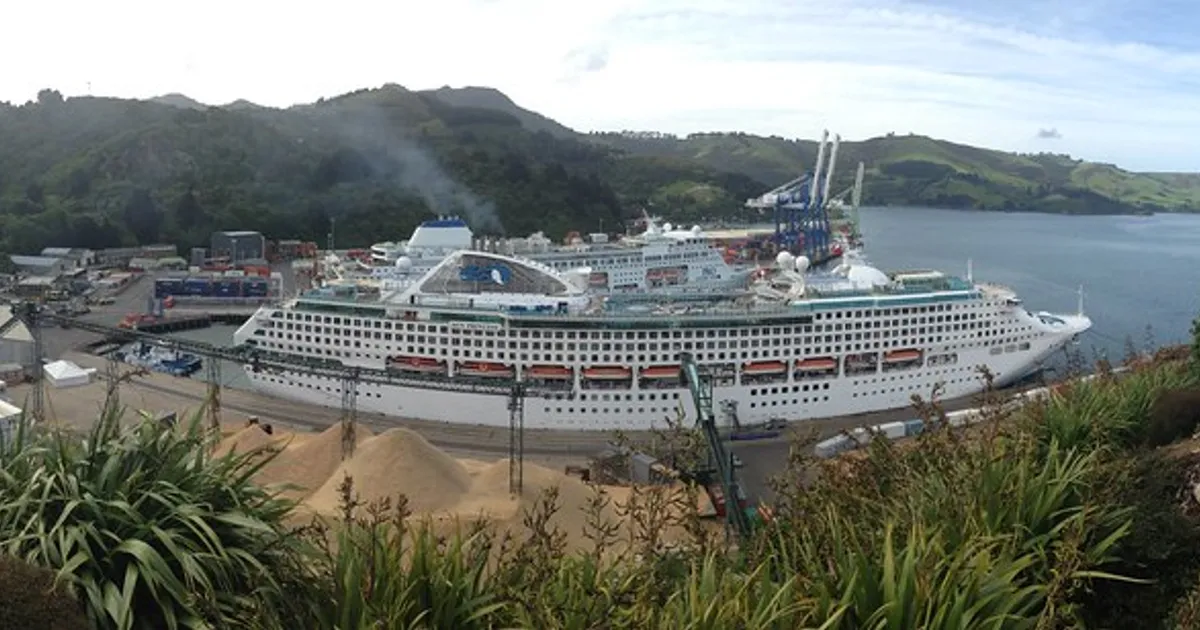
Dunedin is losing vessels. In late 2024, Port Otago projected 85 cruise ship arrivals for each of the next two seasons, down from 118 in 2023-24. That is a near-30 percent contraction over three years.
Port Otago chief executive Kevin Winders was blunt in December 2024: “We’ve seen a reduction as a result of cruising becoming more expensive in New Zealand compared to other regions around the world.” He added that the challenge was to “rebuild the reputation of New Zealand as a cruise-friendly nation.”
In November 2024, CLIA Australasia managing director Joel Katz warned of a 20 percent decline that season and an even larger drop the season after, translating into “hundreds of millions of dollars and thousands of jobs” lost. NZCA chief executive Jacqui Lloyd said cruise lines were telling her New Zealand was now the most expensive region in the world for them to visit. A border levy hike alone added $3.2 million in unbudgeted costs for a single season.
Policy paralysis over Milford Sound compounds the problem. When cruise lines plan deployments two to three years out, uncertainty over whether Milford will remain on itineraries deters them from the entire New Zealand circuit, not just Fiordland.
The environmental critique does not hold up at scale
A sustainable tourism expert argued this week that cruise tourism’s environmental costs outweigh its benefits, noting the sector accounts for approximately 1 percent of total New Zealand tourism expenditure. Professor James Higham pointed to the Fiordland paradox: “Fiordland receives 69 percent of all New Zealand cruise passengers… and 0 percent of spending.”
But that critique applies to Fiordland, not Dunedin. Passengers spend an average of $283 per day on shore excursions, hospitality, and retail. Dunedin City Council data from 2025 showed cruise emissions made up 3.7 percent of total gross city emissions. Real, but not existential, particularly when the council has already conceded it will miss its 2030 net-zero target regardless.
For local hospitality, the stakes are immediate. Mac’s Brew Bar manager Jaz Ngatai said in October 2024: “We really do heavily rely on the cruise ship season just to get us through that summer period.” Craft Bar & Kitchen owner John MacDonald called any drop-off “disappointing” and warned of direct impact on summer trade.
The real threat is not carbon, it is indecision
Dunedin’s cruise debate has been captured by an emissions framing that the government’s own data does not support. The MBIE research already accounts for carbon costs and still finds a net positive of up to $185 million annually. Meanwhile, the actual drivers of decline – border levies, regulatory costs, and Milford Sound uncertainty – sit with central government and remain unresolved.
A city with limited economic levers is watching one of its most reliable revenue streams shrink. The cause is not environmental activism. It is a policy environment that has made New Zealand the most expensive cruise destination on earth, combined with local politics that treats an obvious economic win as a moral dilemma. Dunedin does not have the luxury of both.
Sources
- Cruise tourism brought $1.37 billion into NZ economy last financial year, report finds (2024-11-01)
- Cruising for disaster: High costs have cruise liners bypassing New Zealand (2024-11-01)
- Fewer cruise ships will have impact on city economy: port boss (2024-12-19)
- Cruise ship dip ‘disappointing’ (2024-10-07)
- Environmental cost of cruise ships not worth the economic benefit, expert says (2026-04-29)
- Cruise emissions ‘challenge’ (2025-02-17)