

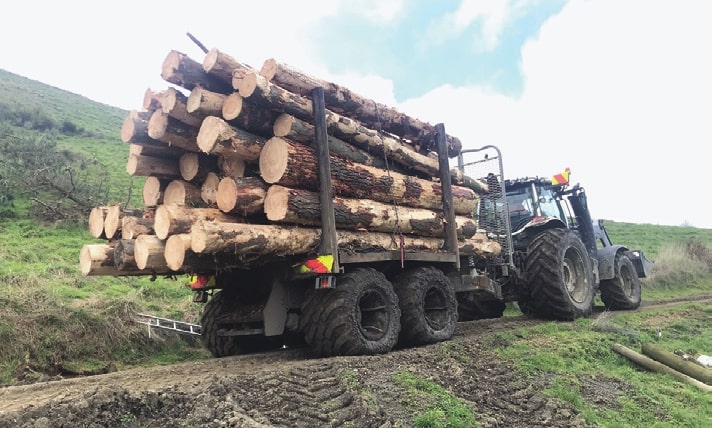
Rising diesel prices are forcing forestry operators across the country to scale back, with some harvests now halted entirely as costs spiral beyond sustainable levels.
In the most severe cases, industry leaders warn forest owners are facing the prospect of no return, or even outright losses, as the expense of running heavy machinery continues to climb.
According to Farm Forestry Association president Dougal Morrison, the latest figures from ports today revealed a 30% drop in log volumes compared to previous months.
He refers directly to diesel costs as the driving force.
“Fuel is used in the harvesting equipment, and you’ve got the transport – the logging trucks on the roads – and the ships exporting the logs as well.”
The strain is already hitting businesses on the ground. Northland-based Tree People has no more felling booked after this month, after clients pulled the plug on harvesting operations.
Director Peter Davies-Colley said the economics no longer stack up. “It doesn’t make sense for them to harvest on the day that high fuel prices mean that their forest isn’t worth anything.”
While his company will shift staff to tree maintenance work, he warned that not all operators will be able to absorb the shock or retain their workforce.
“The major crisis for our industry is when you lose that skillset because you don’t build these teams quickly.”
Morrison echoed those concerns, noting that even trained workers are now being sidelined. He said that even though workers may have completed all the required training and qualifications, they can suddenly find themselves unable to put those skills into practice, making things very difficult for them.
The downturn is especially alarming given the scale of recent private investment. Hundreds of millions of dollars have been poured into upgrading machinery across Aotearoa in recent years to improve safety and efficiency, capital that is now at risk.
Forest Industry Contractors Association chief executive Rowan Struthers said around $300 million has been invested since about 2013, largely by contractors themselves.
“These contractors are family-owned businesses… That might own two to three crews, anywhere from 10 to 30 employees.”
“These are the groups that are most at risk during this fuel crisis because of the level of capital investment that they’ve made.”
Although electrification is often presented as a long-term solution, Struthers made clear it remains in early stages locally, with only limited trials of electric loaders, electric log trucks, and hybrid harvesting machinery underway.
Meanwhile, operators are left exposed to volatile global pressures. Otago logging contractor Steve Jones said work was continuing for now, but uncertainty was mounting as diesel prices surged to $4 a litre.
The fallout is spreading beyond harvesting crews. Forest360 director Marcus Musson warned that sawmills are now being hit as log supply tightens.
“There are a lot of sawmills out there that are having to take shifts out because they simply don’t have the log availability anymore.”
As fuel costs keep rising, it’s hitting hard, putting pressure on key industries and the people who rely on them to make a living. When energy becomes too expensive, the impact quickly spreads.