

The Pentagon moved, Wellington shrugged
A 9 March memo from US Deputy Secretary of Defense Steve Feinberg designated Palantir’s Maven Smart System as a formal programme of record for the entire US military. Not a trial, not a pilot, but the official AI operating system for American warfighting, with stable long-term funding and orders to embed it across every branch. Palantir’s market capitalisation has doubled to nearly US$360 billion in a year. Its US Army contract alone is worth up to US$10 billion.
That same week, New Zealand’s Ministry of Defence deputy secretary Anton Youngman told a select committee that new AI weapon systems “need to be very, very carefully designed to comply with international and domestic laws”. He also acknowledged that “the ability of defence forces to collect and analyse data at speed will increasingly be the key determinant of military advantage”, a statement that reads like a product brief for Palantir’s Maven.
The government says it has no current plans to use Palantir. That is not the point. The point is that New Zealand is spending $14 billion modernising its defence force, holding meetings with the companies that build these systems, and doing it without any public framework for evaluating them.
Thirty-two meetings nobody announced
OIA documents paint a picture of rapid, quiet engagement with Western defence tech firms. The NZDF’s science and technology unit held 32 in-person engagements with the US, UK and Australia focused on intelligence, surveillance, reconnaissance and autonomous systems. None were publicly announced. Many related to a multilateral memorandum of understanding whose contents remain undisclosed.
Separately, the NZDF discussed Anduril’s Lattice AI system, the same platform powering hundreds of autonomous sentry towers on the US-Mexico border. Defence Minister Judith Collins met with Honeywell International to discuss AUKUS Pillar Two, and a briefing note acknowledged that if New Zealand’s defence tech diverges too far from its AUKUS partners, operational cooperation becomes impossible.
Collins told a defence industry event that delivering equipment “needs to be done faster” and flagged giving “selected advanced technology firms access to NZDF test ranges and military use cases.” The Ministry arranged for seven officials to meet with 10 local emerging tech companies and venture capitalists to discuss the Defence Capability Plan. It was the first workshop of its kind.
Treasury does not hold the receipts
A researcher filed an OIA request to Treasury in November 2025 seeking all government contracts and payments to Palantir and 30 other surveillance and defence technology vendors since 2020. Treasury’s response was that it did not hold the information. Not redacted, not withheld. Simply not held.
That means there is no central government register of contracts with the world’s most prominent AI warfare companies. If money has changed hands, the financial record is either dispersed across agencies, held by NZDF under separate authority, or does not exist in any form Treasury can access. Meanwhile, Budget 2025 documents are heavily redacted under security and commercial sensitivity provisions. The government is spending in this space. It will not say on what or with whom.
AUKUS alignment is already happening
Researcher Nicola Macaulay at Massey University’s Centre for Defence and Security Studies has concluded that New Zealand is effectively aligning with AUKUS Pillar Two in all but name, with “far-reaching strategic decisions being made largely out of public view.”
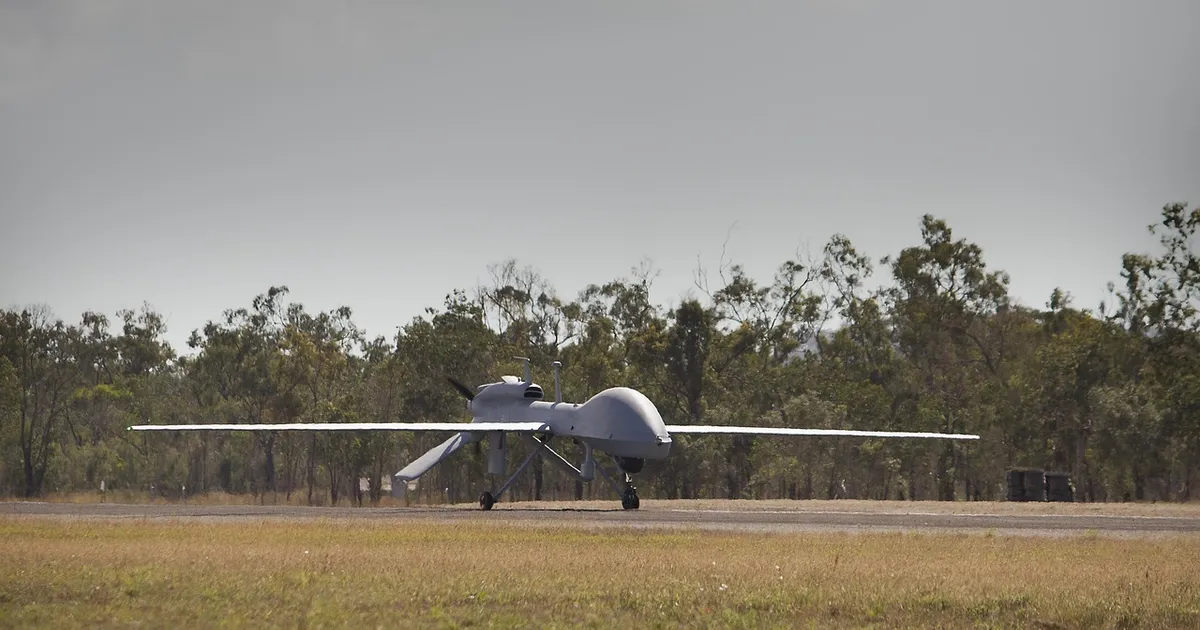
The Defence Capability Plan confirms this. It proposes $100-300 million for long-range uncrewed ISR aircraft and $300-600 million for space-based surveillance capabilities to integrate New Zealand within shared satellite networks. A Persistent Surveillance tender is already inviting industry to design systems involving aircraft, spacecraft and data-management software, concepts that align closely with AUKUS Pillar Two’s multi-domain maritime awareness framework.
The government’s public position is that it is “assessing” Pillar Two membership. The procurement record suggests the assessment has already produced answers that have not been shared publicly.
Local firms are flying blind
For New Zealand’s technology and defence contractors, the $14 billion pipeline is real. Collins has flagged space, autonomous systems and sensors as areas where local firms can compete, with “dual-use applications and, by association, large international markets.”
But opacity cuts both ways. If procurement decisions are shaped by unannounced meetings and OIA-obscured vendor conversations rather than transparent competitive processes, local firms face a structural disadvantage against established US primes. And New Zealand’s AI Strategy released in July 2025 addresses responsible AI governance for the public sector but does not touch defence applications or vendor relationships.
The gap between that document and what is happening in defence procurement is wide enough to drive a Palantir contract through. Capability matters. But drifting into high-stakes technology partnerships without a coherent procurement or sovereignty framework is not strategic agility. It is strategic negligence, and the companies best positioned to exploit it are not based in New Zealand.
Sources
- RNZ: Pentagon to adopt Palantir AI’s core US military system, memo says (2025-03)
- RNZ: AI in warfare being tested in Iran, needs ‘much more’ careful thinking by NZ – Defence (2025-03)
- RNZ: Defence spoke to tech company behind US-Mexico border security towers
- RNZ: Defence Force holds flurry of high-tech meetings with Western power trio
- RNZ: AUKUS Pillar Two – Defence Minister Judith Collins meets with top US military contractor
- FYI: OIA Request for Contracts and Payments to Specific Surveillance and Defense Technology Vendors (2025-11)
- Defence Capability Plan 2025 (2025-04)
- Treasury Report T2024/2990: Budget 2025 Information Release
- The Conversation: Is NZ defence and intelligence policy aligning with AUKUS in all but name?
- RNZ: Is NZ defence and intelligence policy aligning with AUKUS in all but name?
- New Zealand’s AI Strategy: Investing with Confidence (2025-07)