

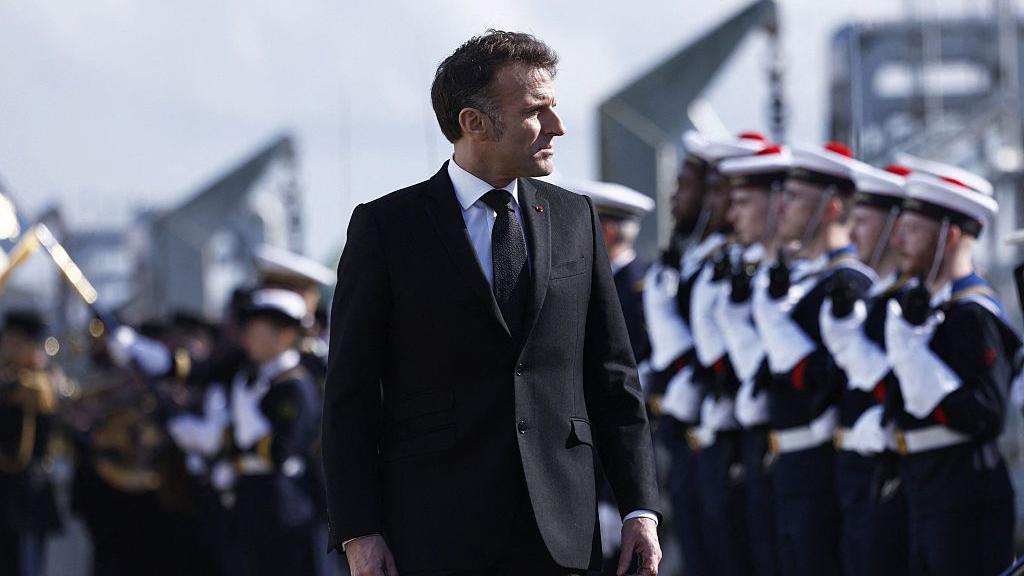
President Emmanuel Macron delivered a seismic shift in French defence policy on Tuesday, announcing plans to expand the nation’s nuclear arsenal and extend its protective umbrella across key European allies amid a darkening global security outlook.
Speaking at the Île Longue submarine base near Brest in Brittany where France’s nuclear-armed vessels are stationed, Macron told naval officers that the coming decades demand a stronger atomic posture.
“The next 50 years will be an era of nuclear weapons,” he declared, vowing to increase warheads beyond the current tally of around 300 while keeping future numbers secret to sharpen deterrence.
By 2036, a cutting-edge submarine named The Invincible will join the fleet, reinforcing France’s triad of sea-, air-, and land-based strikes. The centrepiece, dubbed “advanced deterrence,” invites eight partners—the UK, Germany, Poland, the Netherlands, Belgium, Greece, Sweden, and Denmark—to host French nuclear bombers, participate in force de frappe drills, and collaborate on auxiliary systems like satellite warnings, anti-missile defences, and long-range rockets.
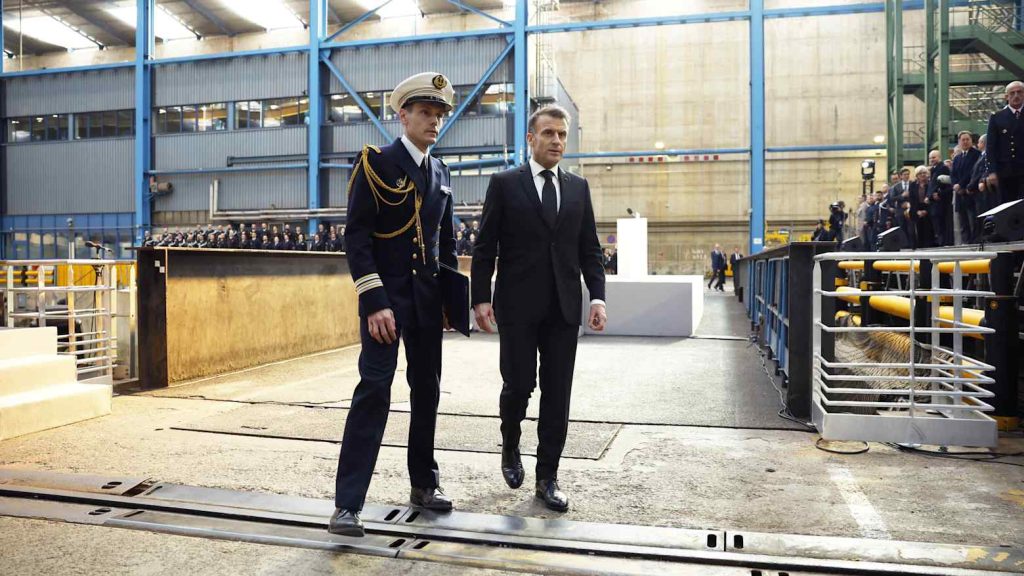
This dispersion of Strategic Air Forces would “spread out across the depth of the European continent, and thus complicate the calculations of our adversaries,” Macron explained.
Echoing Charles de Gaulle’s independent doctrine from 1960—the last major rethink—the strategy offers no formal guarantees, reserving sole launch authority for the French president while underscoring that any assault on “vital interests” (now tacitly European in scope) would exact “an unsustainable price.”
Polish Prime Minister Donald Tusk endorsed it on X, stating, “We are arming up together with our friends so that our enemies will never dare to attack us.”
Building on recent UK training with French forces and a new Franco-German pact signed with Chancellor Friedrich Merz, which pledges joint exercises and conventional arms development this year, Macron stressed complementarity with NATO.
“This cooperation will complement, not replace, NATO’s nuclear deterrent,” they affirmed, even as Berlin voices dilution fears and eastern flanks cheer amid Russian menace.
With U.S. reliability in question post-Trump and Ukraine’s war grinding on, France is staking its claim as Europe’s nuclear linchpin.