


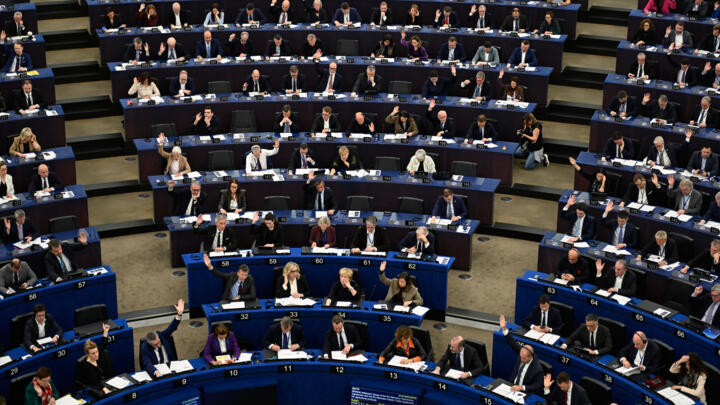
European Parliament members have decided to pause the approval process for a key trade deal with the United States, finalised in July last year, following President Donald Trump’s intensifying efforts to claim Greenland.
This move, set for announcement in Strasbourg today, heightens transatlantic strains after Trump’s weekend tariff threats against several European countries over Denmark’s territory.
Financial markets have grown jittery, with transatlantic equities tumbling on Tuesday—European indices down for a second day, Dow Jones over 1.7 per cent lower, S&P 500 more than 2 per cent off, and Nasdaq about 2.4 per cent down. Asia-Pacific markets opened mixed on Wednesday, gold hitting a record $4,800 per ounce while silver eased from $94 highs.
The Turnberry pact trimmed U.S. tariffs on most EU goods to 15 per cent from 30 per cent, with Europe pledging U.S. investments and export-boosting reforms. Ratification was pending, but Trump’s threats prompted backlash. Manfred Weber said “approval is not possible at this stage.”
Bernd Lange, trade committee chair, called suspension unavoidable. “By threatening the territorial integrity and sovereignty of an EU member state and by using tariffs as a coercive instrument, the U.S. undermines the stability and predictability of EU–US trade relations,” Lange stated.
“There is no alternative but to suspend work on the two Turnberry legislative proposals until the U.S. decides to re-engage on a path of cooperation rather than confrontation, and before any further steps are taken.”
The EU eyes tariffs on €93 billion of U.S. goods from 7 February if unresolved. French President Emmanuel Macron labelled Trump’s tariffs “fundamentally unacceptable” at Davos and backed the “trade bazooka.”
U.S. Treasury Secretary Scott Bessent urged restraint. “I tell everyone, sit back. Take a deep breath. Do not retaliate. The president will be here tomorrow, and he will get his message across,” he said.
U.S.-EU trade hit €1.6 trillion in 2024. Most nations negotiated post-threats, unlike China and Canada. Canadian Prime Minister Mark Carney called for “middle powers” to unite against dominance at Davos. A U.S. Supreme Court ruling looms on Trump tariffs.