

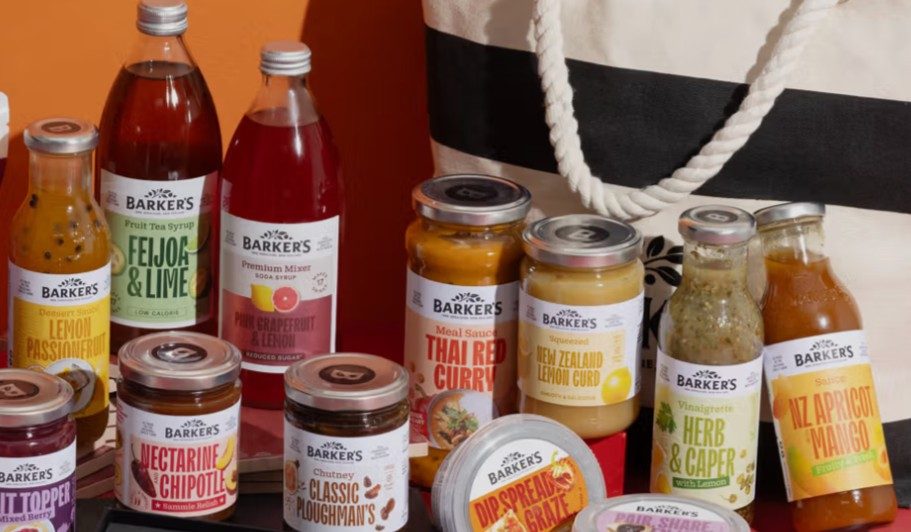
South Canterbury’s iconic fruit company, Barker Fruit Processors, is set to complete its $60 million factory expansion later this year.
The expansion aims to strengthen and future-proof the growing business.
Owned by the Andros Group in France, the company is expanding its Pleasant Valley factory near Geraldine, adding new warehouses and an additional production line for products like its chutneys, jams, and sauces.
As the new construction nears completion, production is anticipated to start there just before Christmas.
“The main point for us is around ensuring that Barker’s is set up and ready for the future in South Canterbury and to provide security to our current staff,” operations manager Bill Pridham said.
“There’ll be a few new job opportunities as well, which is great.”
Pridham stated that the factory manufactures hundreds of different products annually, primarily for the domestic market.
Meanwhile, exports, mainly to Australia, account for roughly 20% of the business.
During the summer peak, the company employed up to 280 staff across the factory, as well as sales and marketing teams based in Auckland.
The company possessed several active resource consents for discharging contaminants onto land and into the air, but the Canterbury Regional Council/Environment Canterbury (ECan) recently investigated it for breaches related to wastewater discharge.
The Department of Conservation (DoC) voiced environmental concerns regarding the factory’s discharge onto a nearby conservation reserve by the Hae Hae Te Moana River.
The company invested $1.4 million in a 14-hectare site adjacent to the factory, according to the Overseas Investment Office.
Pridham explained that the purchase of the additional 14-hectare site next to the factory was aimed at future-proofing the company’s irrigation and wastewater systems.
“Historically, we’ve irrigated onto a block south of the factory, DoC land where historically it was something that had low conservational value. That has recently changed, so we’ve looked for an alternative there.”
“So that’s why we’ve been looking at this other bit of land.”
He said Barker’s plans to use micro-irrigation to align water application with the soil’s capacity to absorb and treat the water, a system designed to support the business’s growth and help future-proof its operations.
“We’re looking at changing our irrigation system there, allowing us to irrigate all year round, where historically we’d irrigate only in the drier months.
“We are working through that consent for the wastewater discharge with ECan and providing them the information they need to give them assurance of our process and how we’re planning to approach it.”
Environment Canterbury’s consents planning manager, Henry Winchester, stated that the new consent application for discharge is currently on hold as they await further information from the applicant.
According to Winchester, Barker’s new application is to discharge factory wastewater onto a site that is partly covered by forestry and partly used as pasture.
“Barker’s isn’t proposing to increase the amount of wastewater generated.”
“We’re following the consent process in the Resource Management Act 1991 (RMA) to ensure that effects are appropriately managed.”