

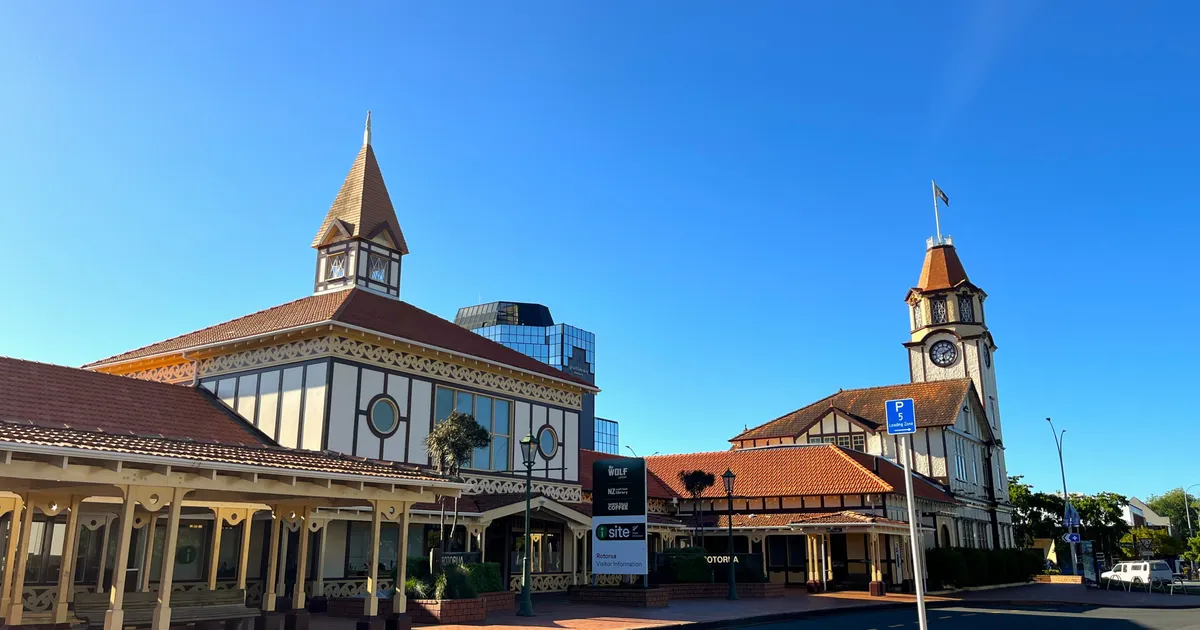
RotoruaNZ’s three isite locations, on Fenton St, at the Redwoods and at the Waipa mountain bike park, lost a combined $438,080 in 2025/26, against a self-set target of “financial self-sufficiency with profit of at least $0”. That happened in a year when isite trading revenue grew 48%. Falling ticket sales swallowed the gain.
The retail growth is real and deserves credit. But the result shows something every ratepayer-funded commercial venture eventually runs into. A busy counter does not make a business sustainable.
Two good years, then a reversal
This is not a story of chronic failure, and it shouldn’t be written as one. The isite lost $827,153 in Covid-hit 2021/22 and $189,880 the year after, then posted surpluses of $177,654 in 2023/24 and a wafer-thin $3,531 in 2024/25. That last figure, confirmed in the audited 2025 accounts signed off in October 2025, shows how close to the line the operation already was.
A $3,531 surplus is not proof of structural sustainability. It is proof that conditions happened to line up. When ticket revenue softened, the margin vanished and then some.
The warning signs were there mid-year. An April 2026 CCO report to council showed an interim loss of about $298,889, described as “on track” because summer usually rescues the numbers. The final result came in roughly $140,000 worse. The summer catch-up didn’t arrive.
Management has a plan
Chief executive Andrew Wilson frames the loss as the cost of “investment to grow revenue and diversify income streams”, with the longer-term aim “to reduce reliance on ratepayer funding for RotoruaNZ as a whole”, according to the Herald’s reporting. That same report notes the isite received more than $50,000 in central government-backed funding for a store refurbishment and digital upgrades.
RotoruaNZ has reviewed the operation, is cutting costs, including closing the satellite isite at the independently run 3Mirage attraction, and says it is “on track to return isite operations to a cost-neutral position” by 30 June 2027. Closing an underperforming outlet is the right call. The question is why it took a $438,000 hole to make it.
A council that shrugs
The council’s response is weaker. Destination development manager Jean-Paul Gaston said the council was “not concerned”, because the loss was absorbed within RotoruaNZ’s overall $14,658 surplus, and called break-even a “stretched target” that RotoruaNZ set for itself.
That is a soft standard for a body receiving around $9.33 million a year from ratepayers. Its own Statement of Intent commits it to “progressively reduce reliance on ratepayer funding through improved commercial performance”. A self-imposed target is still a target. If it doesn’t matter when missed, it was never really a target at all. Rotorua businesses paying commercial rates would not get the same latitude from their bank.
Fewer isites, busier counters
Nationally, the picture is consolidation rather than collapse. Isite numbers have fallen from 74 in 2019 to 44, with seven regional tourism organisations exiting entirely, citing changing visitor behaviour, high operating costs and withdrawn council contracts. Yet the surviving network recorded 2.64 million visitors and $34.9 million in sales in 2025/26, both up on the year before. The lesson for Rotorua is that the model works at the right size. Excess sites and satellite counters are where the money leaks.
The bigger bill is in Wellington
There is a fair structural argument underneath all this. Writing in October, Wilson, also chair of Regional Tourism New Zealand, argued visitors drive demand for local services without adding rating units, while GST on tourism spending hit $4.4 billion in the year to March 2025. The problem, he wrote, is “not a shortage of tourism revenue, but how it is shared.”
BERL economist Connor McIndoe backs that up, citing Sapere estimates that central government collected about $10.5 billion in tourism-associated revenue against roughly $1.4 billion spent attracting and supporting tourism. “The costs of supporting visitors partly fall locally while the revenue flows centrally,” he writes.
That mismatch is real, and the case for a fairer split deserves a hearing. But it is an argument about roads, toilets and conservation land, not about whether a visitor shop can cover its own costs. Retail counters should stand on their own.
The next twelve months will tell. RotoruaNZ has promised cost-neutral isites by June 2027, with a closed outlet and a refurbished flagship to help. If it delivers, 2025/26 was a blip. If it doesn’t, ratepayers are entitled to ask whether the shop is worth keeping open.
Sources
- Rotorua Daily Post: Rotorua isite operations lose over $400k despite retail growth (2026-11-27)
- NZ Herald: Rotorua isite operations lose over $400k despite retail growth (2026-11-27)
- Rotorua Lakes Council: Proposed alcohol fees bylaw, i-SITE operations (2026-11-20)
- RotoruaNZ: Annual Report 2026 (2026)
- RotoruaNZ: Financial statements and independent auditor’s report for the year ended 30 June 2025 (2025-10-16)
- RotoruaNZ: Statement of Intent 2026-2027 (2026)
- NZ Herald: A rates cap won’t solve how New Zealand pays for its visitor economy – Andrew Wilson (2026-10-15)
- BERL: Who should pay for New Zealand’s tourism growth? (2026-11-13)
Join the discussion
Add useful context, ask a good question, or challenge an idea — keep it specific and respectful.