

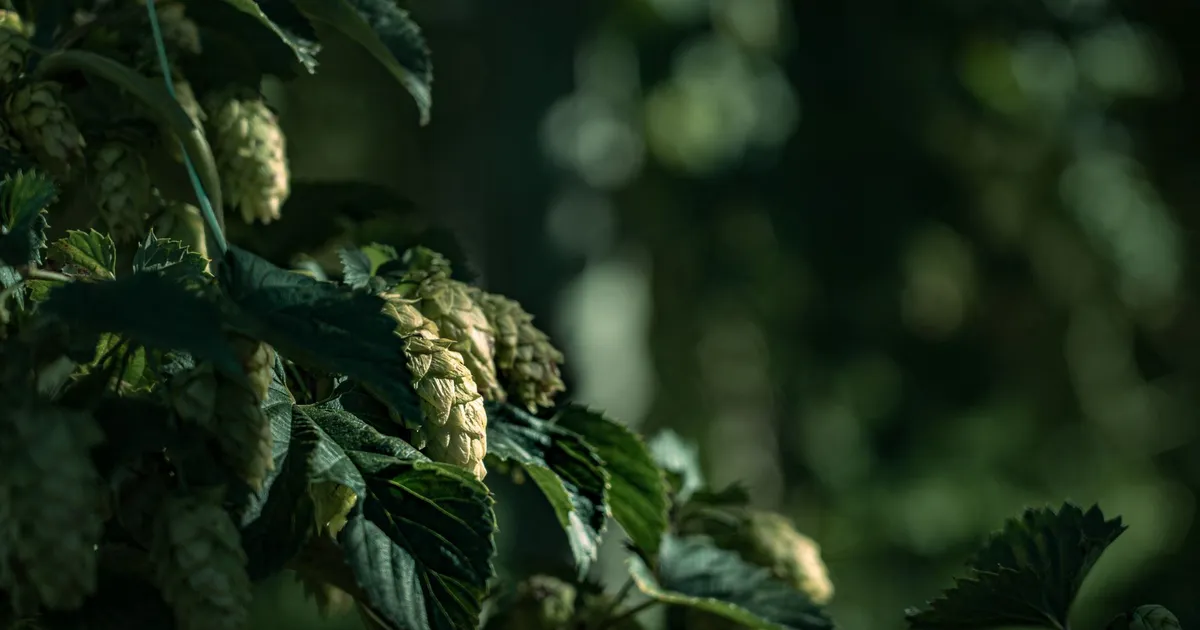
The Otago Daily Times asked this week whether New Zealand’s sought-after hops need protecting. The answer is yes, and the commercial case is sharper than the question suggests. A crop this small survives only on distinctiveness, and distinctiveness that can’t be proven is just a marketing claim anyone can borrow.
A tiny crop with outsized pull
In 2021, Plant & Food Research put annual production at around 1,500 tonnes, roughly 1% of global volume, earning almost $40 million from more than 20 countries. A 2024 Venture Taranaki industry paper found production had grown 130% since 2017 to about 2,300-2,500 tonnes in 2023. Even after that growth, Otago University doctoral research in 2025 still placed New Zealand at just 1-2% of world supply.
That was always the strategy. Nobody expected New Zealand to out-grow Germany or the Pacific Northwest. Back in 2015, the NZ Herald profiled Plant & Food scientist Ron Beatson, who spent his career breeding unique chemistry profiles into local varieties, and reported a government-backed goal of $200 million a year in hop and craft beer exports by 2030.
Nectaron is the flagship of that approach. It took 17 years to bring from first cross to market, and at its 2020 release then-NZ Hops chief executive Craig Orr called it “an absolute candidate to take over from” American heavyweights Citra and Mosaic. That is two decades of patient, private and public R&D packed into one product.
Genetics are guarded, origin is not
The main legal shield is plant variety rights, which in 2020 were described as working “like a patent”, giving NZ Hops exclusive trading rights over a variety’s genetics. That protects the breeding IP. It does nothing to verify where a hop was actually grown, and nothing to stop a competitor marketing its own product as having a “New Zealand character”.
The statutory backdrop is thin by design. The Hop Industry Restructuring Act 2003 turned the old Hop Marketing Board into a co-operative company and removed most regulatory controls. That was sensible deregulation for a small industry. But it left hops without any origin-protection regime comparable to what wine regions or Zespri’s branded kiwifruit rely on.
The science is already on the shelf
Here is the encouraging part. The tools to prove provenance largely exist. The 2025 Otago research found oxygen isotope ratios reliably separated Tasman-grown hops from Central Otago crops, while hyperspectral near-infrared imaging hit up to 95.83% accuracy classifying some cultivars to the individual farm. A 2025 peer-reviewed study in Food and Bioprocess Technology found genetics dominated the results but detected a measurable location effect, clearest in Suderdelic and weakest in Nelson Sauvin.
Neither study claims the job is done. Both say multiple harvest years of validation are needed, and the dissertation recommends building a representative reference database of samples before origin fraud detection becomes practical. That is a modest, well-defined piece of work, not a moonshot.
Squeezed from both directions
The timing makes this more than academic. In April 2026, the NZ Herald reported that rising US tariffs, higher production costs and shipping disruption were pushing growers to diversify. That is a big deal when, as of 2022, 85.7% of exports went to the US.
Prices were already under pressure. In 2025, Dean Palmer of Hinetai Hops told RNZ the market was “currently in a bit of a down” amid a worldwide glut, arguing New Zealand’s edge lay in registered, trademarked varieties such as Nelson Sauvin, Moutere and Nectaron, plus organic and spray-free credentials rivals struggle to copy.
He was right, and the logic cuts deeper now. Diversifying into Europe and Asia means selling to brewers with no long relationship to lean on. In an oversupplied market, the only reason to pay more for a New Zealand hop is that it genuinely is one. If origin can’t be demonstrated, the premium erodes to commodity pricing.
Treat it like the export asset it is
None of this needs a new subsidy or a new bureaucracy. It needs the industry to finish commercialising science that taxpayers and universities have already funded: a reference database, an origin certification mark backed by isotope or spectral testing, and eventually a registration framework of the kind wine already enjoys. That is property rights enforcement, not industry policy, and a co-operative structure is well placed to fund it through growers who stand to benefit.
New Zealand has spent 20 years building one of its rare genuinely premium niche exports. Protecting the genetics was the first half of the job. With the US harder to crack and the global market awash with hops, proving where they come from is the half that will decide whether growers keep the margin or watch imitators drink it.
Sources
- Otago Daily Times: Time for sought after hops to be protected? (2026-11-10)
- Plant & Food Research: NZ hops capturing the world’s attention (2021-01-29)
- Venture Taranaki: Hops – Scale up opportunities (2024-03)
- University of Otago: Investigating geographical traceability methods and the effect of growing origin on New Zealand hops (2025-07-31)
- NZ Herald: Scientist takes hops from cottage industry to world brewing stage (2015-04-29)
- Pursuit of Hoppiness: Nectaron, 17 years in the making (2020-08-27)
- Food and Bioprocess Technology: Near-infrared spectroscopy combined with multivariate analysis for the geographical origin traceability of New Zealand hops (2025-02-12)
- NZ Herald: NZ hop farmers diversify as US tariffs make market harder to crack (2026-04-23)
- RNZ: NZ Hops chalks up EU export ‘win’ amid glut (2025-03-28)
Join the discussion
Add useful context, ask a good question, or challenge an idea — keep it specific and respectful.