

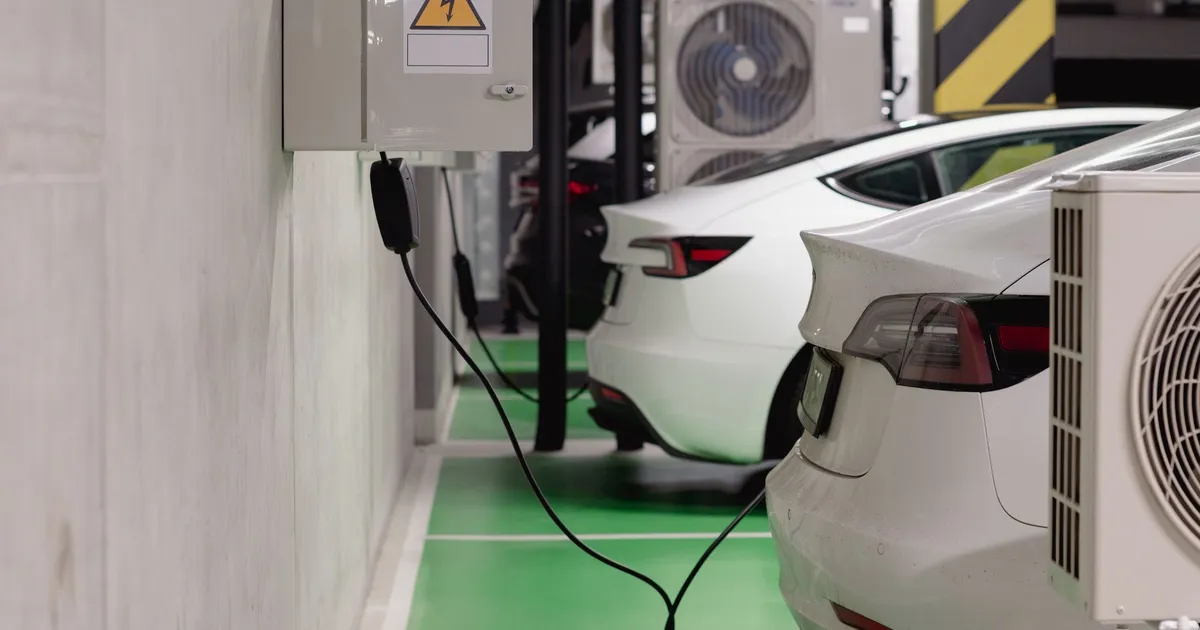
Arrowtown has quietly done something most councils and businesses are still debating. The town’s community centre now has a vehicle-to-grid charger that lets EV batteries back up a designated civil defence emergency hub. If the lines go down, the car in the car park becomes the generator.
The installation is run by the Queenstown Electrification Accelerator (QEA), whose co-lead Josh Ellison demonstrated the charger to Arrowtown Community Resilience Group members Trent Yeo and Zoe Pierce. It is a small piece of kit. The idea behind it is not.
One power line and a fault overdue
The resilience case in the Wakatipu is blunt. Ellison told Newsroom that Queenstown relies on a single power line, and that there is a 75% chance of a magnitude 8 Alpine Fault earthquake in the next 50 years. In that context, a bidirectional charger at an emergency hub is not a sustainability gesture. It is disaster planning using batteries the community has already paid for.
That is the part business owners should notice. Diesel generators cost money, need fuel, sit idle for years and fail when least convenient. Stationary battery banks cost more again. An EV that does a day’s work and then doubles as backup power is a capital asset earning twice.
From one town to a national pilot
Arrowtown sits inside a wider QEA trial, which the QEA describes as a test of whether household and community EVs can support both homes and the local network. The scale is still modest. The NZ Herald reports the pilot started with roughly half a dozen homes, expanding to around 30 more by early 2027, backed by $900,000 from EECA for chargers and installation.
It is no longer alone. The same Herald report details a parallel OpenLoop trial funded at $2.1 million by EECA, plus a separate Genesis-run trial, meaning at least three V2G pilots are now running. RNZ reports EECA plans to install up to 100 two-way chargers in homes and businesses across Auckland and other urban centres, building directly on the Queenstown work.
The number that should interest the boardroom
Household bill savings get the headlines, but the bigger prize is infrastructure that never needs to be built. EECA analysis cited by Newsroom found around two gigawatts of peak demand could be shifted by 2040, saving Transpower up to $3 billion in deferred spending. That is modelling, not a result. But it reframes V2G as a grid-investment avoidance tool, and every business paying lines charges has an interest in that.
It is also a rare example of private capital solving a public problem. The batteries are bought by households and firms, not the taxpayer. The coordination comes through pricing: EECA’s market insights work notes retailers and lines companies have trialled premium export payments where local networks are most constrained. Pay people to help at peak and they will.
Fleets are where this gets real
The fastest movers will not be households. They will be operators with vehicles that sit predictably idle: council pool cars, trades vans overnight, logistics depots. The AA Research Foundation has modelled heavy vehicles providing grid services as worth considerably more per vehicle than cars, and EECA has reportedly considered a small trial of two-way charging for electric trucks.
The fleet base is also growing fast. Back in 2022, EVs were just 1.0% of the vehicle fleet, with 20,896 new registrations that year, double 2021. Much of today’s much larger fleet is technically capable of discharging power, it simply is not allowed to.
The warranty wall
That is the honest catch. The QEA trial only worked after securing warranty exemptions from dealers and BYD, as Newsroom reported in July, so drivers could discharge without voiding cover. Most carmakers have not followed. Until they do, a business buying an EV fleet cannot assume the V2G option is real, however capable the hardware.
Nor is this a plug-and-play solution yet. National installations remain a rounding error against the modelling, and the trials depend on EECA subsidy. Anyone selling V2G as a turnkey resilience product today is ahead of the evidence.
What to do before the Auckland rollout lands
The practical move for decision-makers is to stop treating EV procurement and resilience planning as separate conversations. When buying vehicles, ask whether bidirectional discharge is enabled under warranty. When budgeting for chargers, price the two-way option. When drafting business continuity plans, count the fleet as stored energy.
Arrowtown has shown the concept works where it matters most, keeping an emergency hub running when the power fails. The Auckland rollout of up to 100 chargers is the next proof point. If carmakers open up warranties alongside it, thousands of New Zealand car parks become backup power stations that nobody had to build.
Sources
- ODT: Arrowtown’s emergency power play (2026-11-07)
- Newsroom: How two-way charging between your garage and the grid will slash power bills (2026-07-17)
- NZ Herald: Powering your home with your electric vehicle, trio of trials underway (2026-10-23)
- RNZ: EVs being trialled as giant batteries to power homes for less in Auckland (2026-09-29)
- QEA: Vehicle to grid trial
- EECA: Vehicle-to-grid market insights report
- AA Research Foundation: Powerful potential, V2G potential for New Zealand
Join the discussion
Add useful context, ask a good question, or challenge an idea — keep it specific and respectful.