

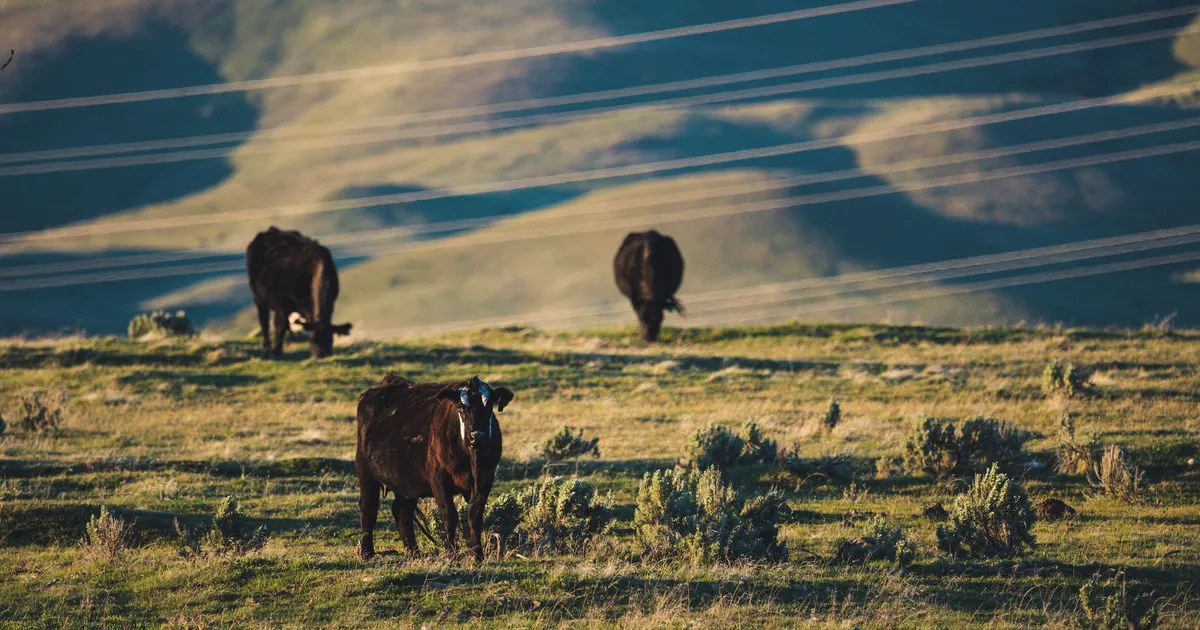
Lyndon McNab no longer runs out hot wire to move cattle. On Lochindorb Run, the 2,500-hectare sheep and beef property he farms with Jade McNab in South Otago, he back-fences with a swipe on his phone. The Otago Daily Times reports he is already seeing less wastage.
This is not a moonshot. It is a practical tool solving an old hill country problem: pasture lost to pugging, labour lost to fencing, and stock that are hard to control on country where building a fence costs more than the grass behind it is worth.
Mud is a cost line
Calving is where the gains show first. “The recovery of those blocks and the initial mess we make through the calving period has been massively reduced,” McNab says. On wet days he moves cattle to higher ground to spare the lower paddocks, and calving alerts flag problems early.
His choice of system came down to infrastructure. McNab credits Halter’s satellite connectivity as decisive, because putting physical towers across the hills for competing systems would have been costly. That matters for anyone weighing agtech. The cheapest option on paper is not the cheapest one to install on your actual land.
Steep country makes the maths easy
The economics are strongest exactly where McNab farms. A 2023 peer-reviewed study in the Journal of New Zealand Grasslands modelled fencing cattle out of waterways on a 1,491-hectare steep hill farm. Virtual fencing cost $129,600 in capital against $1,342,437 for conventional fencing, or $23,328 a year annualised versus $125,294.
The profit hit tells the story. Compared with no waterway fencing, virtual fencing cut annual profitability by 17% on the steep farm. Conventional fencing cut it by 93%. The authors called their figures preliminary and assumed an eight-year life for virtual systems against 30 years for wire. Even with those caveats, on genuinely steep country, conventional fencing is close to economically impossible. Virtual fencing is not.
The vendor pitch has been bolder. In 2023, Halter released modelling projecting a $348 per hectare gross margin improvement on extensive hill country, with collars then priced at $96 each per year. Those were commissioned numbers, not audited results. Also in 2023, the ODT reported that sheep and beef farmers should expect returns to take 18 months to two years, arriving through better pasture and lamb weaning rather than overnight.
Nine farms, real baselines
That gap between pitch and proof is what makes the current phase interesting. Lochindorb is one of nine farms in the Livestock Innovation Farming Transformation (LIFT) programme, a five-year, $8.5 million initiative led by Pāmu and launched in June 2026. MPI is contributing $3.5 million through the Primary Sector Growth Fund, with partners funding the rest.
Each farm is building production, financial and environmental baselines with independent consultants using FARMAX and Overseer. That is the right way to spend modest public money: not subsidising collars, but measuring what they actually deliver so farmers can make their own calls.
Pāmu chief executive Mark Leslie is refreshingly unhyped. “Virtual fencing creates new opportunities to improve profitability and environmental performance, but the technology on its own is not the answer,” he says. At Lochindorb, the McNabs are testing whether tighter grazing control can lift pasture quality in hard-to-reach blocks while protecting sensitive areas.
Water first, collars second
The industry is also being honest about prerequisites. At a Beef + Lamb New Zealand workshop in Ohakune, around 70 farmers heard that buying the technology and integrating it are two very different things. “People are excited about the technology, but it’s important to make sure the basics are sorted first,” says Lisa Chase, B+LNZ extension manager for Tūwharetoa/Whanganui.
Water came up as the biggest gap. If stock cannot reach reliable water wherever the virtual boundary sends them, the system cannot work. Early adopter James Parsons offered a readiness score across six areas: water, capital, skills, systems, stock and measurement. Independent consultancies such as Perrin Ag have made the same broad point, that returns vary widely and only become clear once a system is fully bedded in.
Proof, not promises
For rural lenders, contractors and suppliers, the signal is clear. Virtual fencing is moving from novelty to farm system tool, and the spending will follow into water reticulation, connectivity and advisory work as much as collars.
The LIFT results will matter more than any brochure. If nine commercial farms with independent baselines show the gains McNab is reporting, hill country farmers will have something rare in agtech: evidence before the sales pitch. That is how good technology should earn its place.
Sources
- Otago Daily Times: Virtual fencing reducing wastage on Catlins farm (2026-11-05)
- Farmers Weekly: Virtual fencing delivers early wins on tough Otago hill country (2026-10-26)
- Pāmu: LIFT Programme names nine farms taking virtual fencing from planning to practice (2026-10-14)
- Beef + Lamb New Zealand: Laying the foundations for virtual fencing (2026-10-13)
- Otago Daily Times: The appeal of fenceless farming (2023-12-19)
- Halter: Halter enters beef farm market, virtual fencing to boost efficiency and production (2023-12-05)
- Journal of New Zealand Grasslands: Developing a multiagent framework to explore the implications of fencing waterways using virtual fencing on New Zealand hill country farms (2023-11-10)
- Perrin Ag: Weighing up the true value of technology on farm
Join the discussion
Add useful context, ask a good question, or challenge an idea — keep it specific and respectful.