

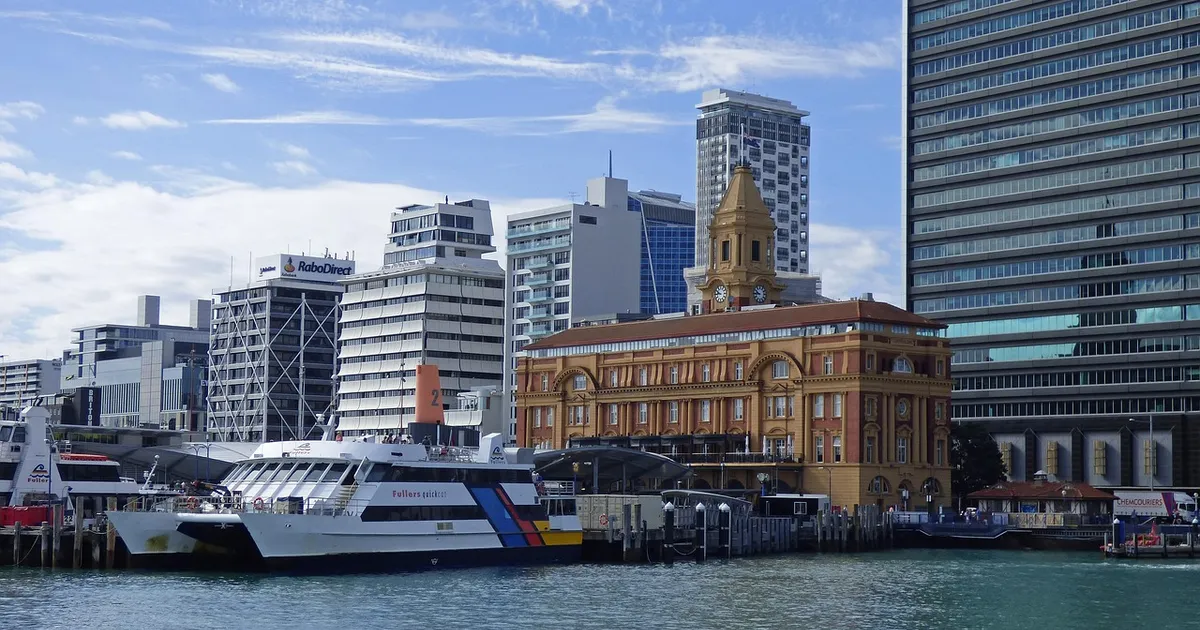
Auckland Transport’s first plug-in hybrid ferry, the $20 million, 300-passenger Waitematā 1, has been tracing slow, empty circles in the inner harbour at night. The reason is simple and embarrassing. Its diesel generators, meant to be a backup, are running at maximum to charge its batteries because there is nowhere else to charge them.
Birkenhead resident Brad Watson’s Facebook post calling it out drew 252 comments from locals fed up with the noise and fumes. They are right to be annoyed. Ratepayers are too, or should be.
The plug is three years late
The vessel entered service on the Devonport-CBD run in June, owned by AT and operated by Fullers. The $27.6 million downtown charging station it relies on was originally due by the end of 2024. It is still in early-stage construction, with completion now slated for mid-2027.
AT programme director Nathan Cammock partly attributes the delay to the need for resilience on AT’s busiest ferry route. The Herald also reports that councillor Mike Lee’s campaign against the charging building as an “eyesore” contributed. Either way, the timeline has slipped repeatedly, from end of 2024 to “later 2026” in May and now to mid-2027.
The second planned charging site, at Hobsonville Point, looks worse. In 2025, AT’s Stacey van der Putten told councillors installation may not happen until 2028.
The fully electric ferry has gone quiet
The hybrid at least carries passengers. The fully electric ferry, a 200-seater built by East Tamaki’s McMullen & Wing to an EV Maritime design, had its technical launch in June 2025. At the time, EV Maritime’s Michael Eaglen expected commercial operation about six months after handover. By July this year it had been on the water a full year without carrying a paying passenger, with no confirmed start date.
That is a finished, paid-for capital asset producing nothing.
Three fleets, none finished
The original ambition, set in 2022, was seven electric or hybrid vessels as a first wave toward replacing the entire 27-strong diesel fleet by 2030. As central and local funding tightened, that stalled at two hybrids and two electric boats.
In July, AT confirmed it was buying eight new diesel ferries as a stopgap. Mayor Wayne Brown framed it bluntly: $8 million per diesel versus $20 million per electric or hybrid, plus $27.6 million for chargers. On a pure capex view, eight diesels for roughly $64 million looks prudent.
The problem is that AT now runs three parallel procurement tracks, hybrid, fully electric and new diesel, each only partly delivered. That doesn’t spread risk. It multiplies it.
Cheap upfront, dear over 25 years
The running-cost numbers for electric are not in dispute. Fullers360 testing found energy costs around 70-75% lower than diesel when the hybrid runs electrically. Swapping one diesel ferry for a hybrid on the Devonport route could cut diesel use by 790,000 litres a year. Fullers Group chief executive Mike Horne argues whole-of-life costs favour electric.
The 2025 breakdown explains why. Diesel engines need replacing every five to seven years across a 25-30 year hull life and have roughly 6,000 moving parts. An electric vessel faces essentially one big bill, an estimated $1 million battery replacement after eight to ten years.
In 2025, BusinessDesk columnist Peter Griffin noted AT’s ferries burned 13 million litres of diesel a year, producing 20% of Auckland’s public transport emissions while carrying 6% of passengers. He warned AT risked buying ferries “that will need to be retrofitted as EVs in the mid-2030s”. Eaglen put it more sharply that year: “you wind up building bad diesel boats, which later become bad electric boats.”
The technology isn’t the bottleneck
EV Maritime has since landed a big contract in Perth. Local boatbuilders can deliver. The failure sits in sequencing and funding certainty, which is why Griffin argued for pooled procurement across New Zealand and Australia to give suppliers a pipeline.
Councillor Richard Hills blames Wellington, saying the Government has “completely deprioritised the ferry electrification programme”. Funding shifts didn’t help. But no funding decision forced AT to commission a $20 million plug-in vessel before securing the plug. That was a local call.
The lesson for any capex committee
Strip out the climate politics and this is a textbook capital discipline failure. A headline asset was committed before the dependent infrastructure, consenting and funding chain were locked down, and a single aesthetic objection was enough to strand it. Any private board approving a new production line without the power supply confirmed would face hard questions. AT should too.
The next test arrives in mid-2027. If the Queens Wharf chargers land on time, Waitematā 1 finally starts earning its whole-of-life case. If they slip again, Auckland will have three half-built fleets and a diesel bill it chose twice.
Sources
- NZ Herald: Revealed: Why Auckland’s first hybrid electric ferry is tracing slow circles at night, making a racket – Tech Insider (2026-10-28)
- NZ Herald: Auckland’s first hybrid electric ferry to launch on Devonport route next month (2026-05-27)
- NZ Herald: Fullers boss on electric ferries’ financial appeal as AT re-embraces diesel (2025-08-03)
- NZ Herald: Auckland’s first electric ferry is on the water, but chargers behind schedule (2025-06-11)
- NZ Herald: Re-embracing fossil fuel, AT getting 8 new diesels; EV Maritime lands big Perth contract (2026-07-06)
- BusinessDesk: NZ’s tech-lite approach to public transport is failing (2025-07-22)
Join the discussion
Add useful context, ask a good question, or challenge an idea — keep it specific and respectful.