

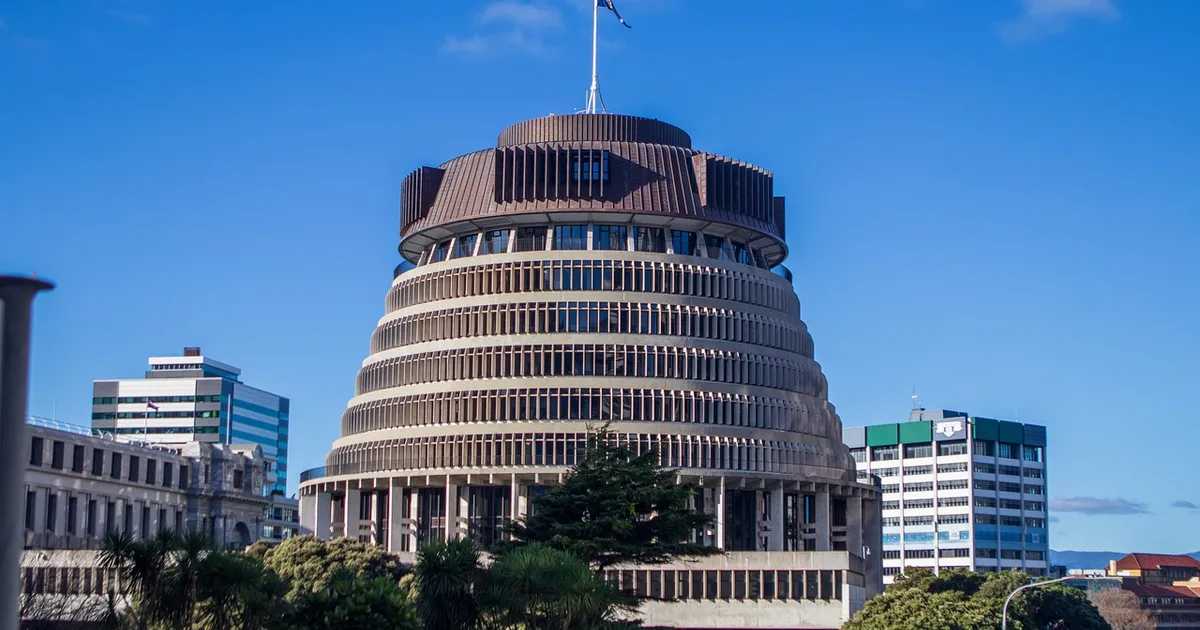
Chris Hipkins has drawn a firm line around the Beehive’s most powerful office. Speaking at the Mike Hosking Leaders Breakfast, the Labour leader said Finance is off the table for coalition partners. He said Police and Justice would not go to Green or Te Pāti Māori MPs either, and that Cabinet would not grow beyond 20 ministers to make room for smaller parties.
It is a tidy answer to National’s attack ads. It is not an answer to the question business should be asking. The risk was never mainly about whose name goes on the Finance Minister’s door. It is about what gets traded across the table to form a government, and on that, Hipkins has promised nothing.
The title fight was always a decoy
The Finance portfolio has dominated the campaign for weeks. Earlier this month Hipkins called it “non-negotiable” that Finance would stay with Labour and go to Barbara Edmonds, after National ran ads suggesting Chlöe Swarbrick would get the job. He has rejected the Swarbrick scenario more than once.
Swarbrick, to her credit, has been honest about why she wants it. In September she told Newsroom she wants “control of the envelope” for Green priorities, including a tax package designed to raise $32 billion over four years, mostly through a wealth tax on individual assets above $10 million and an inheritance tax.
But the envelope is not held by one minister. It is set in the coalition agreement. A junior partner that wins a broader tax base or a bigger spending allowance in writing does not need the Finance title to shape the Budget. Newsroom’s Marc Daalder has been asking exactly this, whether the Greens on the left and Act on the right can dictate fiscal terms to the major parties regardless of who holds the portfolio.
The gap exists before anyone negotiates
The more important point gets less airtime. Labour and National are already far apart on the size of the state. National wants core Crown spending and revenue capped at 30% of GDP. Edmonds has set Labour’s allowance at 33% of GDP once its capital gains tax is fully phased in, roughly 10% more in both spending and revenue. Nicola Willis called it “spending more, borrowing more and taxing more.”
That three-point gap is the starting position, before a single minor-party demand is added.
The books do not leave much room. Treasury’s year-end accounts show core Crown tax revenue of $125.9 billion, or 27.6% of GDP, against expenses of $146.3 billion. The operating deficit sits at $8.7 billion, or 1.9% of GDP, and net core Crown debt is $186.8 billion, 40.9% of GDP. The pre-election update is the baseline every party is negotiating against.
Budget 2026 was built on restraint. The Fiscal Strategy Report said the Government “does not intend to seek major additional sources of revenue” and ran an operating allowance of just $2.4 billion. Any coalition wanting more spending with a deficit that size has two levers, new taxes or more borrowing. Neither requires holding the Finance portfolio to demand.
Where minor parties have real leverage
The tax lawyers are fairly relaxed about most of the Greens’ and Te Pāti Māori’s wish lists. Simpson Grierson’s tax team has argued that a diminished major party still sets the agenda, and that few minor-party tax policies have a realistic path into law under a Labour-led government.
The exception they flag should worry owner-operators. Smaller left-bloc parties may have enough leverage to push a broader capital gains tax than Labour has proposed, extending beyond property to capture gains on the sale of businesses. For a founder planning an exit in the next five years, that is a much bigger deal than whether Swarbrick or Edmonds signs the Budget.
That makes the wealth tax a sideshow too. It is the headline policy, with strong public support in Ipsos polling, but Labour has resisted it. A wider CGT base is a smaller ask, easier to concede, and easier to dress up as a technical tweak.
Uncertainty is a cost on its own
There is also a cost that no coalition agreement will itemise. As Waatea News put it, investors do not need the lowest taxes, but “what they value enormously is certainty”. Businesses make capital decisions over years. A drawn-out negotiation over the CGT base, the spending ceiling and borrowing limits freezes those decisions while it runs.
Hipkins has cleared up who will be in the room. He has not said what Labour will refuse to give away inside it. If he wants business to take the ring-fence seriously, the next step is obvious. Rule out a CGT on business sales, name a spending ceiling and commit to a debt track. Until then, owners should plan for the coalition bill, not the Cabinet seating chart.
Sources
- Newstalk ZB: Chris Hipkins: Finance portfolio off the table for coalition partners (2026-10-27)
- Newsroom: What happens if Labour bars Swarbrick and extra taxes in coalition talks (2026-10-26)
- NZ Herald: Green Party insists on pushing for wealth tax after high poll as Labour, National feud over costings (2026-10-06)
- Stuff: No, Swarbrick wouldn’t be finance minister, Hipkins says
- Newsroom: Chlöe Swarbrick: Why wouldn’t I want to be finance minister? (2026-09-18)
- Newsroom: National and Labour put up small targets, leaving big vacuum (2026-08-24)
- Treasury: Pre-election Economic and Fiscal Update 2026 (2026-09-29)
- Treasury: Fiscal Strategy Report – Budget 2026 (2026-05-28)
- Simpson Grierson: Which election tax policies could survive coalition negotiations?
- Waatea News: Analysis: Could Labour, the Greens and Te Pāti Māori actually make their tax policies work together? (2026-08-30)
Join the discussion
Add useful context, ask a good question, or challenge an idea — keep it specific and respectful.