

A weather event with a supply chain price tag
Typhoon Bavi made landfall in the coastal city of Taizhou in eastern China’s Zhejiang province late on Saturday, with a second landfall near Wenzhou around midnight. Maximum sustained winds hit 144km/h, equivalent to a Category 1 hurricane, and the storm spanned 1,000km at its widest point, roughly the width of France.
Chinese authorities evacuated more than 1.7 million people across Zhejiang, with tens of thousands more moved from Fujian, Shanghai and Beijing, and Beijing released ¥40 million yuan (NZ$10.2 million) in central disaster relief. For New Zealand businesses, the headline number is not the evacuations. It is which ports went dark.
The ports that went quiet
Air freight seized up first. 920 international flights were cancelled across the region, with China Eastern and Shanghai Airlines pulling 188 flights serving Shanghai, Zhejiang, Fujian and Jiangxi. Shanghai raised its typhoon warning to yellow, cancelled all ferry services and slapped a 60km/h limit on highways.
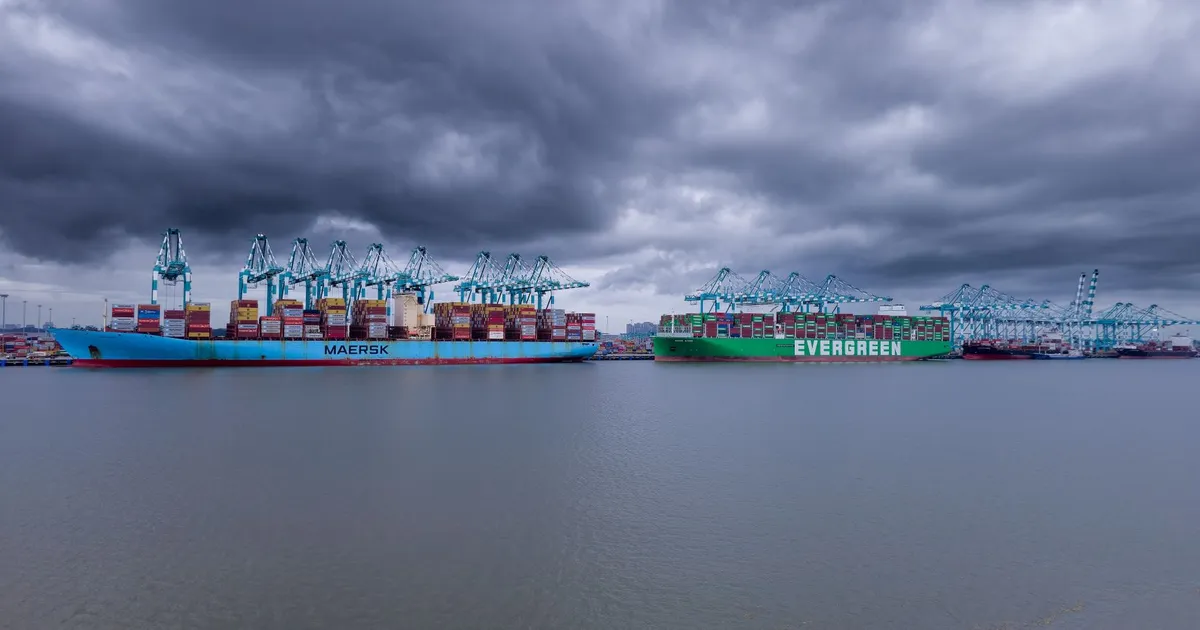
Then the sea freight. Lloyd’s List reported that Ningbo and other Zhejiang and Fujian ports were preparing for closures, with terminal operators scrambling to secure containers before the storm arrived. Kuehne+Nagel reported Shanghai, Ningbo and Yantian were “heavily disrupted”, and Maersk warned of closures and extended waiting times. These are not obscure harbours. They are the exact nodes that move the bulk of New Zealand’s manufactured imports.
Diversifying away from China doesn’t save you
The uncomfortable structural point is that spreading suppliers doesn’t insulate you. As Albert Greenway of The Signal Group noted, companies that have spent years diversifying away from China “may find that remaining connections are now even more vulnerable, as port closures in key hubs like Shanghai affect all supply chain participants regardless of their diversification efforts.”
AInvest put it plainly: “global supply chains have become so dependent on a handful of nodes that a single storm can create cascading delays,” arguing firms and governments should “treat this as an infrastructure question, not merely a weather one.” AXSMarine analysis warned that if Bavi tracked closer to major discharge zones, the impact could shift “from a short-term routing issue into a broader port congestion and vessel supply event.”
This is a season, not an incident
Here is why the two-day storm matters for the next four months. Bavi is the second typhoon to hit China in just over a week, following Maysak on 3 July. China’s National Climate Centre expects up to six typhoons in July alone, above historical averages, and AXSMarine’s seasonality data shows disruption risk staying elevated through November. Taiwan’s forecaster told Reuters that Bavi was likely the largest storm to hit the island since 1987. Any importer treating this as a one-off is mispricing the risk.
Why this hits New Zealand harder than most
New Zealand’s exposure to these ports is not shrinking, it is deepening. Stats NZ’s March 2026 trade data shows goods imports from China rose $255 million, a 20 percent year-on-year jump, in a single month. The biggest rises were in mechanical machinery (up $72 million) and electrical machinery (up $49 million), the capital equipment businesses run on, not discretionary consumer goods.
CEIC data puts NZ’s total imports from China at nearly NZ$999 million in March 2026, against a long-run monthly average of NZ$174 million since 1982, a near-sixfold rise in dependency on one source. The total annual goods import bill hit $84.2 billion for the year to March, led by exactly the machinery categories most concentrated in Chinese manufacturing.
The questions to ask before the next landfall
Neither China nor Taiwan had recorded deaths from Bavi as the storm weakened after landfall. But wind speeds fall faster than shipping backlogs clear. Every importer with eastern China suppliers should be asking a short list of hard questions now, not in October: what is the inventory buffer for critical inputs, do alternative supplier relationships exist outside the Zhejiang-Fujian-Shanghai corridor, and has anyone actually modelled the cost of a two-to-four-week shipping delay during peak season? The firms that treat typhoon season as a recurring operational line item, rather than an act of God, are the ones that will keep their shelves and their factory floors stocked through November.
Sources
- Over 1.7 million evacuated as Typhoon Bavi makes landfall in China (2026-07-11)
- China, Taiwan brace for Typhoon Bavi, possibly the most powerful storm in years (2026-07-09)
- Typhoon Bavi makes landfall in eastern China’s Taizhou after nearly 2 million evacuated (2026-07-11)
- Typhoon Bavi: China’s second major storm in a week makes landfall (2026-07-11)
- China evacuates over 1 million people as Typhoon Bavi nears (2026-07-11)
- Typhoon Bavi: Shanghai, Hangzhou brace for impact as nearby cities start evacuations (2026-07-11)
- Overseas merchandise trade: March 2026 (2026-03)
- Super Typhoon Bavi set to disrupt shipping across China’s busiest ports (2026-07-07)
- Super Typhoon Bavi Puts China Ports, Commodities and Vessels at Risk (2026-07-07)
- A storm in the world’s busiest ports (2026-07-11)
- TSG Super typhoon Bavi heading to Taiwan and China might disrupt commodity supply chain and Pacific vessel supply (2026-07-07)