

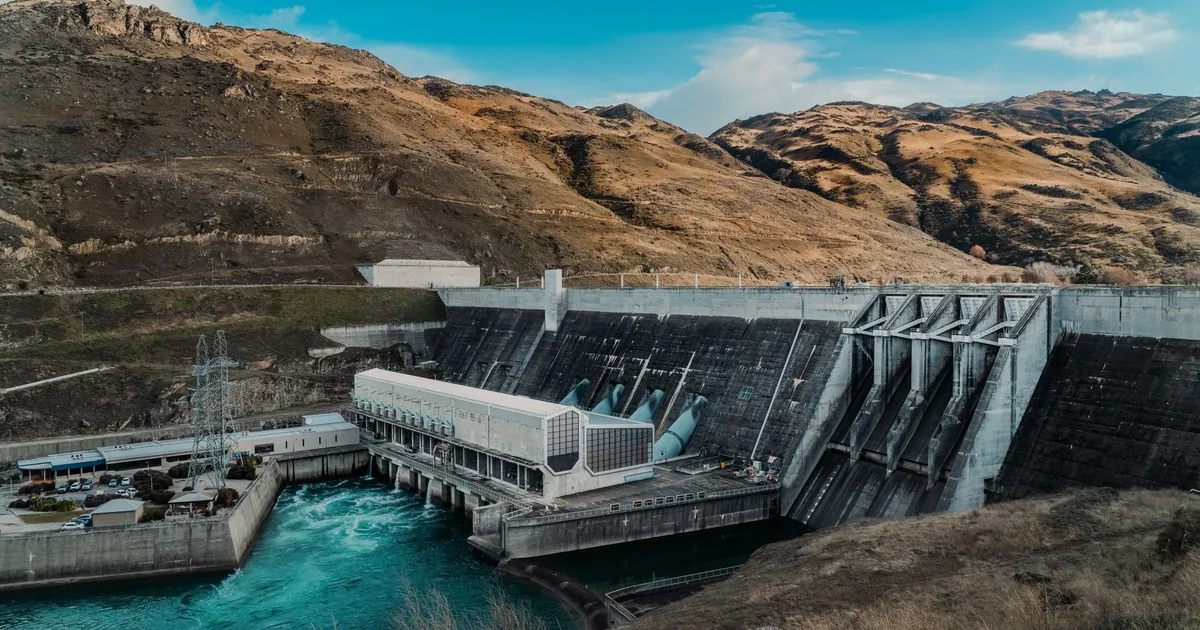
When the coalition cancelled the Lake Onslow pumped hydro scheme in 2023, the logic was hard to argue with. Sixteen billion dollars of public money for a project years from delivery, when faster-build wind and solar could add capacity sooner. But cancellation solved the cost problem, not the underlying one. New Zealand still has no answer to the dry-year risk that sits under its electricity system.
Now the question is back, and this time it comes with private money attached. Newsroom reported on 30 July that Sir Stephen Tindall, Selwyn Pellett and Michael Stiassny have each taken a 5% stake in the Clutha Pumped Hydro Consortium, the private vehicle seeking to build what would be the world’s largest pumped storage scheme by energy capacity. Pellett, a technology entrepreneur and long-time energy commentator, put it bluntly: “We need big projects that inspire people, not kicking the can down the road by importing LNG.”
Why the dry-year problem won’t go away
New Zealand generates more than 65% of its electricity from hydro, a structural strength that becomes a structural weakness roughly every five to six years when a dry year hits and the grid falls back on coal and gas. That backstop is shrinking. As of 2024, hydrocarbon capacity sat at 2.36 GW, about 21% of the 11.03 GW total installed base, and it has been declining for years.
Lake Onslow, a natural lake in Central Otago, would store roughly 5,000 GWh, more than all of New Zealand’s existing hydro storage combined. Water gets pumped uphill when power is cheap and surplus, then released through turbines when demand spikes or the rain doesn’t come. It is the only proven technology that can store energy at that scale.
The premium every energy user is already paying
The cost of the dry-year vulnerability is not theoretical. Analysis on interest.co.nz has noted that contract prices on the ASX now carry a $30-50 per MWh risk premium for supply security. Every manufacturer, food processor, data centre and industrial power user in the country is paying that premium in their long-term contracts. It exists precisely because the grid has no large-scale storage buffer.
That problem gets worse, not better. Electricity demand is forecast to rise by two-thirds by 2050 as transport and industrial heat electrify. More electrification on a grid with a thinning gas backstop means bigger price spikes when the hydro lakes run low.
What private capital actually changes
The shift from government project to private consortium changes the calculus in three ways. First, taxpayer risk disappears. The $16 billion figure that killed the public version is now a private-sector problem to solve, or not. Second, the test becomes binary. If capital won’t fund it at a workable return, it doesn’t get built. If it does, the market has validated the business case more convincingly than any Crown feasibility study.
Third, and most awkwardly for the government, its own Fast Track consenting regime is expected to speed the approval process. The coalition that scrapped the public project may have created the regulatory conditions that make the private one viable.
Sentiment among the gentailers has moved too. When the scheme was framed as a commercial venture rather than a state enterprise, industry attitudes shifted noticeably, with interest.co.nz analysis noting Meridian’s head of hydro development describing the concept as the type of project the system will require in the future. Firming at this scale would also unlock several thousand megawatts of new wind and solar, particularly in Southland, that generators currently can’t justify building without a storage backstop.
Why the names matter
The signal here is the people, not the stakes. Tindall built The Warehouse. Stiassny is one of the country’s most experienced corporate governance figures. Pellett is a technology founder who has spent years arguing about energy policy. These are not passive offshore funds chasing yield. They are sophisticated investors with reputations to protect, willing to be named publicly and to stress-test a business case with their own money in it.
The caveats are real. The three hold 15% combined, and who owns the other 85% is not yet public. Infrastructure cost estimates in New Zealand have a habit of running optimistic. Consenting, even fast-tracked, still has to clear seismic, water and environmental hurdles. And if international funds end up dominating the cap table, the operating profits flow offshore.
But the debate has genuinely changed shape. For three years Lake Onslow was a cancelled government liability. It is now a live capital-allocation question, and the alternative Pellett named, importing LNG, is exactly the expensive, carbon-heavy stopgap that would confirm New Zealand hasn’t built an energy system fit for a decarbonised economy. Whether the market funds the fix is the next thing worth watching.
Sources
- Big-name Kiwi investors buy into world’s largest pumped storage project Lake Onslow (2026-07-30)
- Lake Onslow pumped hydro scheme scrapped (2023)
- Govt looks to boost clean energy supply, commissions $30m investigation (2020-07-26)
- Is the Lake Onslow pumped storage scheme still on the agenda?
- Lake Onslow battery project set for revival?
- New Zealand Installed Electricity Capacity by Source 2024 (2024)