

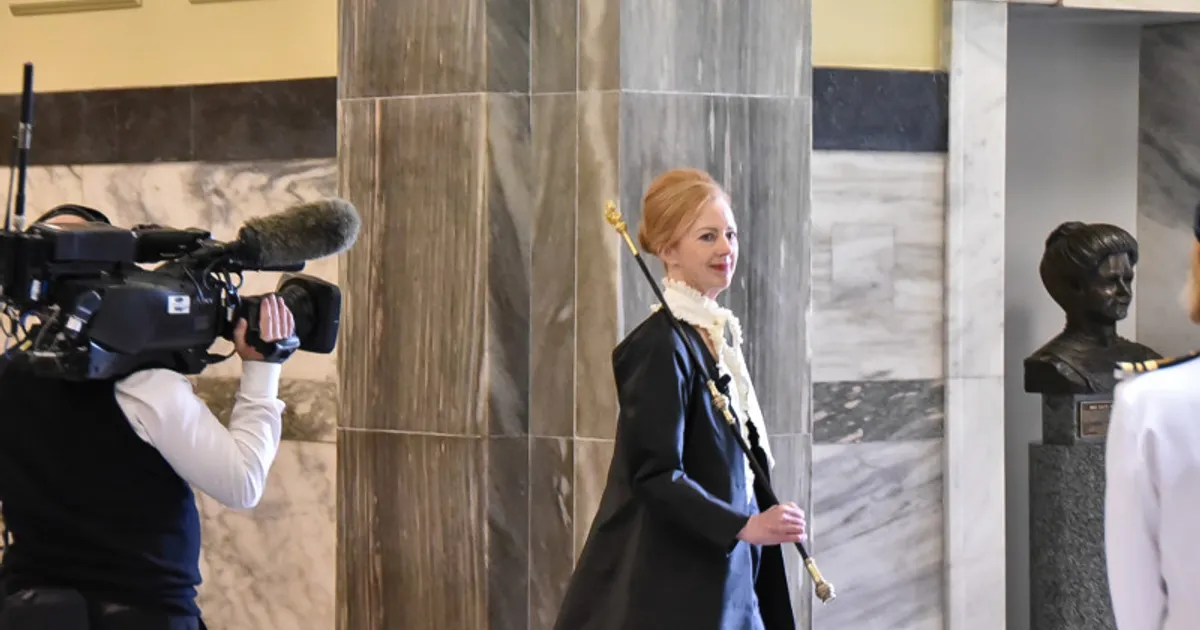
Green co-leader Chlöe Swarbrick is defending productive government debt on the campaign trail. Her argument is that the real question is what borrowing buys, not how much the Crown owes. That is a more sophisticated pitch than “spend more”, and parts of it deserve a hearing. But productive is a word doing an enormous amount of work. Nothing in the Green material says who decides when it applies, what return is required, or what happens when the promised dividend fails to turn up.
The fiscal straitjacket just loosened itself
The timing is awkward for the Greens. Treasury’s year-end accounts show net core Crown debt at $186.8 billion, or 40.9% of GDP, down from 41.8% a year earlier. It is the first fall in debt-to-GDP since 2018/19. The OBEGALx deficit came in at $8.7 billion, $3.3 billion smaller than forecast at Budget 2026.
That is a genuine turn. In 2025, Treasury reported debt had climbed $6.7 billion in a single year, with the government aiming to drag the ratio back towards 40%. It has now done that, at least for one year. The repair job is not finished, because an $8.7 billion hole is still a hole. But the claim that the current rules make progress impossible is harder to sustain when the rules are visibly working.
The Green case is better than its critics admit
The underlying framework dates to the party’s June 2025 fiscal strategy. At the time, Swarbrick said the government was “fixated on self-made constraints, while the real world crumbles around us”. The document argued that chronic underinvestment is as much a failure of fiscal responsibility as excessive debt.
That point has weight. Treasury’s advice to keep net debt below 50% of GDP rests on a 40% shock buffer and an assumed interest-growth differential of 3 percentage points, as interest.co.nz detailed in 2025. Those are judgement calls, not laws of physics.
Serious economists said so. In 2025, Susan St John described the Green document as a genuine attempt to challenge the paradigm of debt targets over real economic constraints. Former Treasury analyst Tayla Forward argued the same year that the government underestimates the benefits of public investment. In a November 2025 paper, Forward and Madeleine Foreman concluded that “public investment can enhance growth, productivity and resilience”.
Swarbrick also landed a fair blow on the right. In 2025 she said the coalition was “borrowing for tax cuts”. Debt-funded tax relief that does not lift output is no more productive than debt-funded anything else.
A ceiling between 36% and 175% is not a ceiling
The problem is what happens when the theory meets a spreadsheet. The Greens’ own modelling put a sustainable debt ceiling anywhere from 36% to 175% of GDP, depending on assumptions. A range that wide is not guidance. Most of the upward lift comes from shrinking the shock buffer and assuming the interest-growth differential falls from 3 points to 1. New Zealand borrows in global markets, so Wellington does not get to set that number.
Then there is the practical record. The Greens’ Alternative Budget paired free GP visits, dental care and prescriptions with new taxes and higher borrowing. That may be defensible social policy. It is recurrent spending, though, not capital investment with a measurable return. Calling it productive debt stretches the label past breaking point.
The 2025 strategy also proposed strengthening domestic financial institutions to hold the debt in the name of economic sovereignty. Business should ask whose savings, and on what terms. Steering local capital into government bonds is not free. It is a cost borne by whoever would otherwise have earned a better return elsewhere.
What business should demand from every party
None of this means Treasury’s 50% line is sacred. It means any party wanting to borrow more on the strength of returns should publish four things. The first is a hard split between capital and recurrent commitments. The second is hurdle rates that projects must clear. The third is an independent body, not ministers, to judge whether they did. The fourth is a repayment rule that bites if they don’t.
Bond markets do not read manifestos for intent. They read them for discipline. Until the Greens show who governs the definition of productive, the pitch remains what it looks like. More borrowing, a better adjective, and the same taxpayer picking up the tab.
Sources
- Stuff: Polls apart, Swarbrick defends productive government debt (2026-10-22)
- Treasury: Financial Statements of the Government of New Zealand for the year ended 30 June 2025 (2025-10-09)
- RNZ: Greens release fiscal strategy that calls for more public investment (2025-06-17)
- Interest.co.nz: Green Party model estimates NZ could sustain 122% net debt (2025-06-17)
- RNZ: Greens promise free doctor visits, childcare but new taxes, higher borrowing
- University of Auckland: Reflections on the Green’s challenge to the fiscal straightjacket (2025-07-28)
- University of Auckland: What does Fiscal Responsibility actually mean? (2025-08-30)
Join the discussion
Add useful context, ask a good question, or challenge an idea — keep it specific and respectful.