

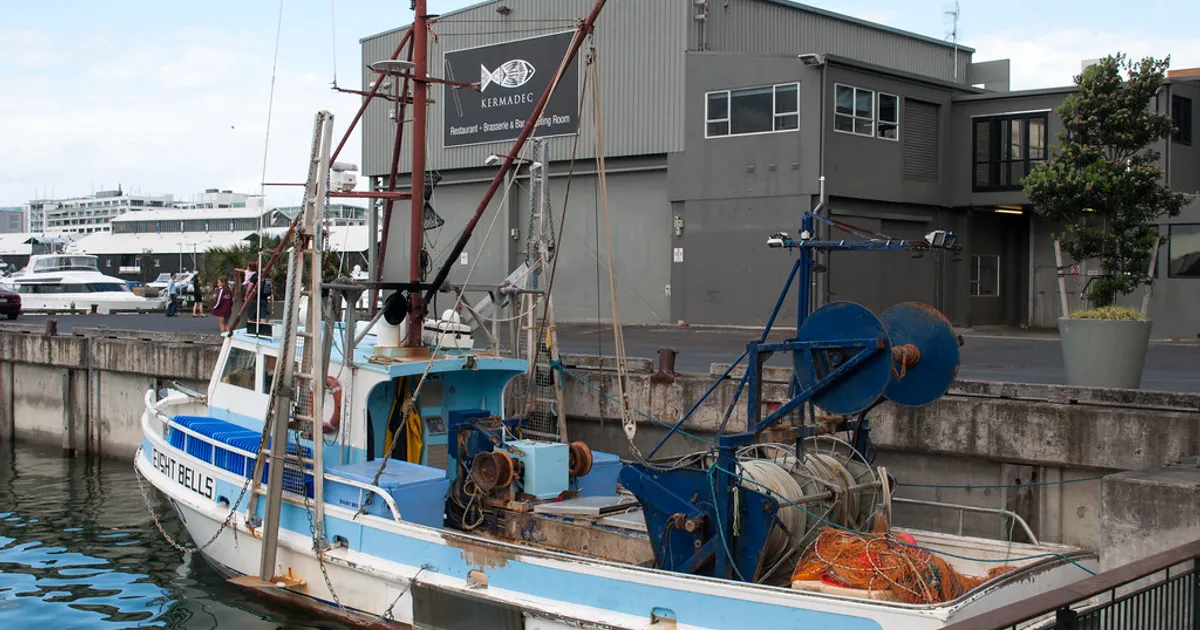
Savor Group is putting $20 million into a roughly 2,000-square-metre expansion on Auckland’s Viaduct, converting its Bivacco site into a three-venue cluster. It is doing so while much of the sector is in retreat. Read the headline and it looks like a bet that Auckland diners are back. Read the accounts and it is something more interesting. Savor has made itself strong enough to expand into a downturn that is still flattening its weaker rivals.
A cluster built for more occasions
The plan, unveiled at Tuesday’s annual shareholders meeting, pairs a bakery, deli and gelato sister site to Amano Britomart with a new Japanese venue pitched as having a ‘Tokyo jazz-bar feel’. Both are targeting spring 2027.
This is not simply more tables. A bakery and gelato counter sells to walk-in traffic in the morning and afternoon. A late-night bar sells to a different crowd after dinner. Savor is trying to capture several spending occasions from each person who walks the waterfront, which is a sensible hedge when no single occasion can be relied on.
The profit came from the cost line
Savor’s FY26 result for the year to 31 March shows net profit after tax of $1.3 million, reversing a $1.2 million loss. Revenue slipped to $55.2 million from $56.6 million. Underlying EBITDA rose 10.3% to $8.0 million on a 14.5% margin, the best in the group’s history. Operating cash flow rose 13% to $7.2 million, and leverage fell to 1.92 times.
Chief executive Lucien Law is upfront about where the gains came from. ‘Revenue softened by under 3%, but Underlying EBITDA lifted 10% and our margin reached a new high’, he said, calling it a year of tremendous progress ‘in what’s been a tough year for the sector’. Two Britomart openings from September 2025 helped. Bar Ziti contributed, and the entertainment-led Flush Golf traded ahead of expectations.
So nobody should mistake this for proof that discretionary spending has bounced. Sales fell for a second straight year. Savor got richer by running its venues more tightly.
The loss that was not what it looked like
The FY25 loss that sets up this recovery was less dramatic than it seemed. In its 2025 annual report, Savor put the hit down mainly to a non-cash write-off tied to the discontinued Seafarers venue. Operating cash flow grew 11% to $7.1 million that year, and the company said then it was positioned for recovery as conditions improved. FY26 bears that out.
The longer history matters more. Back in 2019, Savor was running leverage of around 12 times. By the time of its 2024 annual report it had cut that to under 1 times and declared its turnaround complete. A company that nearly ran out of road five years ago now has the balance sheet to take prime waterfront space.
Capital separates survivors from casualties
That is the real story for business owners. Newsroom frames the expansion against surging hospitality liquidations. In a soft market, smaller operators with thin margins and a single site struggle to refinance or ride out one bad winter. Operators with scale, several formats and falling debt can buy when others are forced to sell, and can lock in sites and leases on better terms.
That is textbook counter-cyclical investing, and Savor has earned the right to try it. The company says momentum is carrying into FY27, with higher revenue, higher EBITDA and lower leverage, which is now around 1.8 times. The board is also turning over. Capital-markets veteran Bhupen Master is retiring, and director Garry Moore is proposed to join.
Where the bet could go wrong
The risk has not gone away, it has just been deferred. Writing three weeks before the announcement, Kalkine analyst Anjali Anand warned that ‘elevated living costs can cause consumers to reduce restaurant visits or shift spending toward lower-cost alternatives’. She also praised Savor for managing its portfolio ‘rather than pursuing growth simply through expansion’. The Viaduct plan is exactly that pivot to expansion.
The demand picture remains murky. MBIE’s hospitality sales dataset tracks spending by customer type and region, and the waterfront depends heavily on corporate clients, tourists and higher-income locals. If that premium end holds up better than the mass market, Savor wins. If a slow recovery drags into 2027, $20 million of new fit-out will test the margin discipline that paid for it.
What happens next
The next 18 months will show whether Savor has outgrown its caution or abandoned it. Delivering both venues on time and on budget by spring 2027, while keeping leverage under 2 times, would confirm that the group has built a machine that makes money even when diners are careful. Either way, the lesson for everyone else in hospitality is already clear. In this market, the operators who can expand are the ones who cut costs and paid down debt when times were tough.
Sources
- Newsroom: Auckland hospo giant bets on waterfront expansion despite surging liquidations (2026-09-30)
- BusinessDesk: Savor 2026 Annual Results (2026-05-26)
- Savor: Annual Report 2025 (2025)
- Savor: Savor Limited 2024 Annual Report (2024-05-22)
Join the discussion
Add useful context, ask a good question, or challenge an idea — keep it specific and respectful.