

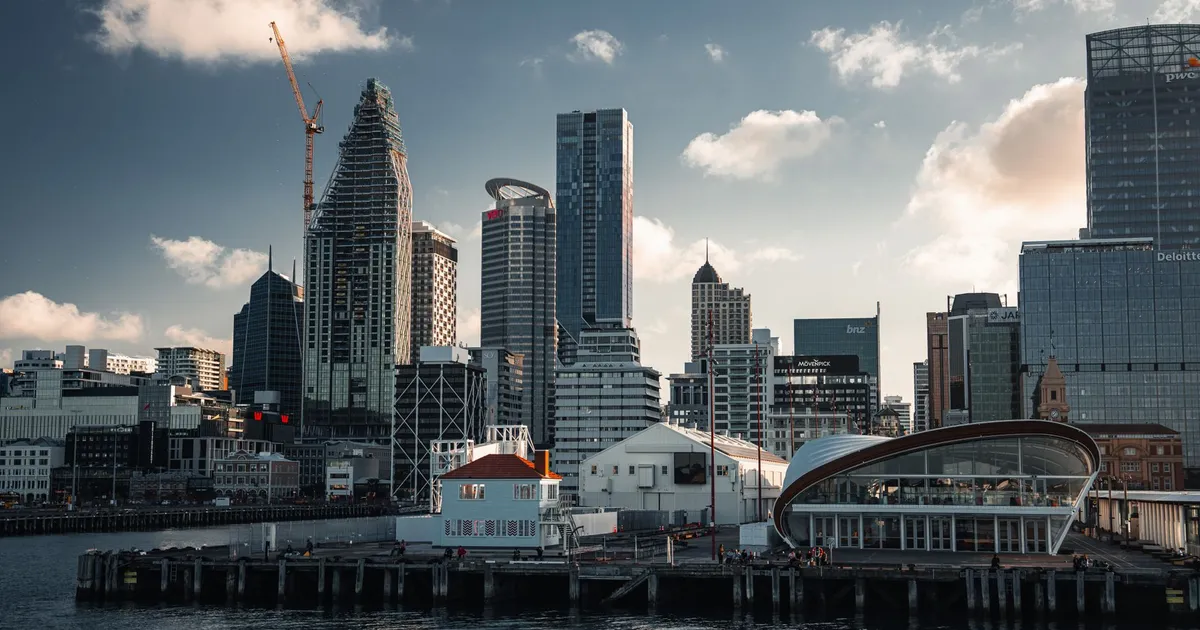
Precinct Property has shelved its Downtown Carpark redevelopment at 29 Customs Street West, and the most telling part is what was not wrong with it. The project had resource consent, contractor Built engaged on an early contractor basis, and advanced pre-leasing negotiations for roughly 50% of the office space. Demand was there. The numbers were not.
Precinct blamed higher financing costs, elevated long-term interest rates, a weaker New Zealand dollar pushing up imported materials, and stubborn inflation that created an unacceptable risk of a construction cost blowout. For a company that builds premium towers for a living, that is an admission that Auckland’s CBD growth story is currently being outvoted by the cost of capital.
The tenants were ready, the maths wasn’t
Chief executive Scott Pritchard did not pretend otherwise. “We are disappointed that current market conditions do not support proceeding with the Downtown development,” he said, adding that the strong occupier interest and agreed rental levels reinforced Precinct’s conviction in the site. The company has not ruled out returning when conditions change.
What was on the table was substantial. Stage 1 was a single 55-storey office tower for more than 7,000 workers, with three podium levels of retail, hospitality and public space. Precinct’s FY26 result presentation in August put Stage 1 at a $1.66 billion total capital commitment, delivering 72,500 sqm of office space, 3,500 sqm of retail and 490 car parks. At the time, Precinct was targeting a 15%-plus return on cost and a mid-to-high 6% yield on cost, and talked up waterfront pull, flight to quality and city-centre consolidation.
Two months later, it will instead keep running the existing car park and target a yield on cost of around 5%. That gap, from mid-6% on a new tower to 5% on a car park, tells you how far the hurdle rate moved in a matter of weeks. When a parking building is the more rational use of prime waterfront land, the development equation is broken.
A fast-track poster child goes nowhere
This was meant to be a showcase for the government’s consenting reforms. The wider scheme, Te Pūmanawa o Tāmaki, received fast-track approval on 5 August 2026 for roughly 170,000 sqm across two towers, three podium buildings, laneways and a civic space.
The economic impact assessment prepared in November 2025 projected $1.64 billion of direct expenditure over eight years and 11,914 FTE years of employment, peaking at 3,491 in a single year. Less than three months after approval, that case is parked.
This is not an argument against fast-track. Removing years of consenting friction is still worth doing, and nobody should want the old system back. But it is a useful correction to the political narrative that red tape is the only thing standing between New Zealand and a building boom. Consent is necessary, not sufficient. If long-term rates, currency weakness and construction inflation make the return unbankable, a faster yes from a panel changes nothing. The government owns part of that macro picture too, through its fiscal settings and the credibility of its inflation story.
Not a one-off
BusinessDesk notes the decision comes a month after Precinct paused another large Auckland project. Two major pullbacks in quick succession from the country’s biggest CBD office landlord is a pattern, not a wobble.
For the construction sector, that matters. A tier-1 contractor had already been engaged, and a pipeline that looked like years of work for subcontractors, suppliers and trades has lost one of its biggest names.
Shareholders win, occupiers pay
Precinct chose capital discipline over a speculative bet, and investors will not complain. It is returning cash through a $103 million special capital distribution, a 17-to-16 share consolidation, a $50 million on-market buyback and a rebased FY2027 dividend of 6.5 cents per share. There is a near-term earnings cost, as Precinct stops capitalising interest and management expenses tied to the project.
The read-through for tenants is less comfortable. Precinct itself points out that premium office vacancy in Auckland remains low, and that higher costs will constrain new premium supply. That is good for the landlord’s existing portfolio and bad for any business hoping to upgrade into quality space at a reasonable rent. Pritchard still has around $900 million of other developments underway, but the flagship that would have added 72,500 sqm of top-tier floorspace is off the table.
If you are a firm with a lease expiring in the CBD in the next few years, assume premium rents keep climbing and negotiate early.
What would bring it back
The trigger for a restart is not another consent or a political announcement. It is lower long-term rates, a steadier dollar and construction inflation that stops surprising on the upside. Until those line up, Auckland’s best-located site will keep earning its keep the old way, one parked car at a time, and the rest of the CBD development pipeline should be read through the same lens.
Sources
- RNZ: Precinct puts downtown development on ice (2026-10-30)
- BusinessDesk: Precinct Properties pauses $1.5b Downtown Carpark project in Auckland (2026-10-29)
- NZX: PCT announces Downtown decision, capital return & buyback (2026-10-29)
- Stuff: Precinct Properties shelves Auckland waterfront project (2026-10-30)
Join the discussion
Add useful context, ask a good question, or challenge an idea — keep it specific and respectful.