

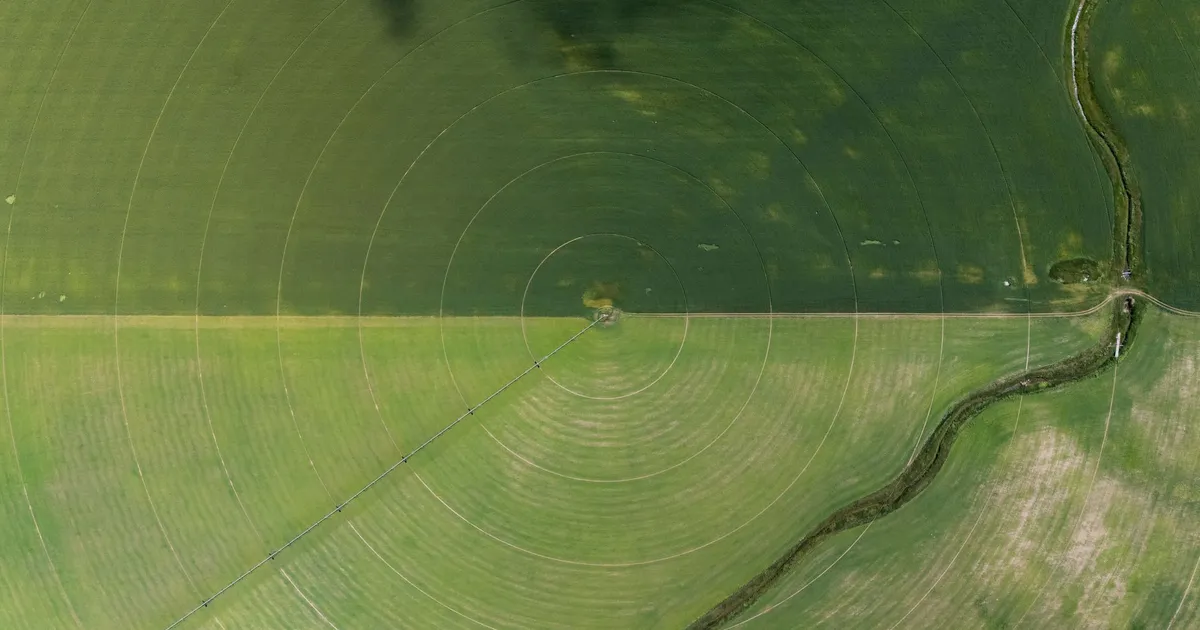
Climate adaptation usually lives in strategy documents and conference slides. In North Otago it shows up as monthly water charges, electricity contracts and interest rate swaps. This week the ODT described a district turned into a green oasis after years of dust and drought, as the North Otago Irrigation Company (NOIC) marks two decades of delivery. The transformation is real. It was also paid for by farmers carrying real financial risk, and they are still paying.
That is the point worth making. Reliable water is not a slogan. It is the difference between marginal land and bankable farms, and between towns that empty out and towns that young families move into.
Seven dry years wrote the business case
Irrigation consultant Chris Dennison, writing this month, says seven hard drought years in the 1970s left North Otago farmers with no feed or income and pushed many into off-farm work. Irrigation, first in the Lower Waitaki and then across North Otago in the 2000s, turned risky subsistence farming into an economic driver.
The structural change is stark. Dennison counts cropping farms falling from 30 to 2 while dairy farms rose from 5 to 40, with struggling individual operators giving way to family corporates running multiple properties. Just as important for a provincial economy, he credits irrigation with attracting younger people and new communities, including Filipino workers, reversing rural depopulation.
The money followed the water
The scheme, drawing from the Waitaki River at Bortons and serving around 10,000 hectares of downlands and the Waiareka Valley, opened in 2006. A 2010 report for the Waitaki Development Board found farmers had invested more than $62 million on-farm in five years on top of the $67 million build, lifting farm income by $44 million a year, creating 76 farm jobs and adding almost $30 million a year in local spending. Dairy land rose from 2,075ha to 5,820ha while sheep land fell from 5,199ha to 1,023ha. The report called it the single most significant economic development project in North Otago in recent years.
That is what private capital does when it can count on an input. Banks lend against certainty. Water gave dryland farms something to borrow against.
Every litre is already spoken for
By 2019 NOIC was selling its final 14% of shares as a last chance for farmers to secure access, because the consented take of 8.22 cumecs was fully allocated. Andrew Rodwell, then running NOIC, said at the time the sales would raise equity, reduce debt and allow lower monthly charges.
Critics of irrigation often frame it as a raid on rivers. Dennison’s numbers cut against that. The Waitaki averages 360 cumecs and irrigators use less than 10%, leaving ample flow for environmental and recreational use.
A balance sheet that feels the weather
The triumphant version of this story skips the accounts. It should not. In the year to June 2024, NOIC supplied 59 million cubic metres of water for revenue of $18.9 million, but power costs jumped 54% to $6.495 million and net finance costs rose to $6.108 million.
The 2025 report was tougher. Water supplied fell 45% to 26.2 million cubic metres in a drier year, revenue slipped to $17.0 million and the company booked a $2.0 million net loss, including a $2 million non-cash swap revaluation. Interest costs were still $5.8 million. The compliance story was clean, with all 40 audited farms passing Environmental Farm Plan audits and 68% graded A.
The same report flagged two pressure points. NOIC’s fixed-price electricity deal with Meridian runs only until June 2027, and costs from ageing infrastructure are expected to rise from 2030. For a scheme that pumps water uphill, the next power contract is not a footnote.
Everything hinges on 2030
Rodwell, now Aqus chief executive, is blunt that the 2030 renewal of the water consent is the issue on which “everything in our future hinges”. He argues New Zealand needs a national water strategy that accommodates storage, and notes that attracting talent to provincial New Zealand remains a challenge.
He is right that this is bigger than one scheme. NOIC has done the hard part without a central plan, and earlier expansion modelling for the company showed there was more value on the table. What farmer-owned infrastructure cannot do is control consenting risk. If a 2030 renewal turns into a multi-year fight, the cost lands on debt-funded farms, contractors, processors and the towns whose revival depends on them.
For business, the lesson is simple. Climate resilience that works looks like North Otago: privately financed, locally owned, audited and priced. The job for policymakers is not to replace that model but to stop it being held hostage by a consent process. Get 2030 right, and the next twenty years are bankable. Get it wrong, and the dust comes back with a mortgage attached.
Sources
- ODT: Irrigation brings a future to North Otago after years of dust and drought (2026-10-23)
- ODT: Irrigation leads to $62m investment (2010-10-29)
- ODT: Share sale ‘last chance’ (2019-07-18)
- Irrigation Leader: From Hardship to Prosperity, Chris Dennison on Irrigation’s Role in the Waitaki River Basin (2026-10)
- Irrigation Leader: Andrew Rodwell (2026-10)
- Aqus: North Otago Irrigation Company Annual Report 2024 (2024-09)
- Aqus: North Otago Irrigation Company Annual Report 2025 (2025-09-24)
Join the discussion
Add useful context, ask a good question, or challenge an idea — keep it specific and respectful.