

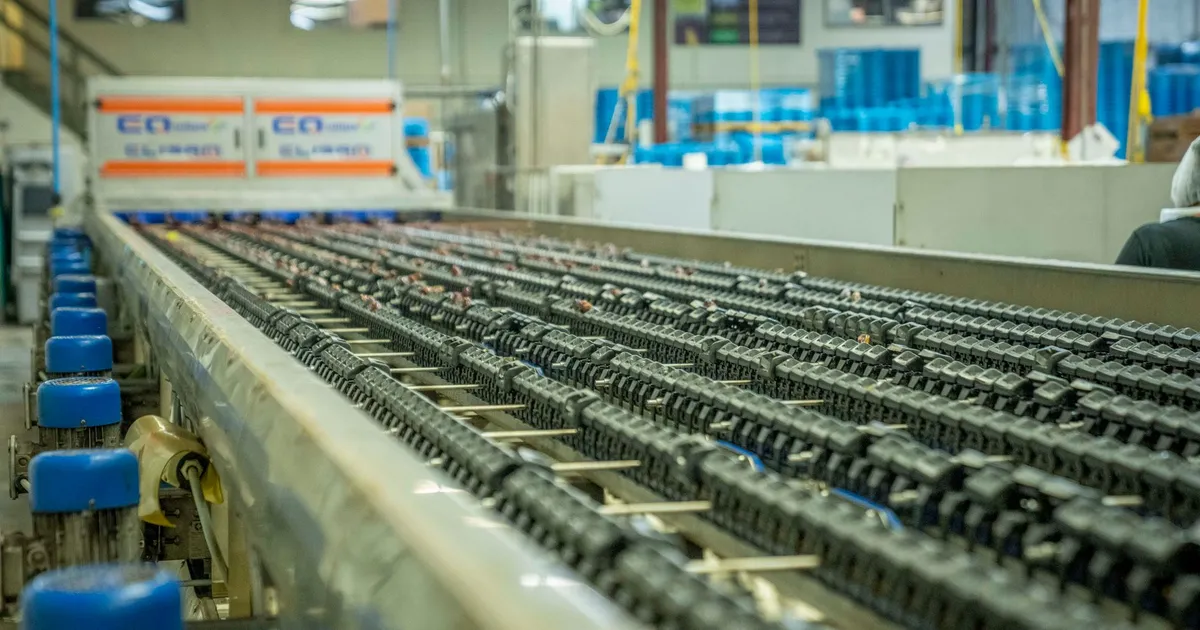
A coolstore that runs on eight people
Mr Apple, the country’s largest vertically integrated apple grower and a subsidiary of NZX-listed Scales Corporation, opened a 7,000m² smart logistics and cold storage hub in Whakatū, Hawke’s Bay, that processes approximately 3,000 apple bins daily with eight staff. The facility cuts orchard-to-packhouse time by 25%, which in export horticulture translates directly into shelf life, quality scores, and the ability to command premium pricing in Asia and the Middle East.
In September 2025, Michael Caccioppoli, Mr Apple’s head of coolstores, logistics and engineering, said the new system lets the company “move fruit from the orchard into the coolstore and through to the packhouse 25 per cent faster than before.”
This is not a technology showcase. It is a margin protection exercise for an industry where export volumes fell 32,129 tonnes between 2019/20 and 2023/24 while export value rose $58.3 million. The sector is chasing dollars per box, not boxes per season. And the biggest variable cost threatening those dollars is labour.
Labour certainty evaporated years ago
New Zealand’s apple and pear industry has always leaned on seasonal workers. A 2021 submission to the Productivity Commission by NZ Apples and Pears showed the sector employed 4,313 permanent workers alongside 14,051 seasonal workers at peak harvest, with roughly 6,500 coming through the Recognised Seasonal Employer scheme.
In that same submission, the industry reported that apple and pear packing wages rose 11% in a single year to $21.52 an hour, while picking wages jumped 14% to $24.76 an hour. Total harvest labour costs hit $65 million after a $10 million annual increase. Those were 2021 numbers. The trajectory since has only steepened.
The NZIER, in a 2021 report to the same commission, noted that the common claim the RSE scheme delivers an unquestioned “triple win” for workers, employers and the economy was “hard to support based on the evidence collected to date.” More pointedly, the report observed that employer certainty about having RSE workers available was itself driving capital investment decisions, meaning labour policy and automation investment are more tightly linked than most people realise.
Government workforce data for the year ending March 2024 showed the total horticulture sector employed 64,835 workers, with 76% of filled kiwifruit roles being part-year positions. Apple and pear processing shows a similar seasonal split. This is structural, not cyclical.
Growers said the quiet part out loud in 2022
Cameron Taylor of Taylor Apples, a fourth-generation Hawke’s Bay grower, was blunt about the maths in January 2022: “The cost of labour is going up and some varieties of apples will not be sustainable to export. The quicker we can get our staff numbers down, the better we survive.”
He was equally direct about how workforce uncertainty was capping growth: “We could sell twice the volume of our fruit, the market is hungry, but we’re restrictive of labour so that’s our biggest thing.” By then, Taylor Apples was already investing over $600,000 in automation, sorting thousands of apples per minute through new grading machines.
Taylor’s packhouse now processes about 3,000 apples per minute as part of the ‘Sassy’ apple export programme, with exports of the climate-resilient variety forecast to nearly double to 1.8 million kilograms in 2025.
Cyclone Gabrielle made the consolidation inevitable
Hawke’s Bay produces 64% of New Zealand’s apple exports. Cyclone Gabrielle in February 2023 destroyed or damaged 610 hectares of apple orchards, half the planted area. The recovery cost opened the door for corporate capital. Erskine Owen’s Veritas investment fund acquired the Whakatū facility for $24 million with a 20-year lease back to Mr Apple, treating post-harvest automation infrastructure as a standalone asset class.
In late 2025, Brydon Nisbet, vice chairman of Horticulture New Zealand and president of Hawke’s Bay Fruitgrowers, said “growers are still grappling with increasing wages, transport, fuel and on-orchard costs, consenting plus tighter margins and loan restrictions.” Automation is one answer, but only for those with access to capital.
The industry’s own 2021 modelling projected that ‘Robot Ready’ orchard structures would need to expand from 13% to 35% of planted area over five years, at a capital cost of $900 million excluding land. That is not family-orchard money.
The automation story is really a consolidation story
New Zealand’s apple export sector is worth close to $940 million FOB. Mr Apple lifted export volumes 11% in 2024 to 3.03 million tray carton equivalents, shipping to more than 33 countries. The game plan, as BayBuzz reported in December 2025, is to double apple exports within the next decade by micromanaging growth from tree to market.
That ambition requires capital, technology, and scale that most independent growers simply do not have. The $24 million facility, the $900 million sector estimate, the institutional property fund backing it all – this is capital flowing to corporates and investors, not to the family operations still digging out from Gabrielle. Small operators who cannot afford the technology face a choice between selling to corporates or exiting entirely. The robots are not the disruption. The disruption is who gets to own them.
Sources
- Cool tech heats up fruit throughput — NZ AgriBusiness Magazine (2025-09-13)
- How’s them apples? — BayBuzz (2025-12)
- Fresh Facts 2024 — United Fresh (2024)
- The New Zealand Apple and Pear Sector — Immigration Policy Settings Submission to Productivity Commission (2021-12-24)
- Picking cherries — NZIER report to Productivity Commission (2021-02)
- Horticulture — Food and fibre workforce insights (2024-03-31)
- Over The Fence — Goldpine: Kelvin and Cameron Taylor (2022-01-06)
- Exports of new climate change resilient apple tipped to nearly double this year — Farmers Weekly (2025-07-07)