

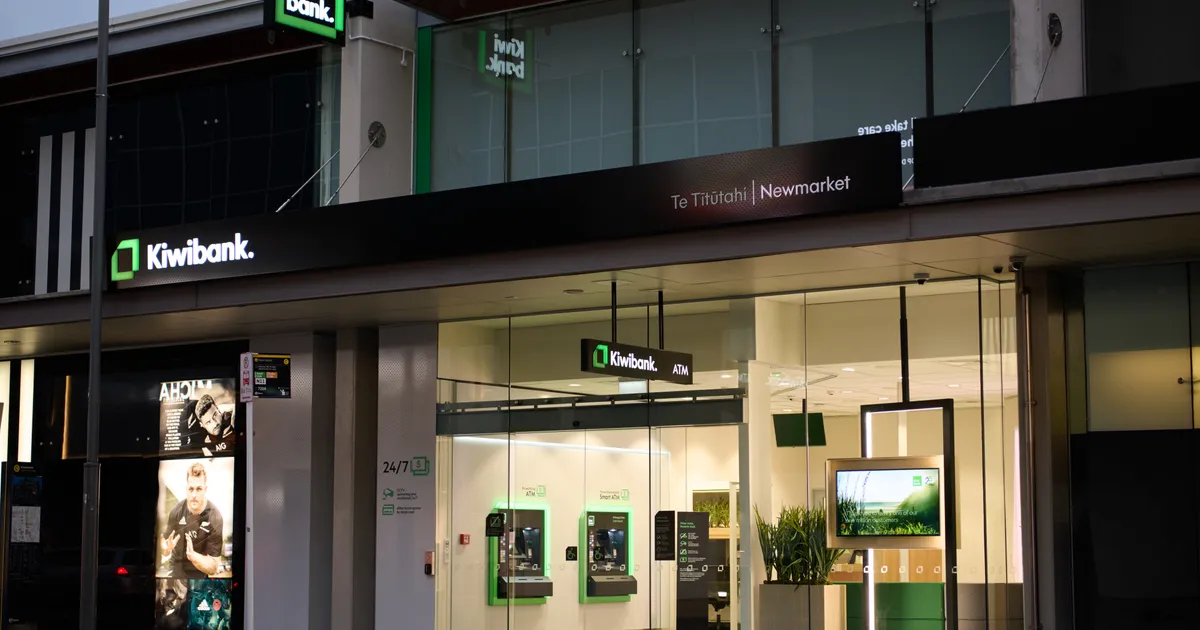
The cheque the Crown cannot write
In 2022, the government paid $2.1 billion to consolidate full ownership of Kiwibank, buying out the NZ Super Fund and ACC. The promise was simple: give the bank the backing to compete properly against the Australian-owned Big Four. Three years later, the Crown is asking private investors to provide that backing instead.
The reason is not ideological. It is fiscal. A November 2025 Cabinet paper approved Kiwi Group Capital to raise up to $500 million from New Zealand-based KiwiSaver funds, institutional investors, and Maori institutions, with the transaction due before 30 June 2026. The paper’s language is unusually direct, citing “the Government’s current significant fiscal constraints” as the driving factor.
Those constraints are real. The Budget Economic and Fiscal Update 2025 showed the Crown running an OBEGALx deficit of $12.1 billion in 2025/26, with net core Crown debt forecast to peak at 46.0% of GDP in 2027/28. Tax revenue came in $13.3 billion lower across the forecast period than predicted just six months earlier. In that environment, writing a $500 million cheque for a bank, however strategic, is not a live option.
The bank is performing. The owner is broke.
Kiwibank itself is not the problem. In July 2025, the bank reported net profit after tax of $92 million for the six months to December 2024, with its lending book up 6% to $34.4 billion and deposits growing at the same pace to $30 billion. Home lending grew 2.1 times faster than the market; business lending grew more than six times faster.
The constraint is capital, not competence. Banking is a balance sheet business. Every dollar lent requires capital behind it, and Kiwibank’s growth ambitions outstrip what retained earnings alone can fund. The Cabinet paper explicitly acknowledged that the bank “needs a reliable channel to regularly access new capital over time, beyond its self-generated retained earnings.”
A one-off $500 million private placement does not provide that channel permanently. An NZX listing does.
The listing nobody will confirm but everybody expects
In October 2024, Treasury recommended to then-Finance Minister Nicola Willis that a public NZX listing was “the natural progression” for Kiwibank, arguing it would “remove challenges arising from illiquid investments, including higher return requirements, greater governance involvement, and complicated exit provisions.” Willis said at the time that no IPO decision would be made during the current parliamentary term.
But the private placement is explicitly designed as a stepping stone. The structural problems with private capital are well documented. When a previous $500 million raise was attempted and subsequently abandoned, potential investors objected to a structure where they could only sell shares back to the government, creating a negotiating power imbalance. Near-term dividends were also hard to promise given the bank’s growth strategy. Those problems have not disappeared.
The competition contradiction nobody has resolved
The entire justification for growing Kiwibank rests on competition. The Commerce Commission found the four Australian-owned banks hold around 90% of all registered bank assets, with competition between them inadequate. Kiwibank holds roughly 5% of banking assets. RBNZ data from March 2026 showed aggregate profit after tax for all 27 registered banks hit $1,976 million in the December 2025 quarter alone. The sector remains enormously profitable.
But genuine disruption requires margin compression, and margin compression is exactly what private shareholders resist. In 2024, Edward Miller argued in The Spinoff that “lower margins also mean lower returns for shareholders”, identifying the core tension: private investors have obligations to maximise returns, while the entire point of a challenger bank is to reduce returns across the sector.
Martien Lubberink, then associate professor at Victoria University of Wellington, raised further concerns in 2024, noting Kiwibank’s return on equity of 7.5% was the lowest among the six largest banks. He warned of “foreign ownership by stealth” through private equity firms using KiwiSaver funds as nominal owners while extracting value through leveraged structures.
What business owners should actually watch
The Crown will retain at least 51% through a “Kiwi Share” mechanism, and no capital from the raise returns to the government. Every dollar goes into the bank for growth. That matters for businesses banking with Kiwibank or competing for its lending products.
But the trajectory is clear. The government bought a bank it could not afford to grow, and is now incrementally privatising it while insisting it is not privatising it. The private placement will likely close before 30 June 2026. The next step, whether this term or next, is an NZX listing. The question that remains unanswered is whether a Kiwibank answerable to private shareholders will deliver the competition the Commerce Commission called for, or simply become a fifth large bank with a slightly different logo on the door.
Sources
- Cabinet Paper ECO-25-SUB-0105: Next Steps in Supporting Kiwibank’s Growth and Competitiveness (2025-11)
- Government approves next phase of capital raise process to support Kiwibank’s growth (2025-07-30)
- Kiwibank a natural fit for sharemarket listing, says Treasury (2024-10-25)
- The case against selling (some of) Kiwibank (2024-08-26)