

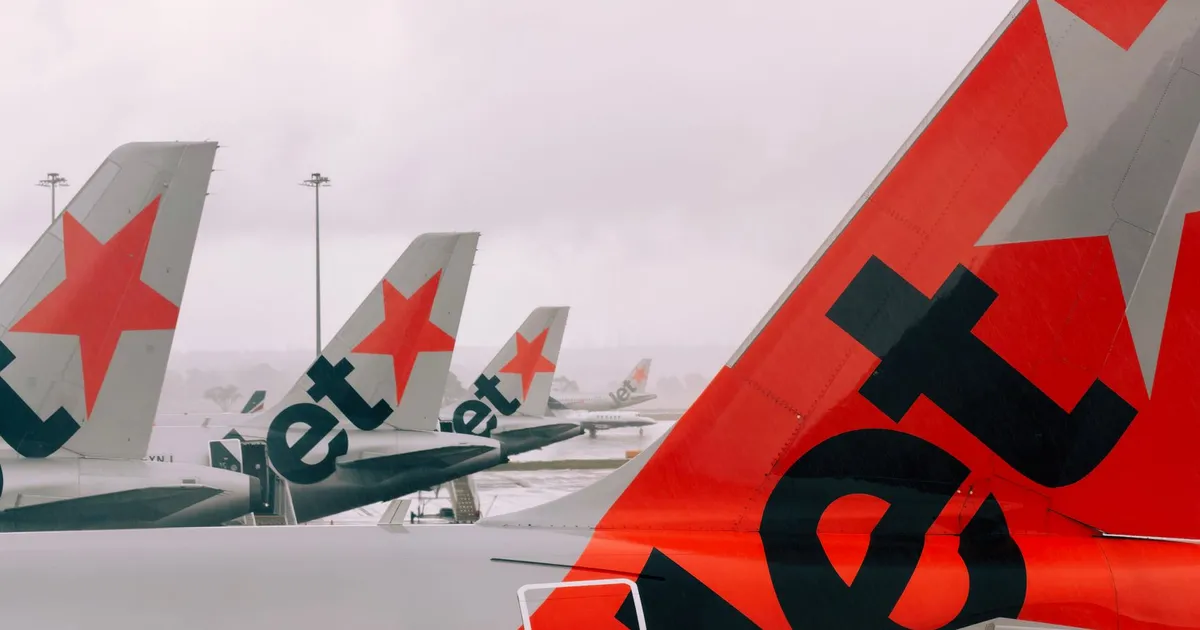
Jetstar is dressing this up as simplification. It isn’t. From February 2, 2027, the airline scraps its 7kg weight-based carry-on rule and replaces it with a size-based tier that gives you one free bag small enough to fit under the seat, and charges you for the privilege of using the locker above your head. The overhead bin, previously a shared commons that came with the ticket, is now a priced product.
What you actually get for free
Every booking includes one underseat bag, maximum 40cm x 30cm x 20cm, which is roughly a small backpack. That is smaller than most standard cabin bags business travellers already own. Anything bigger goes overhead, and that means buying a new add-on called Priority Carry-on, which permits a bag up to 56cm x 36cm x 23cm and throws in priority boarding after business class.
The 7kg limit disappears and the gate scales go with it. Jetstar still asks passengers to keep bags under 10kg so crew can lift them, but size is now checked by eye at the gate. The stressful weigh-in is gone. What replaces it is a fee.
The numbers business travellers should run
On NZ routes, Priority Carry-on starts at $23 for Dunedin-Auckland and $34 for Auckland-Brisbane. Across the Tasman and into Asia, prices range from about $25 to $52 depending on the route, with Sydney-Melbourne from $33 and Perth-Bali from $39.
For anyone managing a travel budget, the maths is worth doing. A return domestic trip carrying a normal cabin bag adds $46 to $68 per person for locker access alone. Put a team of five on Jetstar once a month and you are looking at roughly $2,760 to $4,080 a year in carry-on fees before a single dynamic price uplift. That is the catch. The service is sold using dynamic pricing, so the cost rises as the flight fills and as departure approaches. Business travellers book late. Business travellers will pay the top of the range.
Ryanair’s playbook, now flying out of Auckland
Jetstar CEO Stephanie Tully frames it as choice. “You only pay for what you need,” she said, arguing the change will “make better use of overhead locker space, streamline boarding and help more flights depart on time.”
This is not a one-off tweak. It is the mature low-cost carrier model landing in New Zealand. Jetstar is explicit that the change aligns it with Ryanair and easyJet, both of which already sell overhead locker space as a paid extra. The logic is clean: the headline fare buys a seat and nothing more, and every other service becomes a separate revenue line the airline can price like the scarce resource it is. Overhead space was always finite. Now Jetstar gets paid to allocate it.
The airline had signalled this was coming. In January 2026, a Jetstar spokesperson told 1News that gate weighing “can be a source of stress for our customers” and confirmed a review was underway. The stress got solved. The revenue opportunity got solved harder.
Does the on-time argument hold up
To be fair to Jetstar, the operational case is not empty. Ministry of Transport figures for August 2025 already had Jetstar beating Air New Zealand on domestic punctuality, with 85.1% on-time departures against Air NZ’s 83.0%. Less locker congestion and cleaner boarding could push that further. But the airline earns the priority-boarding fee whether punctuality improves or not, so treat the operational framing as a genuine benefit that happens to sit on top of a revenue play.
The regulatory angle worth watching
Unbundling a previously-included service into a paid add-on is exactly the sort of practice competition regulators watch in concentrated markets, and NZ domestic aviation is effectively a two-carrier duopoly on most routes. The Commerce Commission published an assessment of whether to self-initiate a competition study into the sector in May 2025. Moves like this keep that file warm.
None of this is irrational. It is textbook airline economics, and Jetstar is entitled to price its capacity. But business owners running travel budgets need to update their spreadsheets. From February, the cheapest fare no longer includes the locker, and if you are still assuming it does, you will find out at the gate.
Sources
- NZ Herald: Jetstar to scrap 7kg carry-on limit, add new paid priority service (2026-08-04)
- 1News: Jetstar making major changes to carry-on baggage rules (2026-08-05)
- 1News: Carry-on rules – what Air NZ and Jetstar want travellers to know (2026-01-18)
- Ministry of Transport: Aviation on-time performance – August 2025 (2025-08)
- Commerce Commission: Assessment of whether to self-initiate competition study into the domestic air travel sector (2025-05)