

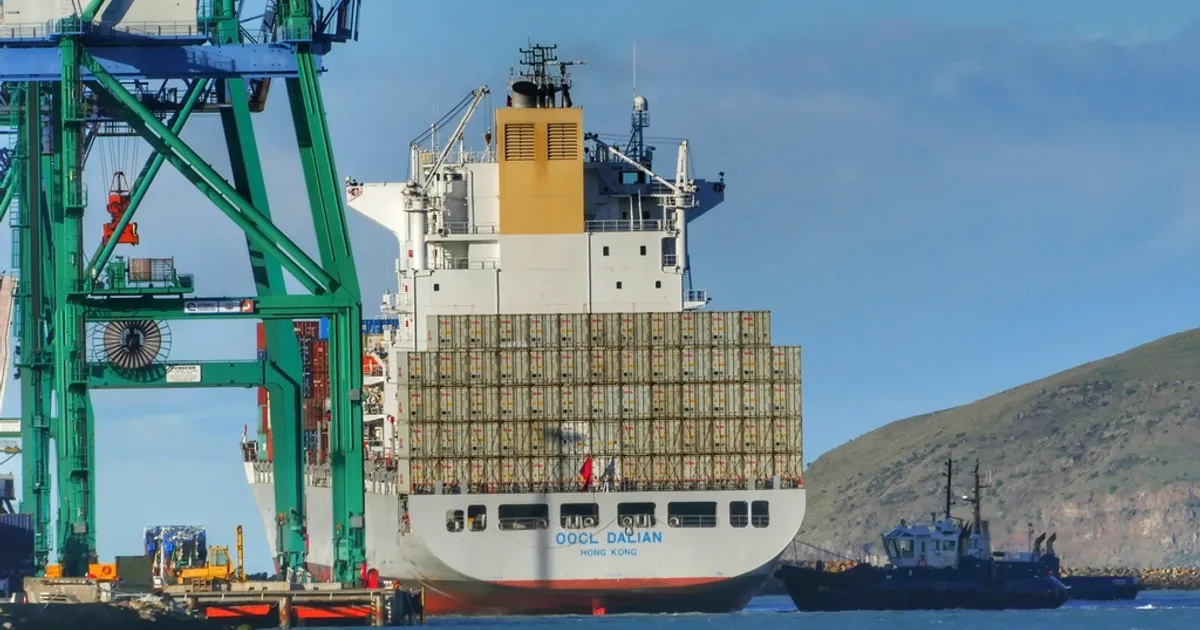
A profitable port, not a rescue case
There is a version of the Lyttelton story where a struggling asset gets bailed out by deep-pocketed foreign capital. This is not that story. In the last financial year, more than $7.5 billion of exports – logs, coal, refrigerated meat and more – left through Lyttelton, while 833,000 tonnes of bulk imports worth $6.38 billion came the other way. The Lyttelton Port Company posted a net profit after tax of $71.6 million in FY25.
So when DP World, a state-owned conglomerate ultimately owned by Dubai’s ruling royal family, makes an unsolicited proposal for a 30-year operating lease, the interesting question isn’t whether the port needs the money. It’s what a foreign state gets in return for stepping into the middle of the South Island’s trade artery.
The structure, and why control is the whole game
The proposal, confirmed in late June 2026, is a joint venture between DP World and Tonui, a collective of three Ngai Tahu runanga. Land and port assets would stay in public hands, owned by Christchurch ratepayers via Christchurch City Holdings. A new joint operating company would run the port and fund growth, and all current workers would stay on with no less favourable terms.
DP World is a serious operator. It runs more than 60 ports and terminals worldwide, including Sydney, Melbourne, Brisbane and Fremantle, employs over 126,000 people, and moves 10 percent of the world’s trade across 85 countries. DP World EVP Nicolaj Noes framed the bid as “a long-term investment in the port and the region” aligned with the runanga’s commitment to intergenerational stewardship.
But the assets-stay-public framing misses the point, and the unions know it. Lyttelton is a natural monopoly. Whoever controls its operations for 30 years controls the price that every South Island exporter pays to move goods. As Maritime Union spokesperson Victor Billot put it, “for 30 years, they would have control of the Lyttelton Port… What is good for DP World is not necessarily good for the people of Canterbury.” Keep Our Assets Canterbury convener Murray Horton called it “privatisation by stealth”.
The Australian numbers that should worry exporters
Strip away the ideology and there is one set of figures Canterbury business should study. Independent UNSW research cited by port unions found DP World used monopoly power at privatised Australian ports to impose landside tariff hikes of up to 52 percent, alongside triple-digit access fees per container. RMTU President Aubrey Wilkinson warned local exporters would “bear the brunt of skyrocketing landside tariff hikes, stripping wealth out of Canterbury.”
Port access is a direct input cost, and it lands at the worst possible time to be casual about it. New Zealand’s food and fibre export revenue is forecast at $64.3 billion for the year to June 2026, up 6 percent, while annual goods exports hit $81.0 billion in the year to March 2026. South Island farmers, log exporters and meat processors are shipping at record values through the one gate that matters. A structural cost increase on that flow would tax the whole region.
The case for not slamming the door
There is a genuine argument on the other side, and it deserves airtime. Lyttelton faces an estimated $900 million expansion bill, and ratepayers are not an obvious source of that capital. The honest centre-right position is not knee-jerk rejection of foreign capital – it’s negotiating hard. DP World’s Australian track record includes a commitment to spend $1 billion upgrading infrastructure, and its 20-year Fremantle operation is a working precedent. The mistake would be handing over 30 years of monopoly control without binding investment commitments and hard caps on landside charges written into the lease.
What happens next
The striking thing about the current state of play is how early it is. CCHL chairman Bryan Pearson has told the council the board had not yet sought independent advice, while conceding the proposal would be “a material change to the operating model at the port.” LPC chief executive Matthew Slater confirmed the CCHL board will be briefed on initial assessments in late July, with council engagement shortly after.
That means the decision that shapes South Island export costs for a generation is weeks away, and being made by a council-owned holding company that only recently started doing its homework. Canterbury exporters, and their counterparts across Te Waipounamu, should be watching what lands on Christchurch councillors’ desks in late July. Foreign capital is not the enemy. An unpriced 30-year monopoly is.
Sources
- Community, unions meet over Lyttelton Port takeover bid, as decision looms (2026-07-17)
- Three runanga partner with global giant for Lyttelton Port bid (2026-06-22)
- Port Unions Warn Tonui Proposal Opens Backdoor To Global Monopoly (2026-06)
- Situation and Outlook for Primary Industries – June 2026 Update (2026-06)
- Overseas merchandise trade: March 2026 (2026-03)