

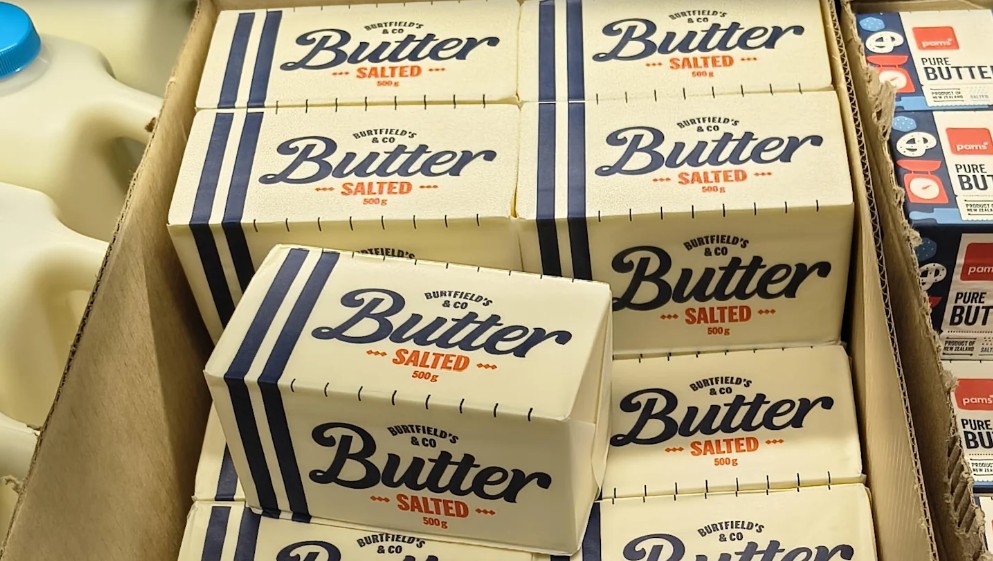
Discounted butter imported from the United States is leaving some shoppers uncertain about what they’re buying, as its packaging closely resembles locally made products.
The brand Burtfield’s & Co. is available in selected Pak’nSave stores nationwide, where it is priced lower than comparable New Zealand butter.
The product is brought into the country in bulk by Synlait-owned Dairyworks, then repackaged at the company’s facility in Hornby, Christchurch. It is sold in 500-gram blocks wrapped in the familiar yellow paper commonly associated with local butter.
Federated Farmers dairy chair Karl Dean said the product should carry clearer country-of-origin information so shoppers can easily identify where it comes from.
Some customers have overlooked the fine print on the packaging, which notes that while the butter is packed in New Zealand, it is sourced from the United States.
Dean acknowledged the imported butter offers another option for buyers but said feedback online suggests many people are finding the origin details difficult to spot. He said imported butter products are usually easier for shoppers to recognise on store shelves.
However, some buyers have been caught off guard after opening a block at home, finding it lacks the rich yellow colour they typically expect.
“There is international butter that’s sold in New Zealand, but I think that’s in foil packaging; it’s in a smaller block, a more premium type of product,” Dean said.
“Whereas here we have a product that looks very, very similar in terms of our paper packaging.”
Dairyworks’ head of marketing and innovation, Maja Szarmach, said the American butter has sparked plenty of discussion.
“It’s actually going pretty well. We’re really pleased with how it’s been performing so far. It has been around for a month or two.”
The lighter-coloured butter, produced from grain-fed cows, is priced between $6.49 and $6.99 for a 500-gram block. By comparison, budget-friendly New Zealand butter of the same size starts at around $7.29.
A Dairyworks spokesperson said the company moved to import the product during a period when US butter prices dropped low enough to make the roughly 12,000-kilometre shipment economically viable.
“If you think about NZ butter, it is a premium global product; most of the butter that is produced here is exported,” Szarmach said.
“So local prices are pretty much driven by global market rates, not just what it might cost to produce the butter here.”
“Think of it as a bit of an opportunity, or a window where the US butter price was at a bit of a low, so we could source that butter and bring it into New Zealand at a competitive price.”