

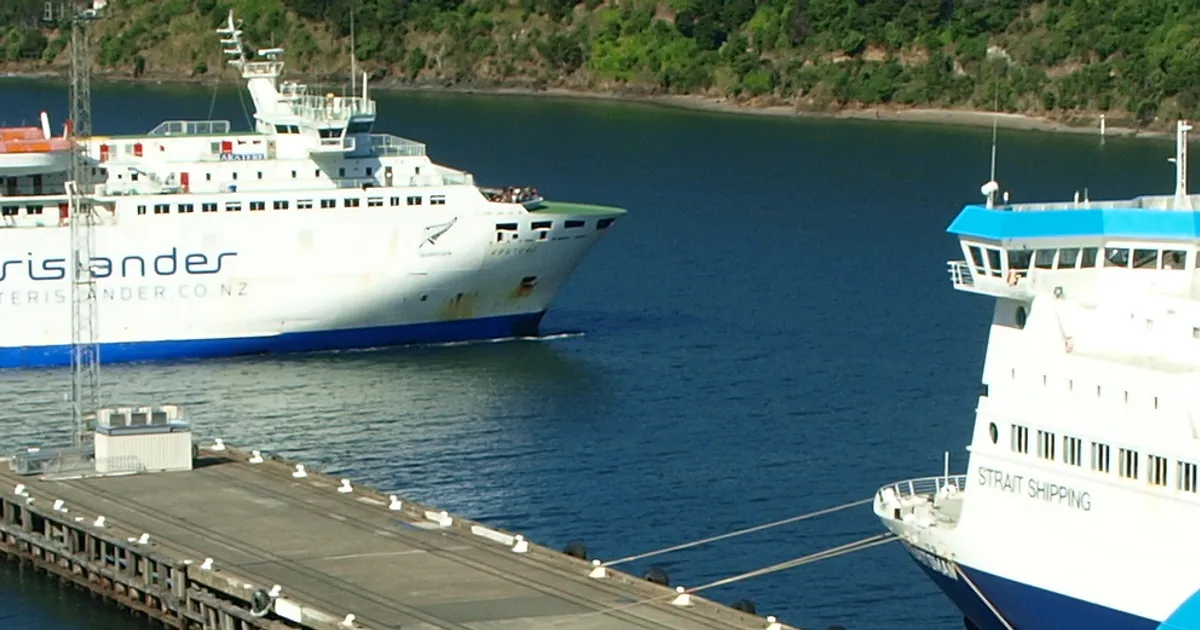
At ITB Berlin, one of the world’s largest travel trade shows, Cook Strait ferries became a talking point among European tourism companies. Not as a scenic highlight. As a risk to be managed.
That is the moment a domestic logistics failure becomes an export earnings problem. When the people who sell New Zealand to the world start designing itineraries that skip the middle of the country, the damage is not theoretical. It lands on accommodation providers in Picton, kayak operators in the Marlborough Sounds, and coach companies running the Top of the South. None of them had any say in the decision to cancel iRex.
$21,000 from a single cancelled sailing
The financial chain is brutally specific. A European operator books a group crossing. The sailing is cancelled due to a mechanical fault. Under EU Travel Law, the operator faces 500 Euro refunds per guest. The group arrives in Picton three days late. Pre-booked kayak tours, boat excursions, and accommodation are scrapped. The cumulative hit across the supply chain: $21,000 from one cancellation.
The rational response is to stop booking the crossing. Some operators have already restructured tours to avoid Cook Strait entirely, flying clients between islands instead. Wellington and the Top of the South simply disappear from the itinerary.
Jens Schlotzhauer, managing director of Nature Trailz Discover New Zealand, put it plainly: “For the vast majority of visitors, a trip to New Zealand is not simply a holiday, it is a life experience. When things go wrong, particularly due to infrastructure failures that are beyond anyone’s control, that experience is diminished, and word travels.”
The damage nobody counts
Stephen Waters, acting head of the Marlborough Chamber of Commerce, identified the mechanism: “People are starting to fly into other ports, not go through Auckland and travel down the country, across the Strait. We might not even see them in Marlborough so we’re going to lose those tourism dollars.”
There are no headlines about tourists who never came. No press releases about bookings that were never made. The damage accumulates invisibly in occupancy rates and activity operator revenues. Waters described Cook Strait as “an extension of State Highway 1”, infrastructure that should carry the same reliability expectation as a road.
Peter Rickard-Green, owner of Real Kiwi Adventures, noted that campervan one-way rentals between islands had become “incredibly difficult to arrange” due to ferry instability. The self-drive tourism market, a significant segment of international visitors, depends entirely on reliable vehicle crossings.
March proved the system is broken
A mechanical fault in March reduced KiwiRail’s fleet to a single ferry during peak season for the first time in four years. British tourist Stephen Edwards described “chaotic scenes” with queues across the terminal as hundreds tried to rebook. American tourist Norman Platt Johnson, 71, had his sailing cancelled and was offered a rebooking five days after his scheduled flight home.
The freight side is no better. Billy Clemens, head of policy at Transporting New Zealand, warned that if similar issues hit during maintenance periods, “you’d be in a situation where Interislander just wouldn’t have any capacity across the strait”, threatening livestock transport and food supply chains. The Interislander carries approximately $14 billion worth of freight annually.
KiwiRail’s 98% claim does not survive contact with reality
KiwiRail says reliability has been above its 98 percent target over the past 12 months, excluding weather. That carve-out is generous for a maritime crossing. And even 2% failure across roughly 3,800 annual services means 76 cancellations a year, each one capable of producing a five-figure loss for an international operator.
Schlotzhauer was blunt: “Ferry cancellations due to technical defects represent a systemic risk with real and recurring financial consequences.”
Four more years of this, at minimum
The government cancelled the iRex ferry replacement programme. The original business case priced it at $1.45 billion for two new rail-enabled ferries and terminal upgrades. New vessels are now not expected until 2029. Meanwhile, Ferry Holdings, which operates Bluebridge, is running 30% over its annual budget just six months in. Both operators are running ageing vessels with rising maintenance costs.
Waters was direct: “Another three or four years is just too long.”
The fiscal case for cancelling iRex looked at the Crown balance sheet. It did not account for the kayak operator in Queen Charlotte Sound who loses a booking every time a sailing drops out, or the Picton motel that sits empty because a tour group flew to Queenstown instead. Those costs are real. They are growing. And they will compound every year until new ships arrive, assuming the replacement programme does not slip further. Given current budget overruns, that is not a safe assumption.
Sources
- RNZ: ‘Word travels’: Cook Strait ferry service’s reputation for unreliability among overseas tour operators (2026)
- RNZ: Concerns Marlborough and South Island will lose tourism over unreliable ferries (2024)
- NZ Herald: Interislander fleet reduced to one after Kaiārahi technical fault (2026-03)
- Stuff: ‘Embarrassing’ for NZ: Tourists scramble to get home amid Interislander cancellations (2026-03)
- Ministry of Transport: Interislander Ferries and Terminals Detailed Business Case
- BusinessDesk: Ferry Holdings 30% over annual budget six months in (2025)