

The horse as a hedge, not a hobby
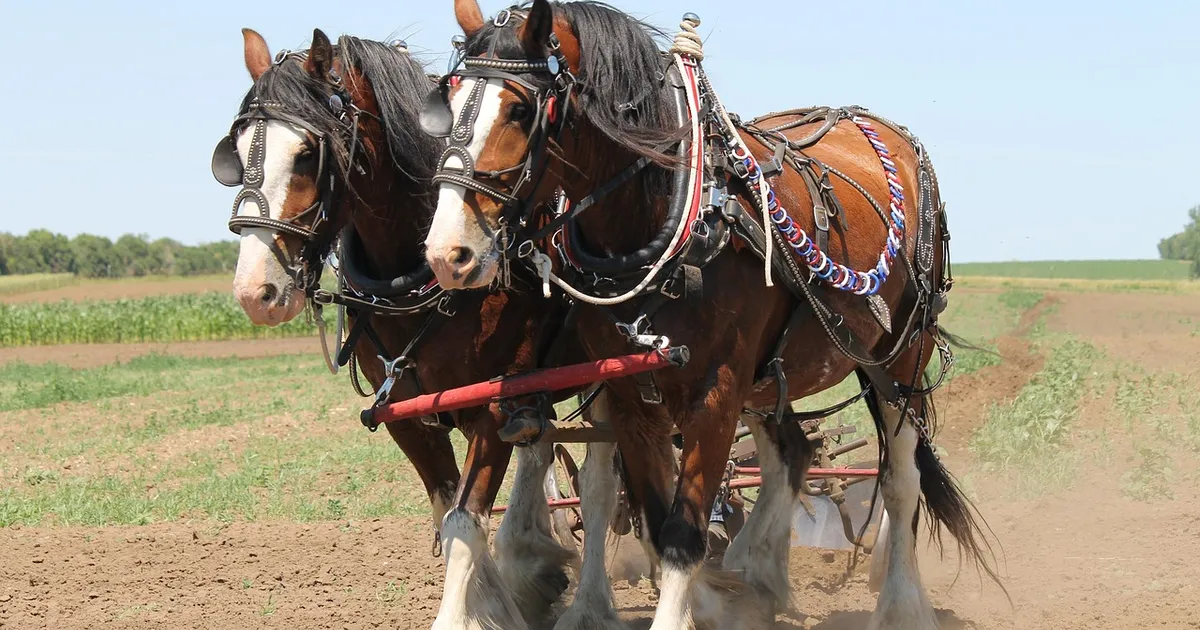
On a Pongakawa dairy farm, contract milker Ross Wilson does the harrowing, fertiliser spreading, feeding out, ploughing and cow-gathering with a team of ten Clydesdales. It reads like a lifestyle feature, and the NZ Herald ran it as one. But the interesting part is the balance sheet logic buried underneath the nostalgia.
Wilson’s horses are fuelled by hay, chaff, oats and pasture, mostly grown on-farm. His key piece of kit is an Amish-style forecart that lets the Clydesdales pull modern implements, with a small petrol motor driving each implement’s hydraulics and PTO. That is the whole trick. It is selective substitution, not a rejection of technology. “As I had my own family, I started buying and breeding Clydesdales,” Wilson said. “We now have 10 and part of the deal with any farm I work on is space for my horses.” He rotates them to stay fit and uses them daily, and reckons they outperform tractors in wet paddocks, where heavy machinery compacts soil.
The industry is sprinting the other way
Everything about the modern dairy trend runs against Wilson. DairyNZ’s 2024-25 statistics show a record 414kg of milksolids per cow, up 13kg on the previous record, with total production up 2.9% despite a 0.5% fall in cow numbers and 115 fewer herds. The direction of travel is consolidation into fewer, larger, more capital-intensive operations chasing per-cow output.
On the surface the money supports that. MPI’s December 2025 SOPI forecasts a $9.70/kg gate milk price for the 2025-26 season. But DairyNZ’s December 2025 economic tracker notes margins stay tight despite the strong payout, as cost pressures keep building. New Zealand remains the world’s lowest-cost dairy producer, Rabobank confirmed in February 2025, but it also flagged a structural uplift in global production costs. The cost edge is real. It is not guaranteed.
The input trap under the record numbers
Here is the crux. Those record per-cow figures rest on two expensive external inputs, nitrogen fertiliser and imported feed. A high-output conventional herd is exposed on all three fronts when nitrogen, PKE and diesel prices spike at once, which they tend to do together. A farm running horse traction for cultivation and feeding out simply carries less of that exposure. The horse eats grass the farm already grows.
Wilson’s operation is not eccentric outlier territory either. Back in September 2023, RNZ’s Country Life profiled Erewhon Station, a 14,000-hectare Canterbury high country property that used eight Clydesdales for around 80% of its cultivation work. “The cultivation is done with an eight or 10-horse team,” Erin Cassie said at the time. “There are no paddock princesses or show ponies here.” Two very different farms, two working horse teams, same underlying economic instinct.
What the model actually costs you
Be honest about the trade-offs. A horse does not need diesel, hydraulic fluid or a machinery dealer, but it needs feed, farriery and veterinary care every day of the year, whether you are working it or not. A tractor sits in a shed costing nothing when idle. A Clydesdale does not.
The bigger barrier is skill. Running a working horse team is generational knowledge. Wilson’s father and grandfather used Clydesdales on a Morrinsville drystock farm long after tractors won the argument. You cannot buy that capability off the shelf, which is precisely why the model does not scale to the whole industry. It also explains why Clydesdales survive at all as working animals rather than show ribbons.
Where this leaves a farming business
This is not a prescription for anyone milking 700 cows on flat, dry Canterbury. For most operations the tractor still wins on speed, labour and capital efficiency. But as a niche strategy for input-cost resilience on the right land, with the right skills, it has genuine economic logic rather than sentiment behind it.
The useful takeaway for any business, farming or not, is the principle. When your margin depends on inputs whose prices you cannot control and cannot predict, the operator who has deliberately engineered some of that dependency out of the system is the one still standing when the price shock arrives. Wilson has done exactly that. The Clydesdales are just the visible part of the hedge.
Sources
- Pongakawa contract milker Ross Wilson uses Clydesdales on-farm (2026-08-08)
- Erewhon Station: Where the tractors have four legs (2023-09-03)
- NZ Dairy Statistics 2024-25 (2025)
- Economic Tracker Quarterly Update – December 2025 (2025-12)
- Situation and Outlook for Primary Industries (SOPI) – December 2025 (2025-12)
- Structural uplift in global dairy production costs, but New Zealand lowest-cost producer in 2024 (2025-02-18)