


China’s brain-computer interface (BCI) industry is rapidly progressing from experimental stages to commercial deployment, emerging as a strong challenger to leaders like Elon Musk’s Neuralink, which positions itself as “pioneering” these technologies.
Startups are fast-tracking both implantable and non-invasive BCI systems, propelled by policy support, clinical trials, and investor enthusiasm. Phoenix Peng, co-founder of NeuroXess (implants) and CEO of Gestala (ultrasound non-invasive tech), notes provinces such as Sichuan, Hubei, and Zhejiang have set medical service pricing to incorporate BCIs into national insurance.
Peng predicts a shift from “treating disease” to human augmentation. “I have always maintained that neuroscience and AI are two sides of the same coin,” Peng said.
“They are destined for deep integration, realizing direct high-bandwidth connections between the human brain and AI. BCI will serve as the ultimate bridge between carbon-based and silicon-based intelligence. While this may sound distant, it represents an unimaginably vast market in the future.”
Over the next few years, healthcare will dominate as the market scales to billions with broader insurance, Peng told TechCrunch. A 2025 national roadmap targets 2027 milestones, standards, and a full supply chain by 2030.
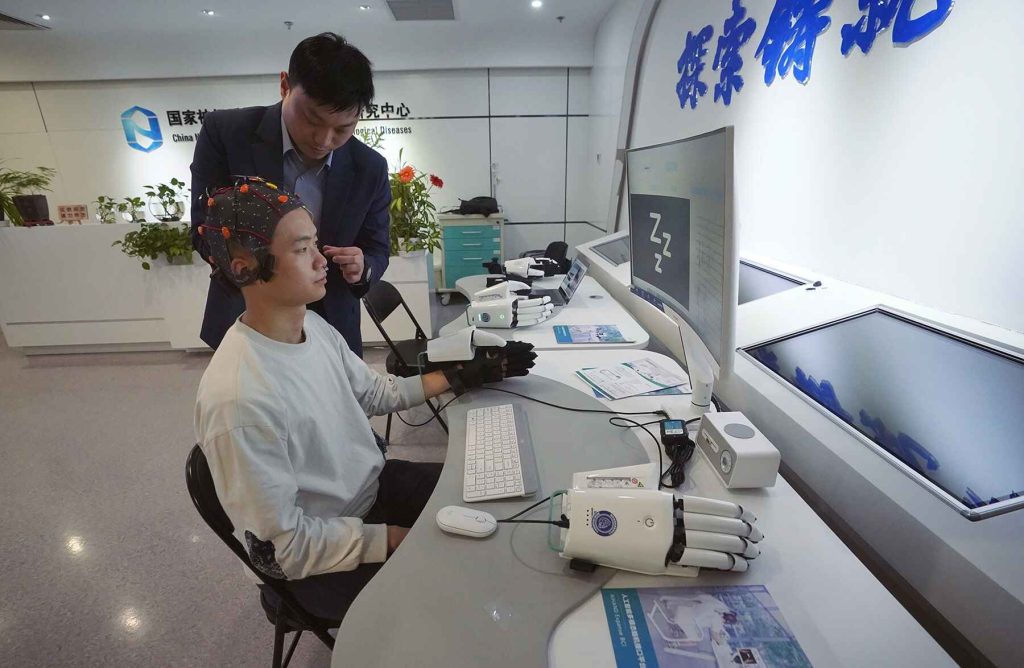
Key drivers include aligned policies and a 11.6 billion yuan brain fund unveiled at the Shenzhen Expo. Abundant patients and low-cost trials hasten approvals under national coverage, surpassing U.S. private insurer delays. China’s second global wireless implant trial enabled wireless control for the paralysed.
“In traditional electrical BCIs, Chinese firms have achieved clinical progress in motor and language decoding, spinal cord reconstruction, and stroke rehabilitation, with over 50 flexible implantable BCI clinical trials completed by mid-2025,” Peng said, with focus now on full-brain ultrasound like Gestala’s.
Manufacturing expertise and investments fuel growth. StairMed raised $48 million, BrainCo eyes a Hong Kong IPO after $287 million, and Gestala seeks angel funds. Firms like Neuracle, NeuralMatrix, and Zhiran challenge U.S. rivals. The market reached $530 million in 2025, projected at 120 billion yuan by 2040.
Invasive BCIs offer precision but surgical risks; non-invasive EEG headsets prioritise safety. Ultrasound from Gestala cuts pain 50% per session for weeks.
“Some technologies may look cutting-edge but far from practical application,” HSG’s Yang Yunxia wrote. Viable options face high costs or barriers, but sustainable businesses attract backing.
Regulations will harmonise with global standards by 2030, easing non-invasive approvals while tightening invasive and data oversight, with enhanced ethics and January 2026 medical norms.