

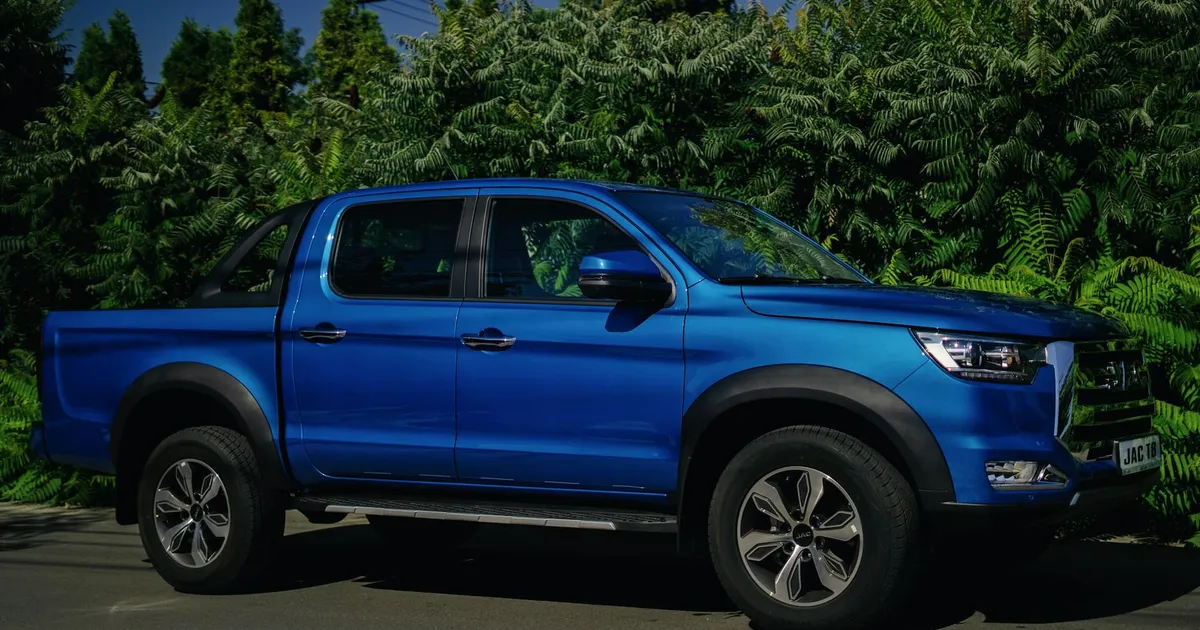
Government agencies have no choice. Under the Carbon Neutral Government Programme, when a fleet ute comes up for replacement, the purchasing officer must prioritise a battery electric or plug-in hybrid vehicle. Right now, only one PHEV ute exists in New Zealand: the BYD Shark 6. Ford’s Ranger PHEV and GWM’s Cannon Alpha PHEV are coming but they are not here yet. Every government fleet ute replaced in the interim is a Shark sale, and more than 50% of Shark 6 customers already come from fleet and government departments.
That structural monopoly will not last forever. But it does not need to. BYD is using it to build the installed base, the dealer network, and the real-world track record that make the next sale easier.
The numbers that matter to fleet managers
The Shark 6 recorded 376 registrations in January and February 2025, its first full two months on sale. By July it was selling 256 units a month, placing it fifth in the entire new vehicle market. That same month Toyota HiLux moved 868 units and Ford Ranger 838. BYD is not threatening the incumbents on volume yet. But it grew into a market where the commercial vehicle segment fell 24.7% year-on-year in February and Ford Ranger registrations dropped 45% to 526 units in the same month.
The fuel economics sharpen the picture further. Long-term testing by Auto Trader NZ found the Shark averaging roughly 70% electric driving in mixed use, with fuel consumption around 2L/100km. Reviewer Richard Edwards put it plainly: “When we are burning fuel, we’re seeing between 6 and 7L/100km, so averaged over total usage, we’re sitting around 2L/100km; that’s exceptional.” Against a diesel ute running 8-10L/100km, the savings across a fleet of 10 or 20 vehicles over 100,000km are not marginal. They are transformative.
BYD NZ general manager Warren Willmot says demand is outpacing capacity: “Our Shark has had a strong start in New Zealand, only limited by our workshop capacity to get the deliveries out the door.”
Rules written when cars weighed half as much
Here is where the story gets absurd. The Shark 6’s gross vehicle mass sits at 3,500kg, which under New Zealand’s vehicle weight licensing rules caps its towing at 2,500kg, a full 1,000kg below the segment benchmark. BYD applied to NZTA for an exemption to operate at 3,700kg as a light vehicle.
NZTA acknowledged the request made sense. Then declined it anyway. Willmot’s account: “They said ‘that makes a lot of sense, we’re changing the rule in two years time anyway, but no you can’t have an exemption right now’.” Three ministers, Simeon Brown, David Seymour, and Chris Bishop, apparently indicated support. NZTA said it was the Ministry of Transport’s problem. The Ministry presumably said it was NZTA’s. The rules date to the 1950s, when vehicles weighed considerably less.
Bishop has since offered the bureaucratic equivalent of a shrug: “I have agreed to a vehicle policy reform programme that may consider adjusting these thresholds in legislation.” “May consider” is doing heroic work in that sentence.
BYD stopped waiting and built around the problem
Rather than wait for Wellington, BYD engineered a workaround. The Shark 6 Performance variant upgrades output to 350kW and 700Nm and, critically, raises towing capacity to 3,500kg within existing rules. A cab-chassis version targeting trade and fleet buyers is also coming, with an alloy tray developed by Australian supplier Ironman 4×4. Beyond the Shark 6, BYD has signalled a smaller Shark 5 and larger Shark 8 for 2027, a comprehensive commercial strategy rather than a single-model experiment.
The incumbent position remains formidable. Thailand-origin vehicles account for 412,616 registered utes and commercial vehicles in New Zealand versus just 22,593 from China. The HiLux and Ranger have decades of brand loyalty, dealer depth, and rural trust behind them.
But the compliance-driven fleet segment does not care about brand loyalty. It cares about emissions targets and total cost of ownership. Once fleet managers have run the Shark for 12 months and seen the fuel bills, the conversation with the rest of the business gets much easier. For any business running a ute fleet, the Shark 6 is now a credible financial calculation backed by a six-year, 150,000km warranty. The question is not whether to consider it. It is whether to wait for competitors to arrive and drive the price down, or move now while BYD has the segment to itself.
Sources
- NZ Herald: BYD’s Shark chomps big chunk of ute market: Bishop, Seymour eye law change
- GoAuto: NZ Sales – Utes drive solid July performance (2025-08-06)
- AutoTalk: New vehicles – Passenger growth, commercial decline
- Driven: BYD Shark 6 Premium review – popularity contrast
- Transport Talk: BYD Shark plug-in hybrid ute unveiled at Fieldays
- Autocar NZ: 2025 BYD Shark 6 Premium Long Term
- Motoring NZ: Shark out for bigger bite of ute sector
- Motoring NZ: Shark promises big battery-fed bite
- Driven: BYD Shark to get more grunt, with more utes on the way
- Figure.NZ: Goods vans, trucks and utes currently registered in New Zealand