

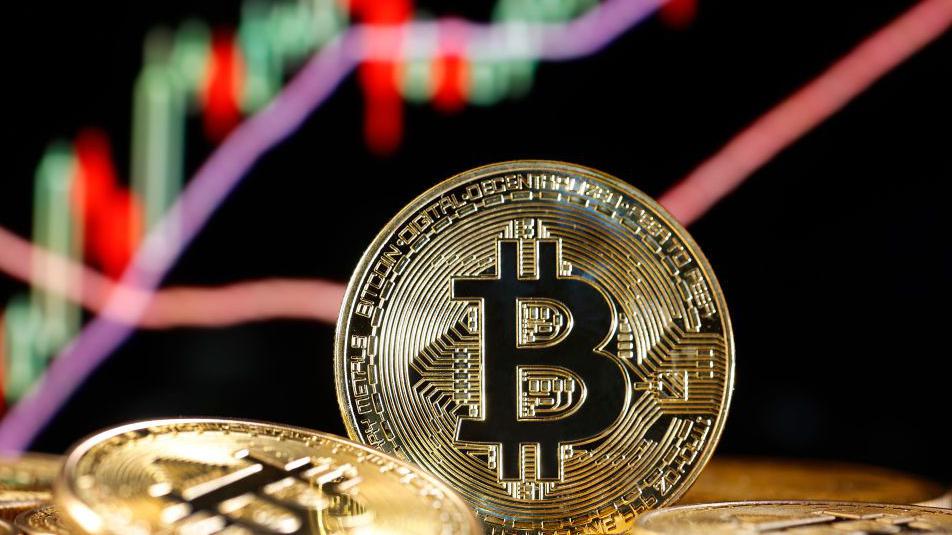
U.S. President Donald Trump’s announcement of plans for 15 per cent global tariffs has triggered a sharp decline in Bitcoin.
The cryptocurrency dropped as much as 5 per cent on Monday, falling below $65,000 BTC.CM=. This plunge occurred even as Asian stock markets rose in early trading, highlighting Bitcoin’s separation from traditional equities during heightened trade uncertainty.
Since peaking above $125,000 in October last year, the world’s leading cryptocurrency has lost 47 per cent from that high. Year to date, it sits 26 per cent lower, extending a sell-off into 2026.
“We believe that the sudden uptick in tariff rates is causing investors to sell crypto assets in anticipation of a more serious market decline,” said Jeff Mei, COO at global blockchain technology company BTSE.
Investor worries also centre on a major U.S. military build-up in the Middle East around Iran. Trump signalled last Thursday he would decide within 10 days on potential strikes against Iran. Mei added that such tensions raise fears of regional conflict disrupting global trade.
Markus Thielen, head of research at market intelligence platform 10x Research, pointed to thin liquidity and low market conviction as key drivers of Bitcoin’s drop, rather than a single news event. He described the pattern as typical of a bear market phase, with subdued volumes and uncertainty over U.S. midterm elections. Thielen expects prices to test $50,000 before forming a firmer base.
Demand for safe-haven assets lifted spot gold XAU= by more than 1 per cent on Monday. This move contrasted with Bitcoin, often called “digital gold” by figures including Federal Reserve Chair Jerome Powell.
Bitcoin trimmed some losses by 12.18 a.m. ET and traded 3 per cent lower at $65,167. Ether ETH.CM=, the second-biggest cryptocurrency, fell 3.9 per cent to $1,867.3.
Earlier this month, Bitwise Chief Investment Officer Matt Hougan linked the downturn to the crypto market’s “four-year cycle,” mirroring past corrections. Bitwise manages more than $15 billion and invests heavily in crypto ETFs. Hougan cited no single cause but noted investor shifts to gold and AI stocks, alongside concerns over Federal Reserve nominee Kevin Warsh and broader “quantum risk.” Bitcoin hit a more than one-year low of $63,119.8 on 5 February.