

The University of Auckland’s plan to build a $125 million Bruce McLaren Centre for High Performance Engineering at its Newmarket campus will mostly be covered as a motorsport tribute. It is more useful to read it as workforce policy. Employers have spent years saying they cannot hire enough technical talent, and this is one of the few concrete attempts to produce more of it at scale.
The harder question for business is whether a building can fix a problem that is now as much about demand as supply.
A legend who quit the degree
McLaren enrolled in engineering at Auckland in the late 1950s, then left in 1958 after winning the first Driver to Europe scholarship. His final report card reportedly read “went motor racing”. He became the youngest driver to win a Formula One Grand Prix, won Le Mans with Chris Amon and founded what are now McLaren Automotive and McLaren Racing, before dying in a testing crash in Britain aged 32.
The naming is not just sentiment. The McLaren link is the most commercially proven part of the faculty’s pitch.
The pipeline already delivers
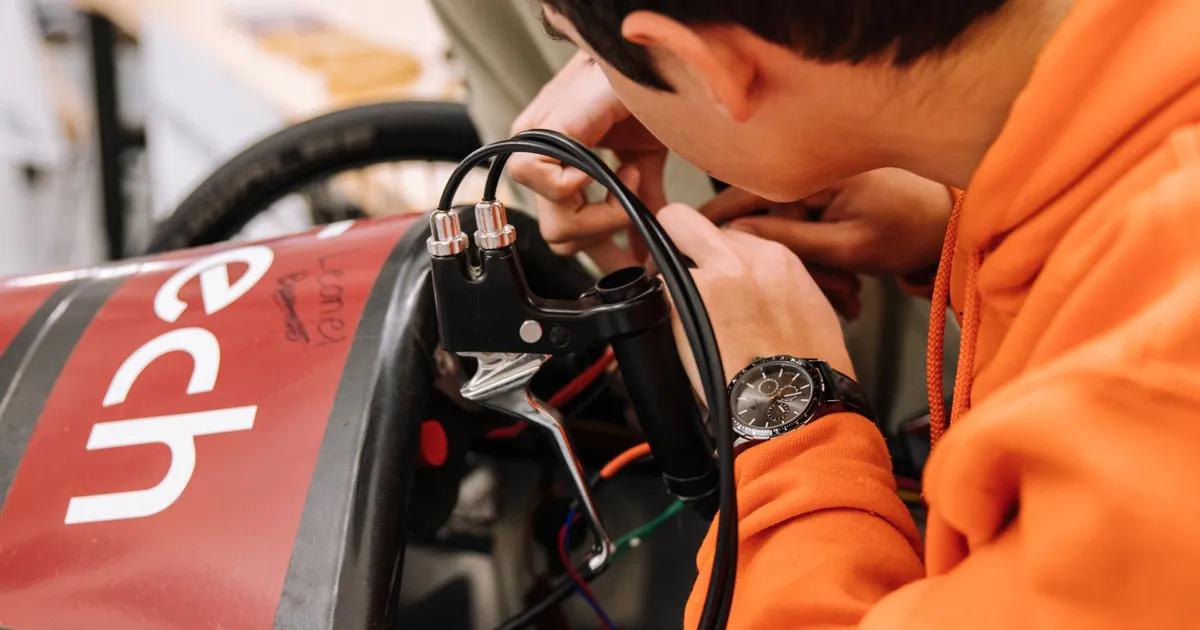
Since 2016, Auckland students have won three-month internships with McLaren in Woking. By 2024 the programme had placed nine interns, with alumni moving on to McLaren Automotive, Rocket Lab and agritech firm Halter. FSAE faculty adviser Dr Tom Allen said at the time it showed Auckland could produce graduates “parallel to all those universities in Europe”.
In 2023, intern Joshua Cates summed up the gap the students were exposed to: “there’s just no automotive industry in NZ like this or anywhere near this scale”. The programme has been underwritten by private money, with donors in 2023 including Sir Colin Giltrap and the UKNZ Link Foundation.
Vice-chancellor Professor Nic Smith says McLaren has hired interns directly “because they tell us the students have all of this amazing technical ability” alongside a willingness to work hard and move quickly. That is the kind of endorsement universities usually have to manufacture. Here a global manufacturer is giving it unprompted.
The shortage is quantified and expensive
The economic case is not soft. A 2023 Engineering New Zealand report backed by PwC estimated engineering contributed $14.6 billion to $18.1 billion a year to GDP, with each engineer generating about $228,000 of GDP, nearly double the average worker. It projected the country needed almost 2,500 new engineers a year to sustain 3% growth, before retirements and departures. Only 9.4% of NZ graduates studied engineering in 2020, against an OECD average of 13.7%.
In 2024, Engineering New Zealand told Treasury that engineering sat on Immigration NZ’s Long-term Skills Shortage list. Importing talent has been the default fix for decades. Growing it locally is cheaper and stickier.
Then the industry shed 1,900 people
Here is the awkward bit. In July 2025, ACE New Zealand reported more than 1,900 people had left the industry in the preceding 18 months, about 1,200 through redundancy and 400 to jobs overseas. Then-chief executive Helen Davidson said the sector already faced “a shortfall of about 2,300 new engineers every year” and warned that “when we’re short of people, costs rise and delivery is affected”.
A structural shortage and a cyclical layoff wave are happening at once. The cause of the second is a thinning infrastructure pipeline. No training facility fixes that. Graduates who cannot find local projects will follow the 400 who already went offshore.
The money question nobody has answered
The university is not flush. Its 2025 annual report showed research revenue down about $32 million, or 12.1%, roughly $93 million below target, which it blamed on government funding cuts. Rolls grew 7.1% and graduate employment held at 93.6%, so demand from students is not the problem.
The centre has been in planning since at least 2023, when the university said it would host research on energy efficiency, emissions and low-carbon manufacturing. What has not been disclosed is how the $125 million is funded. If it is largely philanthropic and industry capital, that is exactly the model the sector should be copying. If it draws down reserves while research budgets shrink, ratepayers of a different kind, students and staff, are carrying it. The university should say which.
What business should do with it
The centre is a genuinely good bet. It builds on a pipeline that already places Kiwi graduates into McLaren, Rocket Lab and Halter, and it is anchored by private donors rather than a ministry wish list. Firms that complain about hiring should be at the table now, offering placements and co-funding projects, not waiting for graduates to appear.
But supply only pays off if there is work to absorb it. The government’s job is not to fund buildings. It is to give the engineering sector a stable, bankable project pipeline so the talent Auckland is about to produce actually stays here.
Sources
- NZ Herald: The University of Auckland plans a new $125m engineering centre (2026-10-22)
- NZ Herald: Bruce McLaren engineering centre, University of Auckland plans $125m state-of-the-art facility (2026-10-22)
- University of Auckland: Students fuelled by McLaren internships (2024-04-22)
- 1News: Young Kiwi engineering students visit McLaren supercars in Britain (2023-03-05)
- Scoop: University’s Bruce McLaren Engineering Scholars Welcomed At UK-based Supercar Company McLaren (2023-01-20)
- Engineering New Zealand: Engineering worth up to $18b a year to economy (2023-04-03)
- Treasury: Engineering New Zealand Future of Work submission (2024-05)
- The Post: Infrastructure future depends on reversing the engineering exodus (2025-07-21)
- University of Auckland: Annual Report 2025 (2025)
- University of Auckland: Annual Report 2023 (2023)
Join the discussion
Add useful context, ask a good question, or challenge an idea — keep it specific and respectful.