

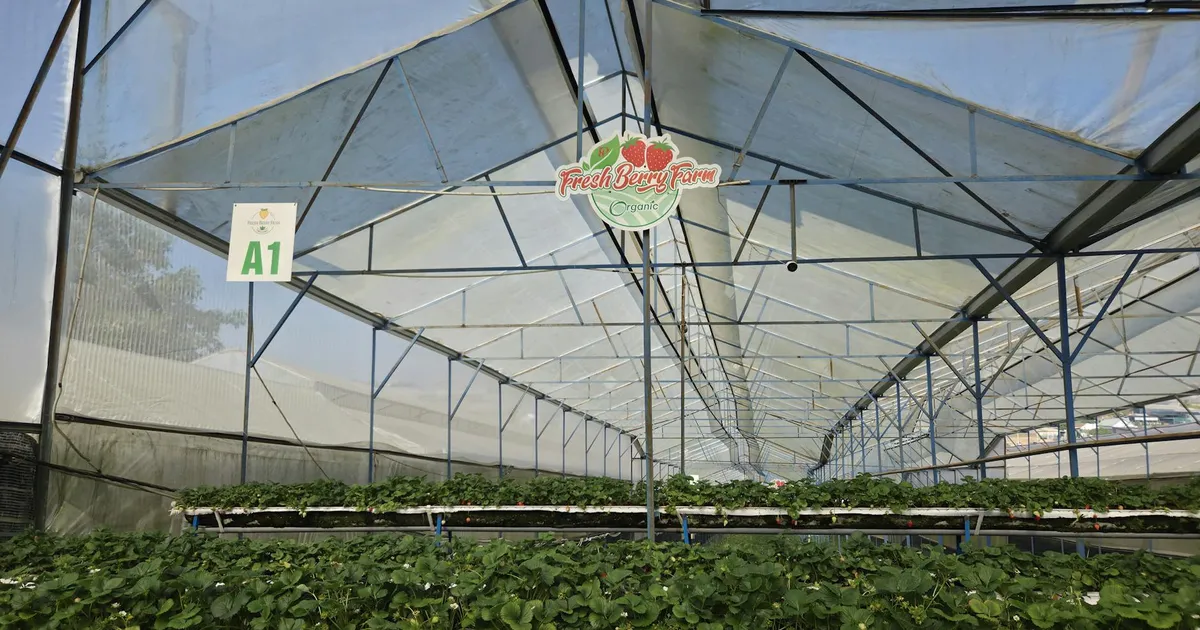
A berry grower walks into the desert
When 26 Seasons signed a commercial partnership with Saudi Arabia’s Qassim Strawberry & Fruit Cooperative Society during a government trade mission to Riyadh, it looked like a curiosity. A New Zealand vertical farm operator helping grow strawberries in desert conditions for a market most Kiwi exporters couldn’t find on a map.
But the deal was one of five partnerships signed across food, agri-tech, and creative sectors on that visit, collectively expected to generate more than $100 million in commercial value. The model, exporting intellectual property and growing systems rather than just fruit, aligns directly with Gulf food security priorities under Saudi Arabia’s Vision 2030.
This is not a one-off. It is the leading edge of a pattern that NZ business owners and investors should be watching closely.
The trade deal that changed the maths
The NZ-UAE Comprehensive Economic Partnership Agreement, which took effect on 28 August 2025, fundamentally altered the economics of exporting perishables to the Gulf. In November 2025, Air Cargo News reported that 98.5% of NZ exports now enter the UAE duty-free, rising to 99% by the start of 2027.
The logistics infrastructure is already in place. Emirates SkyCargo exports nearly 10,000 tonnes of perishable goods from NZ annually and operates two daily A380 flights between NZ and Dubai plus two weekly freighters into Auckland, providing up to 600 tonnes of freight capacity per week. Wayne Turkington, Emirates SkyCargo’s NZ cargo manager, said in November 2025 that the UAE had climbed from NZ’s 30th largest trading partner to 11th over the airline’s 22 years on the route.
Duty-free access plus dedicated freight capacity equals a viable channel for small operators who would never crack a commodity market.
NZ fruit already tops Gulf consumer rankings
The demand side is just as compelling. NZTE consumer research conducted in the UAE and Saudi Arabia in July 2025 found NZ fruit rated first on the vast majority of quality characteristics by consumers aged 21 to 70. Freshness, quality, taste, nutrition, and ripeness were the top purchase drivers. The research specifically identified opportunities in premium packaging and fruit gifting formats, precisely the high-margin niches where small-batch NZ producers can compete.
This is not hypothetical. NZ Bloom owner David Ballard told Air Cargo News in November 2025 that demand for NZ-grown orchids in Dubai had increased an average 50% year-on-year over the past two seasons and had doubled over two years. Approximately 90% of orchids grown in NZ are sold internationally, with the UAE one of the fastest-growing markets.
More operators are piling in
The pattern extends beyond flowers and berries. Māori Kiwifruit Growers Ltd, representing around 50 producers and over 70 orchards supplying 8% of NZ’s kiwifruit industry, partnered with Zespri and Mr Apple to launch kiwifruit in the UAE. That partnership was backed by the Māori and Indigenous Peoples Economic and Trade Co-operation Chapter embedded in the CEPA, the first such chapter in any NZ trade agreement.
Private capital is following. Fund manager Greener Pastures launched a kiwifruit investment fund with at least $4.8 million earmarked for the sector, with NZTE approval. 26 Seasons is also raising capital. The amounts are modest, but directionally significant.
The bigger picture is record-breaking
This Gulf channel is emerging against a backdrop of record food and fibre performance. MPI’s December 2025 Situation and Outlook report showed record export revenue of $60.4 billion in the year to 30 June 2025, up 13%. Horticulture specifically is forecast to reach $9.2 billion in the year to 30 June 2026. Combined fresh and processed produce exports hit $6.85 billion FOB for the year to June 2025.
The traditional markets still dominate by volume. Australia, Japan, China, and the EU absorb the bulk. But volume markets compress margins. The Gulf thesis is different: premium pricing, brand-conscious consumers, structural food import dependency, and a trade agreement purpose-built to remove friction.
What this means for NZ exporters
The risk is real. Vertical farming is capital-intensive and operationally complex. The Gulf premium is attractive but unproven at scale for most NZ producers. And the $100 million headline from the Riyadh trade mission covers five deals across multiple sectors, not a single company.
But the infrastructure is now in place: duty-free access, dedicated freight capacity, consumer research validating NZ’s brand advantage, and early-mover operators proving the channel works. For NZ food and agri-tech businesses still fixated on traditional commodity markets, the Gulf represents something rare: a premium channel being built deliberately through trade policy, logistics, and targeted partnerships.
The question is not whether the opportunity exists. It is whether enough NZ operators are positioned to use it before someone else does.
Sources
- Emirates SkyCargo sees New Zealand demand rise following trade deal (2025-11)
- Situation and Outlook for Primary Industries – December 2025 (2025-12)
- FreshFacts 2025 – New Zealand’s Fresh Fruit & Vegetable Industry (2025-11-28)
- Selling New Zealand Fruit in the Middle East – NZTE Market Research (2025-09)
- New Zealand’s 26 Seasons signs Saudi strawberry partnership
- Māori kiwifruit growers secure UAE export partnership with Zespri
- Māori kiwifruit growers launch UAE export partnership with Zespri and Mr Apple