

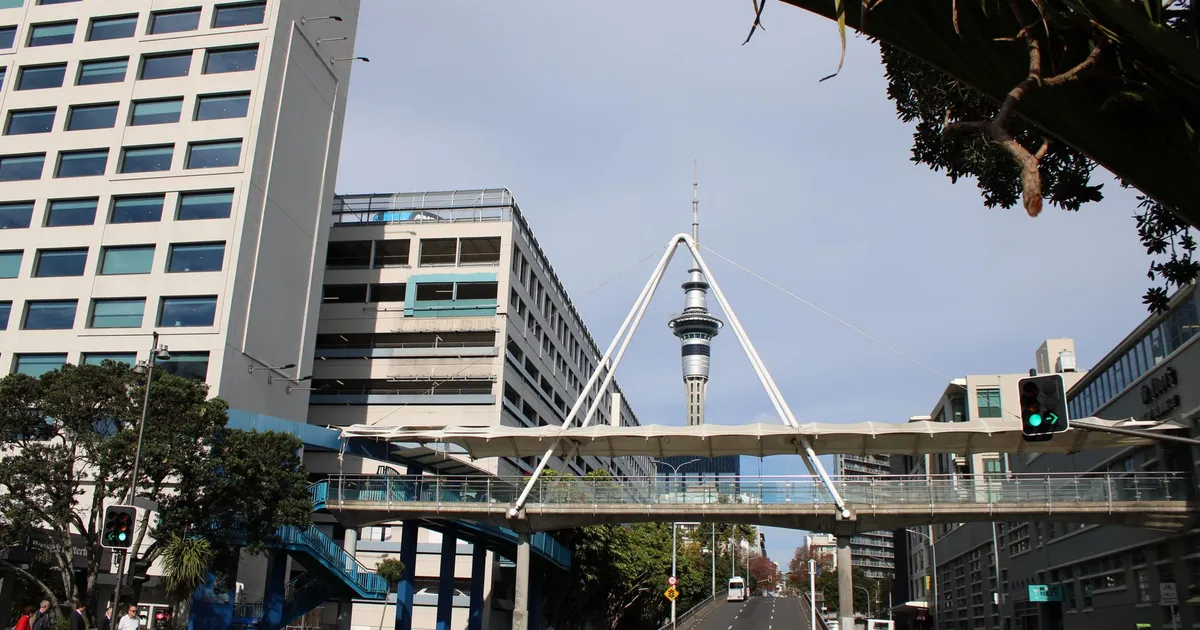
Two employers, same building, opposite bets
In early 2025, engineering firm Beca moved 1,400 staff out of 21 Pitt St and into a new $300 million Wynyard Quarter headquarters built around the hybrid-work orthodoxy. The new office provides only 900 desks for those 1,400 people, on the logic that typically only 800 to 900 turn up on a busy day.
Now the same building is being bought and rebuilt for exactly the opposite reason. Billionaire retailers Anne and David Norman, owners of James Pascoe Group, are undertaking a major makeover of the former Beca House to create a consolidated head office. Hundreds of staff from Farmers, Whitcoulls, Stevens, Stewart Dawsons and Pascoes the Jewellers, currently split across Union St, will move in once the work is done.
Beca vacated Pitt St to go smaller and more flexible. The Normans bought it to go larger and more centralised. Two major Auckland employers, two fundamentally different theories of how people will work.
Bought at a discount, backed with capital
The Normans purchased the site in late 2025 through 21 Pitt St Ltd, incorporated in December 2025 with the couple as sole directors. The Colliers-brokered deal was reported at around $50 million, a steep discount to the $72.5 million council capital valuation. This is the kind of asset repricing a family with $1.1 billion on the NBR Rich List can move on quickly.
David Norman was candid that the fixer-upper is no bargain in disguise, calling it “a building that presents many challenges that will potentially take up to two years to rectify”. The plan, drawn up by Ignite Auckland with Wellington contractor L.T. McGuinness, demolishes the motorway-facing auditorium and courtyard and upgrades two nine-level blocks totalling 16,600 sqm of floor area, with a new loading dock and drop-off area. A key attraction, the paper reports, is parking for more than 200 vehicles.
The City Rail Link is the real play
The underplayed detail is transit. When buying in December 2025, Norman singled out the $5.5 billion City Rail Link, saying they believe “the City Rail Link will be a game-changer with the Karanga-a-Hape station only metres away”. That is not sentiment. It is the single biggest variable reshaping which CBD locations are worth backing, and 21 Pitt St is a direct beneficiary.
It also lines up with what workers actually value. JLL’s workplace survey found employees rank location for ease of travel, quality of space and wellbeing at the top of their priorities. A rail-connected, freshly refurbished, single-site head office is precisely that pitch.
The market is splitting, not dying
The convenient narrative is that AI and remote work are hollowing out offices. The data says otherwise. JLL’s September 2026 analysis describes a market in bifurcation rather than decline, with prime stock now making up 56% of total Auckland CBD supply and roughly 313,000 sqm under development or refurbishment across the main centres. Office-related sectors, JLL notes, account for around 20% of GDP.
CBRE research head Zoltan Moricz has directly rejected the doom scenarios, saying the fears about AI’s impact on office-based jobs “are likely to be overplayed”. CBRE’s modelling shows office employment still growing under every AI scenario, at up to 0.9% a year.
What it means for the Pitt St strip
The timing is instructive. Auckland unemployment hit 6.4% in the December 2025 quarter, the highest-equal since 2014, yet the same survey found 60% of Auckland businesses expecting improved conditions, the strongest reading since 1994. Nationally, operating profit rose 7.9% to $29 billion in the June 2026 quarter and filled jobs edged up to 2.27 million. Buying near the bottom, into a recovering employer mood, is exactly what conviction capital does.
Hundreds of retail head office staff landing next to a new rail station is a shot of daytime foot traffic for the surrounding Pitt St and Karangahape hospitality and retail. The losers in this market are not offices in general. They are the tired, poorly connected buildings that cannot attract this kind of investment. The winners are quality, transit-linked, centralised workplaces. The Normans have just bought one, and bet their own workforce on it.
Sources
- Billionaires Anne and David Norman’s massive makeover of Auckland’s ex-Beca House (2026-09-22)
- Billionaire Normans buying ex-Beca House: City Rail Link station proximity big drawcard (2025-12-08)
- Property Insider: Retailing Normans buying ex-Beca HQ; Ryman abandons Moondah (2025-12-31)
- First look: Inside new $300m Beca headquarters, Wynyard Quarter (2025-03-10)
- New Zealand’s Office Property Trends (2026-09-08)
- Office employment and demand should withstand the impacts of AI – CBRE research (2026)
- Auckland economic update April 2026 (2026-04)
- Business financial data: June 2026 quarter (2026-09-08)
- Business employment data: June 2026 quarter (2026-09-08)
Join the discussion
Add useful context, ask a good question, or challenge an idea — keep it specific and respectful.