

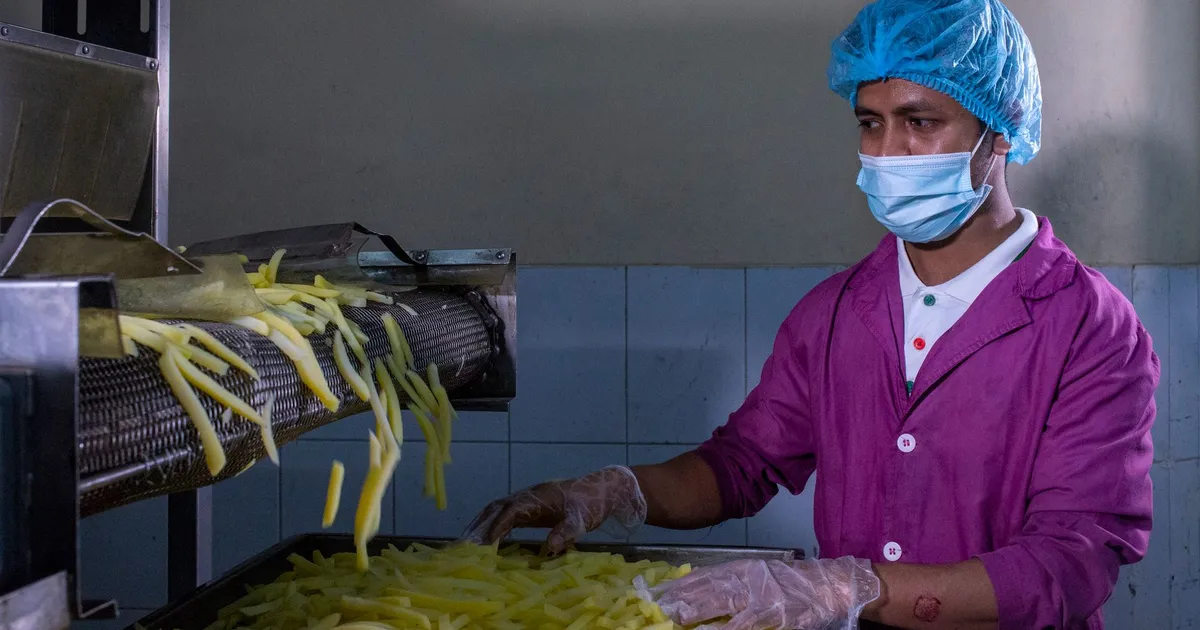
A record exporter that can’t freeze its own peas
New Zealand’s primary industries pulled in a record $60.4 billion in export revenue in the year to June 2025, beating the previous high of $59.9 billion. And yet, in the space of a few weeks in early 2026, the country lost much of its ability to freeze the peas, beans, corn and carrots grown in its own paddocks.
In March 2026, Heinz Wattie’s announced the closure of four sites – Hastings, Dunedin, Auckland and Christchurch – while McCain simultaneously confirmed it was shutting its Hastings vegetable processing plant. The Wattie’s restructure alone means 350 direct redundancies and hits 220 suppliers. Add McCain’s Hawke’s Bay growers and the toll runs to more than 320 growers across Canterbury and Hawke’s Bay.
That headcount understates the real damage. In March 2026, Central Hawke’s Bay mayor Will Foley pointed to the wider chain: “If you think of all the contractors that grow the crops, harvest the crops, the trucking companies, the logistics… you’d be talking about hundreds and hundreds of people impacted.”
The rescue bid died when the machines were pulled
A Hawke’s Bay growers’ consortium spent months exploring a cooperative takeover of the McCain plant. That effort collapsed in July 2026 once McCain confirmed the processing equipment was no longer available. Grower spokesperson Hew Dalrymple said the news “fundamentally changed the situation”.
This is the detail that matters most. A closed factory can, in theory, reopen. A factory stripped of its commercial-scale freezing line cannot, at least not without capital and workforce investment no grower group can shoulder alone. An industry observer warned back in May 2026 that “when the industry’s go they’re very hard to get back” – a prediction the equipment removal has already confirmed.
Squeezed at both ends
The government inquiry that reported on 17 September 2026 drew rare cross-party alarm, with National, Labour, Greens and ACT MPs all uneasy about the loss of strategic processing capacity. Commerce Commission chairperson Dr John Small gave the plain diagnosis: fewer processors leaves growers weaker when negotiating prices.
The economics show why growers have so little room to manoeuvre. They receive roughly 63 cents per kilogram for peas that retail at around $6 per kilogram – about a tenth of the shelf price reaching the farm gate. With the Foodstuffs and Woolworths duopoly dominating retail and processing capacity now shrinking, the squeeze comes from both directions.
David Hadfield, chair of Processed Vegetables NZ, called the closures “symptomatic of margins being squeezed by rising costs and compliance regulations” and was blunt about the competition: “There are relatively few manufacturers in New Zealand with the capability to produce at the scale, quality and price our customers expect, particularly in commodity lines like frozen peas and beans, where there is strong global competition.”
It’s not just one income stream
The damage extends beyond the cheque for the crop. Peas, beans and corn are rotation crops that fix nutrients in the soil and aid cashflow, letting growers buy store lambs to graze harvested croplands. Pull the processing market and you don’t just remove revenue – you break the agronomic logic that holds an entire mixed farm system together.
There is a resilience argument too. The Employers and Manufacturers Association warned of a nationwide ripple effect, and Hadfield went further, cautioning that without local food production the country is more exposed to disruptions such as shipping route interruptions from international conflicts. Recent years have shown how fast global freight shocks feed through to food prices and availability.
The window closes faster than policy moves
Growers appearing before the inquiry want it to examine the role of supermarkets, international subsidies and energy prices in pushing manufacturing offshore, framing this as systemic failure rather than a string of unrelated commercial decisions. MPs have floated whether government could preserve strategic facilities long enough for a cooperative takeover.
The McCain episode already answers that question. Intervention that arrives after the equipment is trucked out is intervention that arrives too late. Those affected remain hopeful a solution can be found, but the trajectory since March 2026 is a warning: for a nation that exports $60 billion of food a year, letting the machinery to process its own vegetables quietly disappear is a strategic choice, not an accident. And it is one that is very hard to reverse.
Sources
- Growers fighting to save local vege processing ask Govt to look at bigger picture (2026-09-17)
- Cross-party alarm over loss of strategic processing in primary sector (2026-09-17)
- Hawke’s Bay growers abandon bid to save McCain factory after equipment pulled (2026-07-29)
- Hawke’s Bay growers mull McCain takeover bid (2026-05-13)
- Call for new ‘Buy Kiwi Made’ as McCain Foods latest to face closures (2026-03-25)
- Heinz Wattie’s restructure will have ripple effect, EMA says (2026-09-18)
- Vege processing exits will hit 300-plus growers (2026-09-18)
- Situation and Outlook for Primary Industries (SOPI) – December 2025 (2025-12)
Join the discussion
Add useful context, ask a good question, or challenge an idea — keep it specific and respectful.