

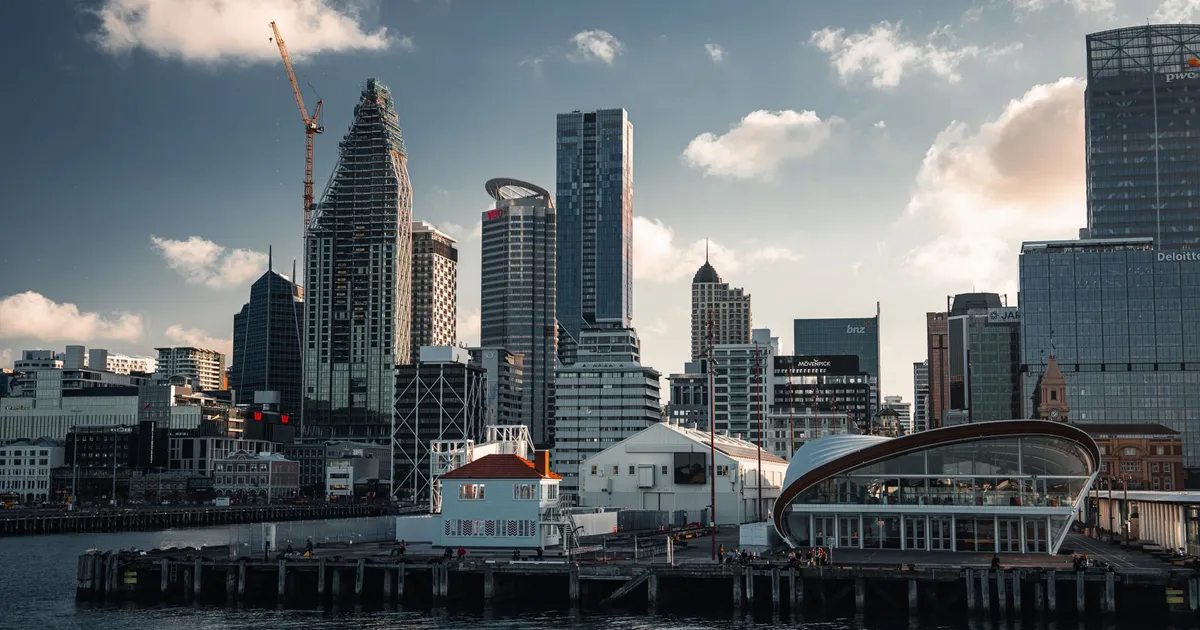
The rules finally catch up with the trains
Auckland spent roughly $5.5 billion on the City Rail Link, and until now the planning rules made much of the surrounding land unbuildable at the density the project was designed to reward. That changes with a proposal announced on 18 September 2026 to remove height limits across most of the city centre, along with rules governing tower dimensions, setbacks, separation, and floor area ratios.
The timing is deliberate. The City Rail Link opened on 11 September, with passenger services from 13 September. Under the current regime, parts of the city centre are capped at 72.5 metres and others at just 35 metres. Protected viewshafts, sunlight and wind controls, and heritage protections would stay. The rest of the ceiling comes off.
A very big number, with conditions attached
The economic modelling is the headline act. If commercially feasible development is delivered and occupied, the changes could support 17,000 additional dwellings and 37,200 additional jobs plus 31,600 more residents in the city centre. The theoretical floor space runs to 20.3 million square metres, of which 2.75 million is judged commercially feasible, generating an estimated $1.87 billion in annual GDP and a net present value of roughly $42.6 billion over 40 years.
This is not density for its own sake. Auckland’s city centre already produces about 8% of national GDP and nearly 6% of the country’s jobs. The NZ Herald points out that if the CBD were a region, it would be the country’s fifth-largest economy. This is the one place in New Zealand where building up genuinely pays.
The economic logic is hard to argue with
RMA Reform Minister Chris Bishop framed it as capturing an investment already made. “City Rail Link has transformed the way Aucklanders can get into and around the central city,” he said, arguing the next step is “allowing more people and businesses to locate close to world-class transport infrastructure”.
Academics made the same point earlier. In May 2025, University of Auckland planning academic Dr Timothy Welch argued that “one of the strongest arguments for greater height lies in our $5.5 billion City Rail Link investment,” noting the business case had always envisioned offices, apartments and shops packed within walking distance of stations. Building up, he added in 2025, means “we can better use existing pipes, roads, and bus stops instead of extending services 20km north or south.” The land market reinforces the case: a November 2024 Treasury analysis found urban Auckland land priced at $494 per square metre against $35.60 for rural, a distortion that only more floor space per site can relieve.
Rare cross-party cover for investors
What should interest developers most is the politics. This is a joint announcement from the Minister for RMA Reform, the Minister for Auckland Simon Watts, and Auckland Mayor Wayne Brown, who said Auckland needs to “intensify in the right places” close to rapid transit and existing infrastructure. When central government and the mayor of the country’s largest city sing from the same sheet, the risk of a policy reversal shrinks, and that certainty is exactly what long-horizon property capital prices in.
It caps a long process. In February 2026, Cabinet shifted from blanket suburban intensification toward targeted density near CRL stations and transit corridors, cutting Auckland’s overall capacity target from 2 million to at least 1.6 million dwellings. Auckland Council, meanwhile, has spent around $15 million reworking its Unitary Plan, with the council’s chief economist Gary Blick estimating in July 2026 that added supply could leave future house prices 3 to 5 percent lower than otherwise.
Zoning is permission, not delivery
Here is the part business readers should hold onto. Massey University transit experts Dr Imran Muhammad and Dr Arshad Javed warned, days after the CRL opened, that “TOD does not happen automatically when a railway station is built”. It requires zoning, infrastructure capacity, fast consenting, development partnerships and investor certainty. Auckland Council, Auckland Transport, NZTA and developers, they argued, “must work collaboratively to create enabling conditions.”
The $42.6 billion is conditional on cranes actually going up, not just permits being available. Public consultation runs until 16 October 2026. The rules are finally right and the political cover is unusually solid. Whether that translates into towers, or another well-modelled report that gathers dust, now depends on consenting speed and infrastructure that has to keep pace with the ambition.
Sources
- Auckland CBD height limits could be scrapped (2026-09-18)
- Unlocking Auckland City Centre After City Rail Link (2026-09-18)
- Auckland city centre intensification: Government targets height limits in growth proposal (2026-09-17)
- As the City Rail Link opens, will it change the way we build our cities? (2026-09-12)
- Auckland’s ‘shambolic’ quest for more housing has an upside for Bishop (2026-07-22)
- Government weakens housing intensification rules for Auckland (2026-02-19)
- Auckland’s half-hearted reach for the sky (2025-05-27)
- Analysis of availability of land supply in Auckland (2024-11)
Join the discussion
Add useful context, ask a good question, or challenge an idea — keep it specific and respectful.