

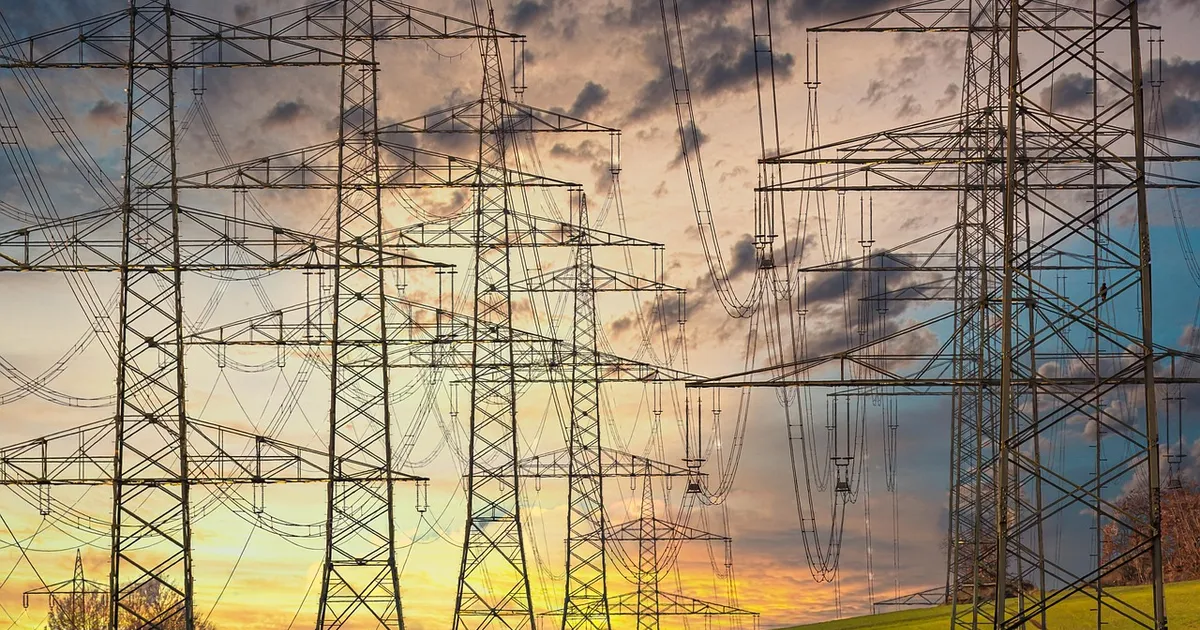
The bill no one can escape
For a food processor, cold store or data centre, distribution charges are the one energy cost with no competitive alternative. You pay whatever the local monopoly charges, and right now those charges are climbing fast. Power distribution now makes up about 24.5% of the average power bill, second only to generation at 38.5%, and MBIE’s latest March-quarter report found average household electricity costs rose 11.7% on the March 2025 quarter, driven primarily by network charges.
On 13 September, the Major Electricity Users’ Group, whose members include Amazon, Fonterra and Woolworths, released an election manifesto telling all parties to commit to tougher efficiency rules for the country’s 28 electricity distribution businesses. This is not a plea for handouts. It is a demand for the kind of scrutiny competitive markets impose automatically.
The number most coverage misses
The strongest evidence in MEUG’s favour is buried in a Commerce Commission-commissioned study most reporting has ignored. In June 2024, consultancy CEPA found EDB sector productivity had declined by roughly 1.4% a year on average, a cumulative 20% fall over the 15 years to 2023. Over the same period, real operating spend rose 45% and real capital services rose 40%, against output growth of just 16%.
The pattern shows up in the balance sheets too. In the year to 31 March 2025, line charge revenue reached $2,920.7 million, up 1.6%, while the regulatory asset base swelled from $14,521.8 million to $18,204.5 million, a 7.8% jump, even though energy delivered grew only 1.0%. Assets are ballooning far faster than the electricity actually flowing through them. That is the definition of a sector building for its own sake.
Locked-in increases and a $32 billion pipeline
None of this is a one-off. Commerce Commission-sanctioned increases in transmission and distribution charges began in 2025 and are locked in until 2030. Household and small-business prices rose 6.8% in the first half of 2026 after an 8% increase the year before, two-thirds of which came from lines charges. And lines companies are forecast to spend more than $32 billion over the next decade, with consumers picking up the tab.
You can’t run a plant on a cost you can’t predict
For large users the headline cost is only half the problem. The other half is that the bill has become unforecastable. MEUG executive director Karen Boyes told RNZ it had become nearly impossible for large businesses to forecast energy costs year on year, because transmission charges now depend not on a firm’s own consumption but on who else connects to the grid.
“It’s a very technical, complex methodology that even some of our very sophisticated members are having to get consultants to come help calculate their charges,” Boyes said. “That’s not where you want businesses to be spending their money.” For a firm deciding whether to expand a processing line or site a new facility, an energy cost trajectory that swings on other people’s projects is a direct brake on capital allocation.
What they’re actually asking for
MEUG wants the Commerce Commission empowered to benchmark EDB performance against other networks and international best practice, minimum performance standards regardless of ownership, a review of how networks are funded when they invest ahead of demand, and an overhaul of the Electricity Authority’s “opaque” transmission pricing methodology. “It shouldn’t be harder or more expensive to do business simply because you are connected to one network rather than another,” Boyes said.
The government has already moved partway. It began consulting in August via an MBIE discussion document proposing powers to restrict EDB dividends and enable comparative benchmarking, with Energy Minister Simeon Brown saying he expected the sector to boost efficiency through greater collaboration and standardisation. But it rejected forced mergers, preferring voluntary collaboration.
The catch reformers can’t wish away
There is one genuine complication. Many lines companies are council-owned and their dividends fund local services. Orion, Christchurch’s network, pays the city council about $27 million a year, cutting rates by 7%. Restrict those dividends to force more investment and you simply shift the cost onto ratepayers. That trade-off has not been resolved, and it is why the reform debate is harder than the slogans suggest.
Still, the core case is strong. New Zealand cannot lecture itself about productivity while tolerating a monopoly sector where costs rise, assets balloon and output barely moves. The businesses paying the bills have put a credible, market-minded fix on the table. Whether any party campaigning in November has the nerve to take it up is the open question.
Sources
- Electricity prices: Major New Zealand power users call for more efficient distribution (2026-09-13)
- NZ’s largest electricity consumers seek bipartisanship on policy (2026-09-14)
- Govt targets power line companies as spending forecast hits $32 billion (2026-08-19)
- Govt tightens pressure on power networks, rejects forced mergers (2026-08-20)
- Total electricity distribution Year to 31 March 2025 (2025-03-31)
- EDB Productivity Study – CEPA report for Commerce Commission (2024-06-24)
Join the discussion
Add useful context, ask a good question, or challenge an idea — keep it specific and respectful.