

For years the gas shortage read like a sectoral squabble – producers, generators and industrial users lobbying Wellington for a friendlier policy settlement. That framing is now obsolete. On 9 September 2026 the Energy Transition Framework, an industry group chaired by Orion Group chief executive Nigel Barbour, published a report urging urgent government action to avoid ‘significant economic harm’. Its central message is blunt – the shortage is real, already underway, and growing.
The supply picture supports the alarm. MBIE’s petroleum reserves data shows proven plus probable gas reserves fell to 731 petajoules at 1 January 2026, a 23% drop in a single year. Net production in 2025 was 102 PJ, down 14% and the lowest on record, with gas-fired electricity generation at its weakest since 1981. The Maui field is signalled to reach end of life by the end of 2026, and Turangi now holds over half of what remains.
The first big industrial casualty
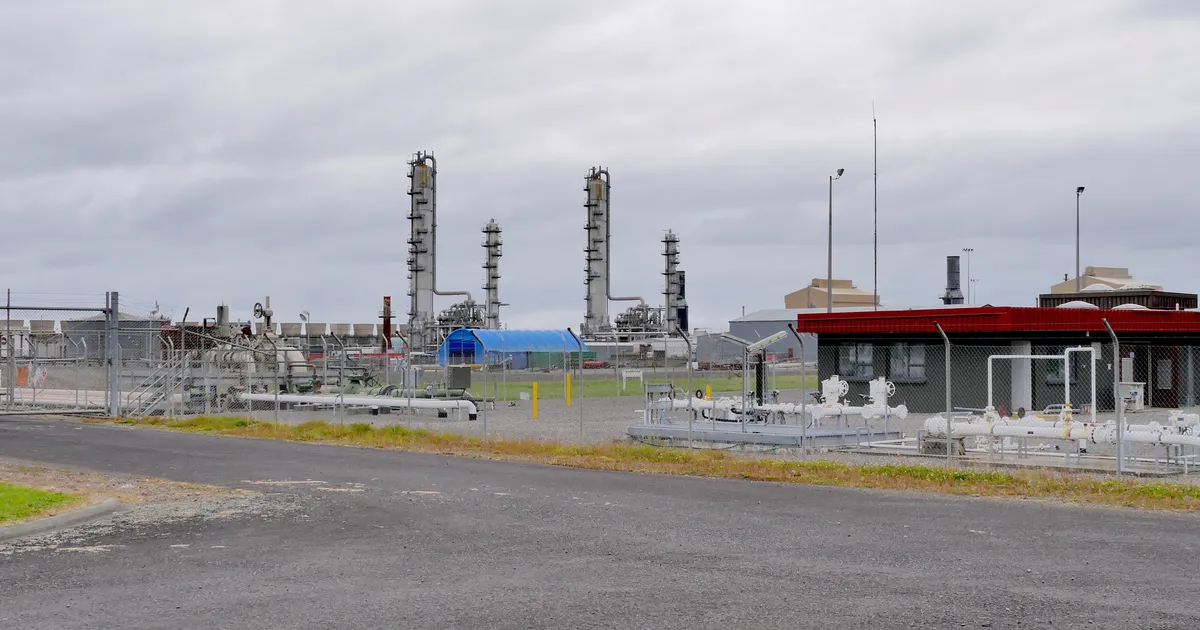
The abstract became concrete on 2 September, when Methanex announced it will idle its Motunui plant and sell all of its New Zealand gas entitlements from the first quarter of 2027. The Canadian methanol producer has run in Taranaki for four decades and has historically consumed 30 to 40% of all New Zealand’s gas production. It employs around 300 people directly, exporting roughly 95% of output to Asia Pacific.
The damage does not stop at those 300 jobs. Taranaki Chamber of Commerce chief executive Arun Chaudhari warned of ripple effects across almost every sector, including hospitality and the visitor economy. New Plymouth Mayor Max Brough made the more important point – Methanex had effectively subsidised retail gas prices for decades by anchoring demand. Its exit pushes prices higher for every remaining user. Energy Minister Simeon Brown attributed the situation to Labour’s 2018 ban on new offshore exploration.
The government’s own numbers are damning
The most authoritative data comes from the government itself. Sense Partners modelling published in December 2025 found that without an LNG terminal, GDP falls $4.5 billion (0.96%) below baseline by 2035 and 9,500 fewer FTE jobs by 2032, costing $2.5 billion in tax revenue. Even the best case, an LNG terminal by 2030, still leaves GDP $3.3 billion below baseline and 4,600 jobs short by 2032. Officials were candid in February 2026 – most of the economic damage is already locked in.
Switching isn’t the escape hatch people think it is
The comforting assumption that industry can simply electrify is wrong. In 2025, BusinessNZ chief executive Katherine Rich said almost half of gas users had already cut operations, raised prices or shed staff, with prices up over 100% in five years and 80% of contracts expiring by 2027. She warned that food producers found local electricity networks lacked the capacity for their industrial needs. In August 2025, EMA head of advocacy Alan McDonald called it laughable that firms were being forced to switch to coal or diesel or shut down entirely.
The timeline is the trap. Network upgrades take two to six years and LNG will not be operational until 2028 at the earliest, while contracts expire in 2027. Oversight, meanwhile, is scattered across the Commerce Commission, the Gas Industry Company, the Electricity Authority and EECA – fragmentation that slows any coordinated response.
The scale of exposure
The Business Environment Council’s April 2026 analysis frames the stakes. Gas-dependent operations directly generate $18-24 billion in GDP and support 220,000 to 264,000 jobs; with multipliers that reaches $27-36 billion and up to 400,000 jobs, 12-14% of the workforce. Australia, the UK, the EU, Canada and Japan all use grants and low-interest loans to keep energy-intensive industry competitive through transitions. New Zealand has no equivalent mechanism.
The Framework wants a nationally coordinated plan on the scale of the fibre rollout or the Canterbury rebuild. Its warning is the one business owners should sit with – none of these timelines shorten by waiting, and the range of options narrows every month the shortfall grows. Methanex is the first name on that list. It will not be the last unless someone decides to stop debating the transition and start managing it.
Sources
- Gas shortage: Industry group urges Government action to avoid economic harm (2026-09-09)
- Methanex to effectively close and sell off gas contracts (2026-09-02)
- Methanex to close Taranaki plant, citing ‘decline’ in gas supply (2026-09-02)
- Methanex closure to have ripple effect across the region (2026-09-02)
- Most economic damage from gas crisis ‘locked in’, officials warn (2026-02-12)
- Gas crisis will cost NZ jobs and industry (2025-08-12)
- EMA: Industrial gas users ‘almost out of options’ (2025-08-20)
- The Gas Transition: The Need for Government Assistance (2026-04)