

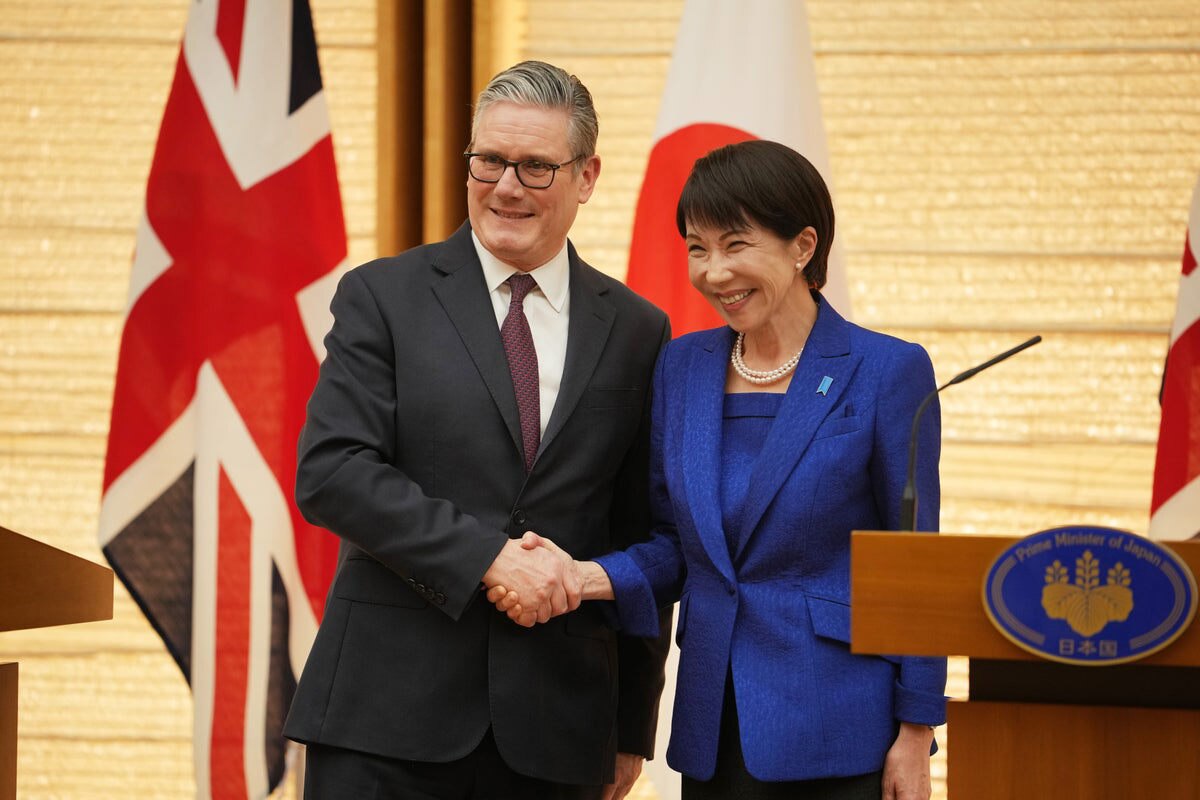
Britain and Japan have announced investment plans worth more than £18 billion, in a deal the UK government hopes will strengthen economic ties and support growth across energy, infrastructure, property, and technology.
The agreement was confirmed during Japanese Prime Minister Sanae Takaichi’s visit to London, where she met Prime Minister Sir Keir Starmer and senior business leaders at Downing Street. Starmer said the package would help create a “new era of co-operation” between the two countries.
Downing Street said Japanese firms are expected to invest more than £9 billion in UK infrastructure, real estate, and financial services over the next five years. A further sum of up to £9 billion has been linked to offshore wind projects, including schemes that could support Britain’s clean energy targets and create tens of thousands of jobs.
The government named Mitsubishi Estate, Mitsui Fudosan, and Nomura Real Estate among the companies involved in the investment plans. However, it has not set out how much of the total represents new funding, or how much relates to projects that may have already been under discussion.
The talks also covered wider co-operation in energy, research, and defence. Rolls-Royce is set to work with Japan’s Atomic Energy Agency and the UK National Nuclear Laboratory on next-generation nuclear technologies. Another agreement will connect British research and software expertise with Japan’s advanced manufacturing sector.
Both countries also reaffirmed their commitment to the Global Combat Air Programme, the next-generation fighter jet being developed by the UK, Japan, and Italy. Starmer said he was “really pleased” by the renewed backing for the project.
Speaking through a translator, Takaichi described Britain as “an extremely important partner,” reflecting the growing importance of the relationship across trade, energy security, defence, and emerging technologies.
The Conservatives welcomed the announcement but criticised Labour’s wider economic approach. Shadow business and trade secretary Andrew Griffith said his party supported “any deal that brings investment” to Britain, while arguing that government policy was placing added pressure on employers.
The deal comes as the UK faces a fragile economic outlook. Growth reached 0.6% in the first quarter, but economists expect conditions to become more challenging as global tensions weigh on business confidence and trade.