

The bridge is the economy
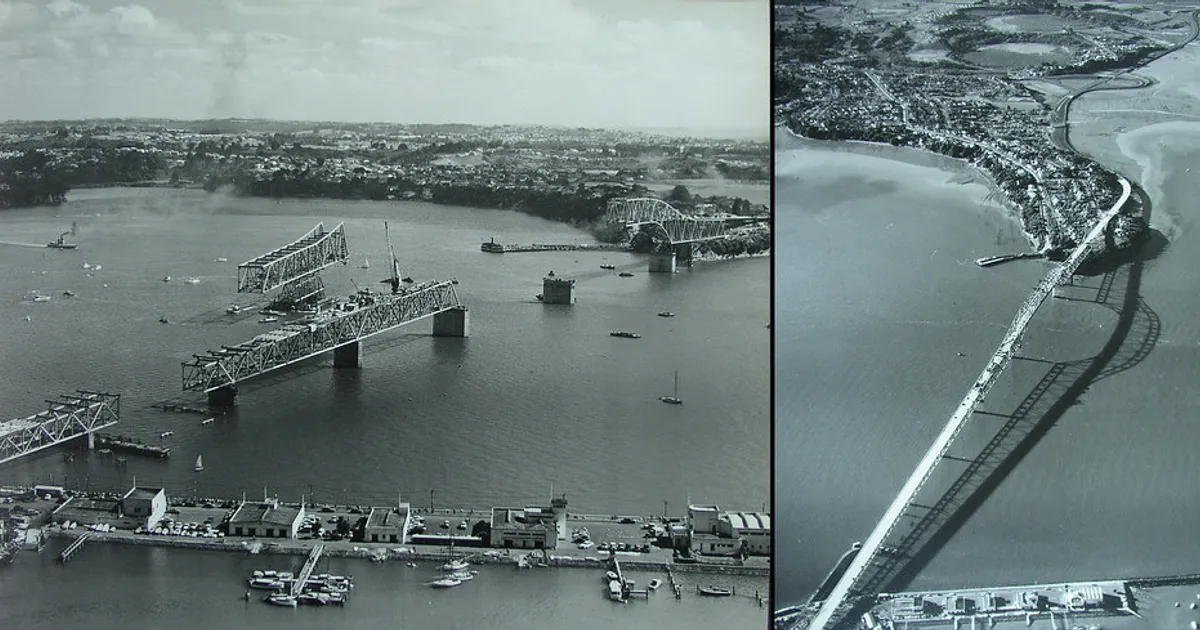
Auckland generates nearly 40 percent of New Zealand’s GDP. The only direct road link between the North Shore, Northland, and the rest of the city is a steel truss bridge that opened in 1959, received clip-on lane extensions in 1969, and was designed for a 50-year lifespan. It is now 66 years old. When it closes, there is no equivalent detour. Traffic reroutes through the Western Ring Road via SH16 and SH18, adding distance, time, and cost to every journey.
This isn’t a hypothetical. In May 2025, a single truck breakdown at 6:05am pushed journey times from Albany to the CBD to nearly an hour by 8:30am. Two southbound lanes blocked, buses delayed across the network, and a councillor advising motorists to cancel travel entirely. One truck. One bridge. No plan B.
$22 million a year just to keep it standing
The maintenance bill is accelerating. Annual repair costs nearly doubled to $22.4 million in the year to June 2025, up from $12.2 million the previous year. The driver is the Truss Bridge Refurbishment Project, which involves stripping the original paint coating to bare steel and recoating. The previous approach of spot repairs and over-coating has reached the end of its useful life.
As of January 2026, the repaint project had cost $11.6 million and covered only the land-based southern end. NZTA manager Jacqui Hori-Hoult confirmed that “expert teams are still developing plans for repainting the main section crossing the sea, with work expected to commence in 2026”. The full project is estimated to take 12 years. NZTA expects funding to remain at similar or slightly higher levels over the next five years.
The practical reality: the most complex phase of work, on the main sea-crossing spans, is only just beginning. Businesses relying on the bridge will be navigating active large-scale maintenance until at least the mid-2030s.
Every closure costs $2,700 a minute, and that’s the small number
In 2024, Infometrics principal economist Brad Olsen estimated that weather-related closures totalling about 700 minutes over the preceding two years cost approximately $2.1 million in direct costs, at roughly $2,700 per minute. But the far larger figure was behavioural: people taking preemptive detours when they expected the bridge might close. Olsen put that cost at nearly $36 million.
The bridge closes entirely at 110 km/h wind gusts and faces speed restrictions from 90 km/h. In an Auckland winter, those thresholds are routine. Olsen noted that “wind-anomics are unlikely to disappear soon”. As maintenance intensifies, the frequency of lane restrictions will only increase.
The structural question behind the paint job
In October 2024, Greater Auckland analyst Tim Adriaansen published analysis suggesting the bridge faces “critical failure” by decade’s end due to metal fatigue unless daily traffic volumes are roughly halved. His framing was stark: “For every 100 people that currently cross the bridge by car, approximately 50 of them will need to get access to things in another way.”
NZTA has not publicly endorsed this analysis and describes the bridge as safe. But any scenario involving sustained lane reductions transforms from a commuter inconvenience into a supply chain crisis. Back in 2020, AUT’s then-Professor of Construction John Tookey warned that “it is relatively easy to shut down Auckland economically and socially” given the city’s dependence on a single crossing. That vulnerability has not changed.
The second crossing is still a study, not a project
In March 2025, Transport Minister Chris Bishop appealed for international input on a second harbour crossing. A preferred option is expected in mid-2026, meaning a decision on what to build, not a build date. Labour’s pre-election proposal for two road tunnels and one light rail tunnel carried a price tag of up to $45 billion. Even the most optimistic timeline puts a second crossing more than a decade away.
Infrastructure New Zealand chief executive Nick Leggett, speaking at a March 2026 summit, called the second crossing a prime example of the country’s “study loop” where projects are “revisited, often redesigned and delayed rather than actually delivered”. His blunt assessment: “We can’t build our way out of this.”
Businesses cannot plan around hope
With Treasury forecasting GDP growth of just 1.7% in 2025/26 and Auckland’s economy already underperforming, there is no slack to absorb rising transport costs. Freight operators, retailers, construction firms, and every business with staff commuting across the harbour are pricing in disruption that will persist for a decade or more.
The bridge is not background infrastructure. It is a single point of failure for the country’s largest economic region, and the only plan currently funded is to keep painting it.
Sources
- Auckland Harbour Bridge maintenance costs nearly double because of paint job (2025-10-11)
- Auckland Harbour Bridge repaint project: Where things stand more than a year later (2026-01-22)
- Auckland Harbour Bridge closures costing millions, economist estimates (2024-08-19)
- Auckland’s traffic woes threaten New Zealand’s productivity – Infrastructure New Zealand (2026-03-18)
- Auckland traffic: Harbour Bridge lanes blocked after truck breakdown (2025-05-05)
- Auckland Harbour Bridge is collapsing (2024-10-17)
- Half Year Economic and Fiscal Update 2025 (2025-12-16)
- Repairing the Auckland Harbour Bridge – Expert Reaction (2020-09-21)